4,068 posters, 219 videos, 101 topics, 69 sessions, 14,365 authors, 6,128 institutions
ePostersLive by SciGen Technologies S.A. All rights reserved.
Alzheimer's Association International Conference 2026
July 12-15, 2026 | London, United Kingdom, and Online

8702
The ‘Lost Years’ Of Dementia In India: A Cross-sectional Analysis Of Diagnostic Latency And Barriers In An Urban Tertiary Setting
Poster Presenter
Authors
Affiliations
Part of Topic
Video
The ‘Lost Years’ of Dementia in India: A Cross-Sectional Analysis of Diagnostic Latency and Barriers in an Urban Tertiary Setting
Jyothsna Balasubramanian¹, Ratnavalli Ellajosyula², Uday Murgod3
Affiliations:
¹ Consultant Neurologist, Cognitive neurology clinic, Annasawmy Mudaliar General Hospital, Bangalore
² Senior Consultant Neurologist and Specialist in Cognitive Neurology, Head, Cognitive neurology clinic, Manipal Hospitals, Old Airport Road, Bangalore; Annasawmy Mudaliar General Hospital, Bangalore
3 Senior Consultant Neurologist, Manipal Hospitals, Old Airport Road, Bangalore
ABSTRACT:
Background: n India, the incidence of dementia is approximately 11.7 per 1,000 person-years for those aged >55 years with a prevalence of 7.4% in those over 60. Despite the availability of disease-modifying treatments that rely on early detection, significant diagnostic delays (averaging 24 months) persist. This study identifies barriers to timely diagnosis and investigates the sociodemographic factors influencing these delays in an urban Indian context.
Methods: We conducted a prospective study of 60 patients at an urban specialist tertiary care center in India (2024–2025). Assessments included comprehensive sociodemographic profiling and cognitive evaluation using MoCA, ACE-III, and CDR scales. Caregiver burden was measured using standardized scales to evaluate the psychosocial impact of delayed intervention.
Results: A diagnostic delay was identified in 91% of patients, with a mean delay of 32 months. Notably, 93.4% of delays were attributed to non-financial factors, primarily "neglect" and "incorrect diagnosis". At presentation, 41% of the cohort already exhibited severe dementia (CDR-3).
- Age and Gender: Young-onset dementia (<65 years) faced longer delays (36 months) than late-onset cases (31 months). Males experienced longer delays (38 months) compared to females (27 months).
- The Socioeconomic Paradox: Contrary to expectations, the longest delays were observed in highly educated individuals (37 months) and those in the upper-middle class (42 months).
- Caregiver Impact: 29% of caregivers reported severe burden, while 38% reported little to no burden, suggesting a potential correlation between perceived burden and the decision to seek care.
Conclusion: Our findings reveal a critical "Lost Years" gap that is more pronounced in affluent and educated urban populations, suggesting that awareness and stigma—rather than financial constraints—are the primary drivers of diagnostic delay. Addressing health system readiness for new therapies in India requires targeted clinician training to reduce misdiagnosis and public health campaigns to counter elder neglect.
Key words: Diagnostic latency; dementia in India; barriers to care; Caregiver burden; socioeconomic factors.
Introduction:
-
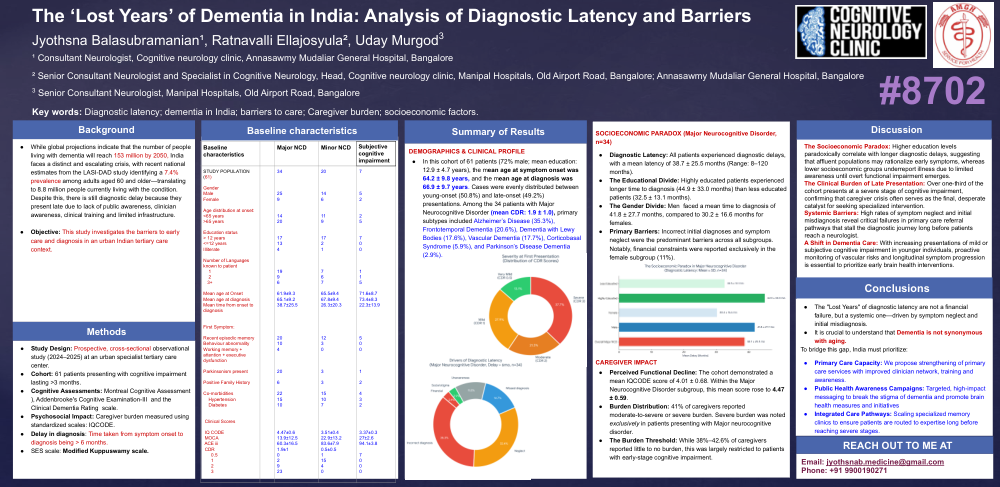
While global projections indicate that the number of people living with dementia will reach 153 million by 2050, India faces a distinct and escalating crisis, with recent national estimates from the LASI-DAD study identifying a 7.4% prevalence among adults aged 60 and older—translating to 8.8 million people currently living with the condition. Despite this, there is still diagnostic delay because they present late due to lack of public awareness, clinician awareness, clinical training and limited infrastructure.
-
Objective: This study investigates the barriers to early care and diagnosis in an urban Indian tertiary care context.
Methods
-
Study Design: Prospective, cross-sectional observational study (2024–2025) at an urban specialist tertiary care center.
-
Cohort: 61 patients presenting with cognitive impairment lasting >3 months.
-
Cognitive Assessments: Montreal Cognitive Assessment (MoCA), Addenbrooke's Cognitive Examination-III (ACE-III), and the Clinical Dementia Rating (CDR) scale.
-
Psychosocial Impact: Caregiver burden measured using standardized scales (e.g., 22-item Caregiver Burden Scale, IQCODE).
-
Delay in diagnosis was defined as time taken from symptom onset to diagnosis being > 6 months.
-
Socioeconomic status was defined using Modified Kuppuswamy scale.
DEMOGRAPHICS & CLINICAL PROFILE
-
In this cohort of 61 patients presenting with cognitive impairment, the mean age at symptom onset was 64.2 ± 9.8 years, with a mean age at diagnosis of 66.9 ± 9.7 years.
-
The study population exhibited a male preponderance (n=44, 72%) and a relatively high mean education level of 12.9 ± 4.7 years.
-
There was nearly equally distributed between Young-Onset (<65 years, 50.8%) and Late-Onset (≥65 years, 49.2%).
-
Among the 34 patients diagnosed with Major Neurocognitive Disorder(Major NCD), the mean Clinical Dementia Rating (CDR) score was 1.9 ± 1.0, and the primary subtypes identified were Alzheimer’s Disease (35.3%), Frontotemporal Dementia (20.6%), and Dementia with Lewy Bodies (17.6%), followed by Vascular Dementia (17.7%), Corticobasal Syndrome (5.9%), and Parkinson’s Disease Dementia (2.9%)
|
|

SOCIO-ECONOMIC PARADOX
-
Overall Latency: Within the cohort presenting with Major Neurocognitive Disorder (n=34), All of them had delayed time to diagnosis and the overall mean diagnostic latency was 38.7 ± 25.5 months.(Range: 8-120 months)
-
The Educational Divide: The highly educated patients experienced time from onset to diagnosis of 44.9 ± 33.0 months compared to less educated patients who had time to diagnosis ranging 32.5 ± 13.1 months.
Barriers: For the highly educated group, barriers to diagnosis were incorrect initial diagnoses (35%) and symptom neglect (29%). For the less educated group, neglect (35%) and incorrect diagnoses (35%) were equally prevalent barriers.
-
The Gender Divide: Men and women had a mean time to diagnosis of 41.8 ± 27.7 months and 0.2 ± 16.6 months respectively.
Barriers: the Barriers to diagnosis in men were primarily incorrect diagnoses by primary providers (36%) and neglect (32%). Barriers in women were equally distributed by neglect (33%) and incorrect diagnoses (33%), alongside the only reported instance of financial barriers (11%) in this specific subgroup.


CAREGIVER IMPACT
-
Perceived Functional Decline: The cohort demonstrated a mean IQCODE score of 4.01 ± 0.68. Within the Major Neurocognitive Disorder subgroup, this mean score rose to 4.47 ± 0.59.
-
Burden Distribution: 41% of caregivers reported moderate-to-severe or severe burden. Severe burden was noted exclusively in patients presenting with Major neurocognitive disorder.
-
The Burden Threshold: While 38%–42.6% of caregivers reported little to no burden, this was largely restricted to patients with early-stage cognitive impairment.
-
The Socioeconomic Paradox: Higher education and socioeconomic status correlate with longer delays in Major Neurocognitive Disorder in this dataset. This finding could be because patients from lower socioeconomic backgrounds frequently exhibit shorter reported illness durations, likely reflecting a diminished awareness of early cognitive changes and a tendency to underplay subtle symptoms until they manifest as overt functional impairment. This hypothesis is not clear enough yet and needs more studies to understand the possible correlation.
-
Clinical Burden of Late Presentation: One-third of the cohort present at a severe stage (high mean CDR), missing the initial measures that can be taken to slow down the progression of the illness. Caregiver burden often becomes the final, desperate catalyst for seeking specialized care.
-
Systemic Barriers: High rates of neglect and misdiagnosis indicate failures in referral pathways. Diagnostic delays often occur before reaching a neurologist, highlighting a critical lack of clinical acumen and clinician awareness at the primary care level.
-
A Shift in Dementia Care: There are younger patients presenting with mild and subjective cognitive impairment which could be attributed to psycho-social factors. It is vital to look for progression of symptoms over time and note the lifestyle and vascular risk factors contributing and promote various brain health measures that can be taken.
Conclusions
-
The "Lost Years" of diagnostic latency are not a financial failure, but a systemic one—driven by symptom neglect and initial misdiagnosis.
-
It is crucial to understand that Dementia is not synonymous with aging.
To bridge this gap, India must prioritize:
-
Primary Care Capacity: We propose strengthening of primary care services with improved clinician network, training and awareness.
-
Public Health Awareness Campaigns: Targeted, high-impact messaging to break the stigma of dementia and promote brain health measures and initiatives
-
Integrated Care Pathways: Scaling specialized memory clinics to ensure patients are routed to expertise long before reaching severe stages.
Comments
Email is required but is not shown publicly.
Loading comments...