4,068 posters, 219 videos, 101 topics, 69 sessions, 14,365 authors, 6,128 institutions
ePostersLive by SciGen Technologies S.A. All rights reserved.
Alzheimer's Association International Conference 2026
July 12-15, 2026 | London, United Kingdom, and Online

10014
A Randomized Controlled Trial Of Lingual Strengthening And Saliva Substitute Interventions For Dysphagia In Dementia
Poster Presenter
Part of Topic
Randomized Controlled Trial of Lingual Strengthening and Saliva Substitute Interventions for Dysphagia in Dementia
Background
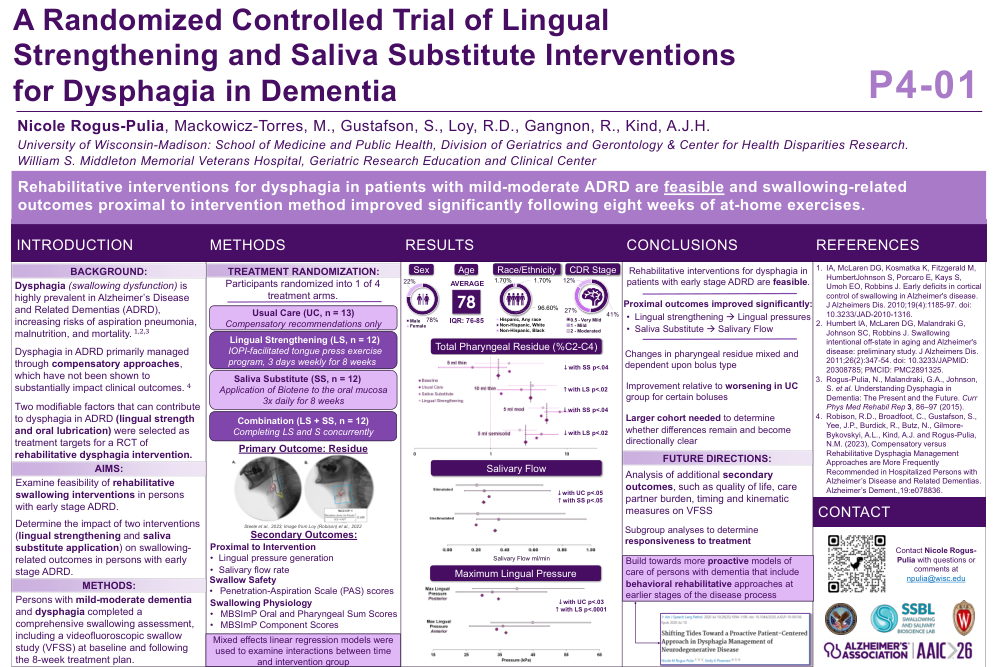
- Dysphagia (swallowing dysfunction) is common in Alzheimer's Disease and Related Dementias (ADRD), increasing risks of aspiration pneumonia, malnutrition, and mortality.
- Traditional management relies on compensatory strategies, which have limited impact on clinical outcomes.
- The study targeted two modifiable factors: lingual strength and oral lubrication.
Study Aims
- Assess the feasibility of rehabilitative swallowing interventions in early-stage ADRD.
- Evaluate the impact of lingual strengthening and saliva substitute interventions on swallowing-related outcomes.
Methods
- Participants: Individuals with mild-moderate dementia and dysphagia.
- Randomized into four groups:
- Usual Care (UC): Compensatory recommendations only
- Lingual Strengthening (LS): Tongue press exercises, 3 days/week for 8 weeks
- Saliva Substitute (SS): Biotene application, 3x daily for 8 weeks
- Combination (LS + SS): Both interventions concurrently
- Comprehensive swallowing assessments, including videofluoroscopic swallow study (VFSS), at baseline and after 8 weeks.
Key Results
- Feasibility: Rehabilitative interventions were feasible for patients with early-stage ADRD.
- Lingual Strengthening:
- Significant improvement in lingual pressure generation (p < .0001).
- Reduction in pharyngeal residue for certain bolus types (p < .02).
- Saliva Substitute:
- Significant increase in salivary flow rate (p < .05).
- Reduction in pharyngeal residue for certain bolus types (p < .04).
- Usual Care:
- Decline in salivary flow and lingual pressure compared to intervention groups.
- Combination Group:
- Showed improvements similar to individual interventions.
- Secondary Outcomes:
- Improvements in swallowing physiology and safety were observed, but changes in pharyngeal residue were mixed and dependent on bolus type.
Conclusions and Implications
- Rehabilitative interventions (lingual strengthening and saliva substitute) are practical and beneficial for early-stage ADRD patients with dysphagia.
- Lingual strengthening improves tongue strength; saliva substitute increases oral lubrication.
- Some swallowing outcomes improved relative to usual care, suggesting potential for better clinical management.
- Larger studies are needed to confirm findings and clarify long-term benefits.
- Future research will explore quality of life, care partner burden, and more detailed swallowing measures.
Example Implementation
- Incorporate lingual strengthening exercises and saliva substitutes into early-stage dementia care plans for dysphagia management.
- Monitor swallowing outcomes using objective assessments (e.g., VFSS) to track intervention effectiveness.
Comments
Email is required but is not shown publicly.
Loading comments...