4,068 posters, 219 videos, 101 topics, 69 sessions, 14,365 authors, 6,128 institutions
ePostersLive by SciGen Technologies S.A. All rights reserved.
Alzheimer's Association International Conference 2026
July 12-15, 2026 | London, United Kingdom, and Online

1827
Neighborhood Factors And Racial Disparities In Cognitive Decline In The Health And Retirement Study
Poster Presenter
Authors
Kendra Sims, Audrey Murchland, Tanisha Hill-Jarrett, Yulin Yang, M. Maria Glymour
Affiliations
Department of Epidemiology, Boston University School of Public Health, Boston, MA, USA, Department of Neurology, University of California, San Francisco Memory and Aging Center, San Francisco, CA, USA, Department of Epidemiology and Biostatistics, University of California San Francisco, San Francisco, CA, USA
Part of Topic
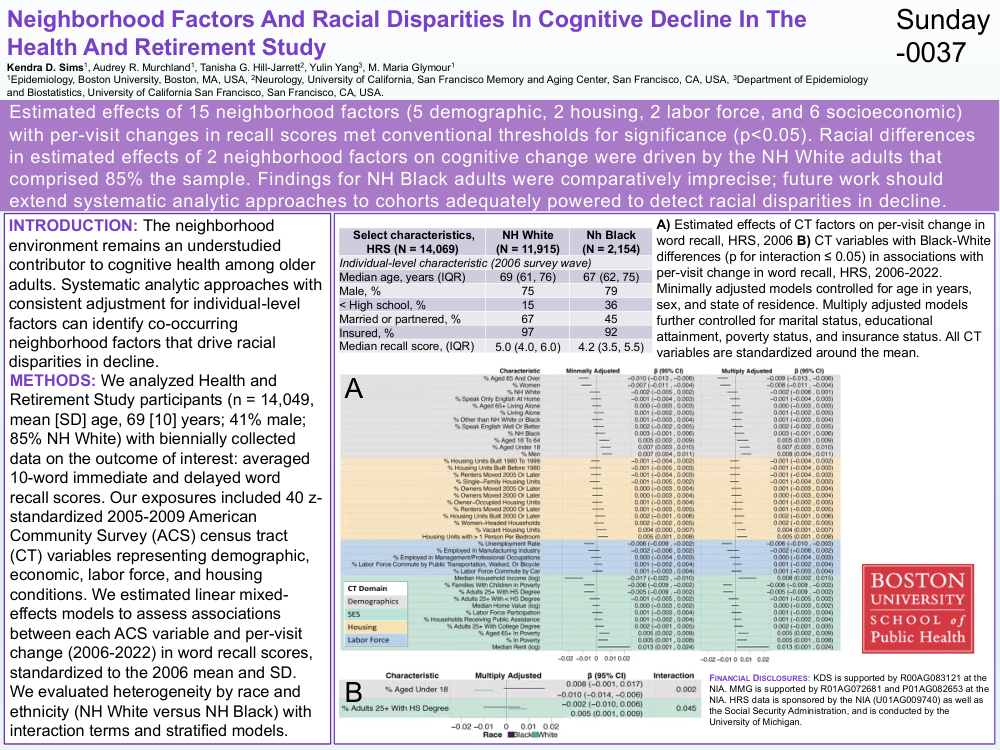
INTRODUCTION: The neighborhood environment remains an understudied contributor to cognitive health among older adults. Systematic analytic approaches with consistent adjustment for individual-level factors can identify co-occurring neighborhood factors that drive racial disparities in decline.
METHODS: We analyzed Health and Retirement Study participants (n = 14,049, mean [SD] age, 69 [10] years; 41% male; 85% NH White) with biennially collected data on the outcome of interest: averaged 10-word immediate and delayed word recall scores. Our exposures included 40 z-standardized 2005-2009 American Community Survey (ACS) census tract (CT) variables representing demographic, economic, labor force, and housing conditions. We estimated linear mixed-effects models to assess associations between each ACS variable and per-visit change (2006-2022) in word recall scores, standardized to the 2006 mean and SD. We evaluated heterogeneity by race and ethnicity (NH White versus NH Black) with interaction terms and stratified models.
RESULTS AND CONCLUSIONS: Estimated effects of 15 neighborhood factors (5 demographic, 2 housing, 2 labor force, and 6 socioeconomic) with per-visit changes in recall scores met conventional thresholds for significance (p<0.05). Racial differences in estimated effects of 2 neighborhood factors on cognitive change were driven by the NH White adults that comprised 85% the sample. Findings for NH Black adults were comparatively imprecise; future work should extend systematic analytic approaches to cohorts adequately powered to detect racial disparities in decline.
Comments
Email is required but is not shown publicly.
Loading comments...