4,068 posters, 219 videos, 101 topics, 69 sessions, 14,365 authors, 6,128 institutions
ePostersLive by SciGen Technologies S.A. All rights reserved.
Alzheimer's Association International Conference 2026
July 12-15, 2026 | London, United Kingdom, and Online

8735
AI Enabled Conversational Agent For History Taking In Alzheimer’s Disease And Related Dementias (ADRD): A Pilot Study
Poster Presenter
Authors
Andrew Breithaupt, Arin Nelson, Oz Alon, Jeanne Powell, James Finch, Nayoung Choi, Howard Rosen, James Lah, Allan Levey, Jinho Choi
Affiliations
University of California San Francisco, Emory University, Department of Neurology, Emory University School of Medicine, Emory University Biomedical Informatics, Emory Natural Language Processing Research Lab
Part of Topic
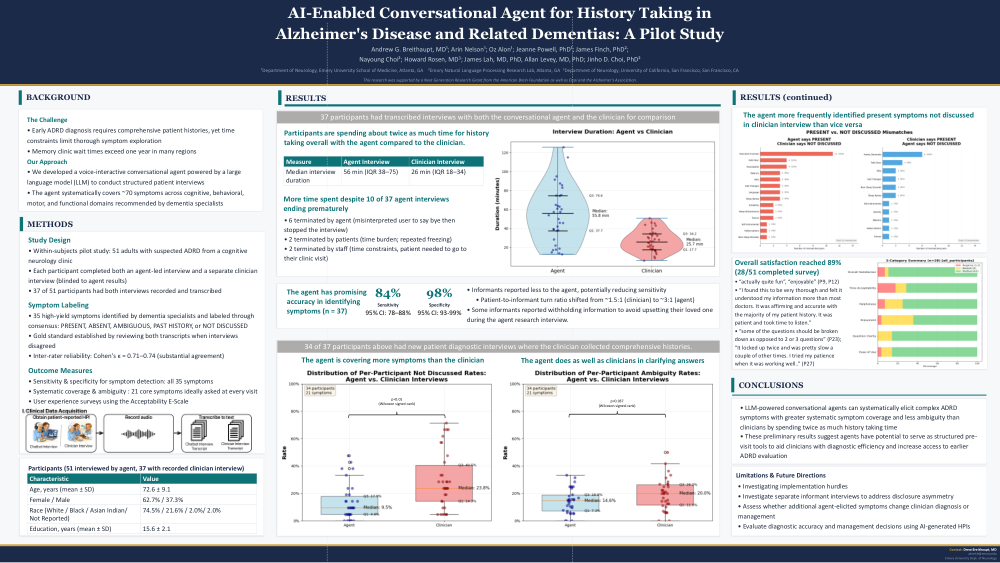
AI-Enabled Conversational Agent for History Taking in Alzheimer's Disease and Related Dementias: A Pilot Study
The Challenge
• Early ADRD diagnosis requires comprehensive patient histories, yet time constraints limit thorough symptom exploration
• Memory clinic wait times exceed one year in many regions
Our Approach
• We developed a voice-interactive conversational agent powered by a large language model (LLM) to conduct structured patient interviews
• The agent systematically covers ~70 symptoms across cognitive, behavioral, motor, and functional domains recommended by dementia specialists
Study Design
• Within-subjects pilot study: 51 adults with suspected ADRD from a cognitive neurology clinic
• Each participant completed both an agent-led interview and a separate clinician interview (blinded to agent results)
• 37 of 51 participants had both interviews recorded and transcribed
Symptom Labeling
• 35 high-yield symptoms identified by dementia specialists and labeled through consensus: PRESENT, ABSENT, AMBIGUOUS, PAST HISTORY, or NOT DISCUSSED
• Gold standard established by reviewing both transcripts when interviews disagreed
• Inter-rater reliability: Cohen's κ = 0.71–0.74 (substantial agreement)
Outcome Measures
• Sensitivity & specificity for symptom detection: all 35 symptoms
• Systematic coverage & ambiguity : 21 core symptoms ideally asked at every visit
• User experience surveys using the Acceptability E-Scale
Results
Participants are spending about twice as much time for history taking overall with the agent compared to the clinician.
More time spent despite 10 of 37 agent interviews ending prematurely
• Informants reported less to the agent, potentially reducing sensitivity
• Patient-to-informant turn ratio shifted from ~1.5:1 (clinician) to ~3:1 (agent)
• Some informants reported withholding information to avoid upsetting their loved one during the agent research interview.
Overall satisfaction reached 89% (28/51 completed survey)
Conclusions:
• LLM-powered conversational agents can systematically elicit complex ADRD symptoms with greater systematic symptom coverage and less ambiguity than clinicians by spending twice as much history taking time
• These preliminary results suggest agents have potential to serve as structured pre-visit tools to aid clinicians with diagnostic efficiency and increase access to earlier ADRD evaluation
Limitations and Future Direction
• Investigating implementation hurdles
• Investigate separate informant interviews to address disclosure asymmetry
• Assess whether additional agent-elicited symptoms change clinician diagnosis or management
• Evaluate diagnostic accuracy and management decisions using AI-generated HPIs
Comments
Email is required but is not shown publicly.
Loading comments...