4,068 posters, 219 videos, 101 topics, 69 sessions, 14,365 authors, 6,128 institutions
ePostersLive by SciGen Technologies S.A. All rights reserved.
Alzheimer's Association International Conference 2026
July 12-15, 2026 | London, United Kingdom, and Online

9831
False Narratives And Missed Opportunities: Black American Adult Attitudes Towards Biomarkers Testing
Poster Presenter
Authors
Lilcelia Williams, Hector Salazar, Julie Klinger, Kyaien Conner, Dara Méndez, Thomas Karikari, C. Elizabeth Shaaban, Jennifer Lingler, Ann Cohen
Affiliations
University of Pittsburgh, University of California, Davis, Betty Irene Moore School of Nursing, University of Pittsburgh Department of Psychiatry, School of Medicine & Alzheimer’s Disease Research Center at the University of Pittsburgh
Part of Topic
Title: False Narratives and Missed Opportunities: Black American Adult Attitudes Towards Biomarkers Testing
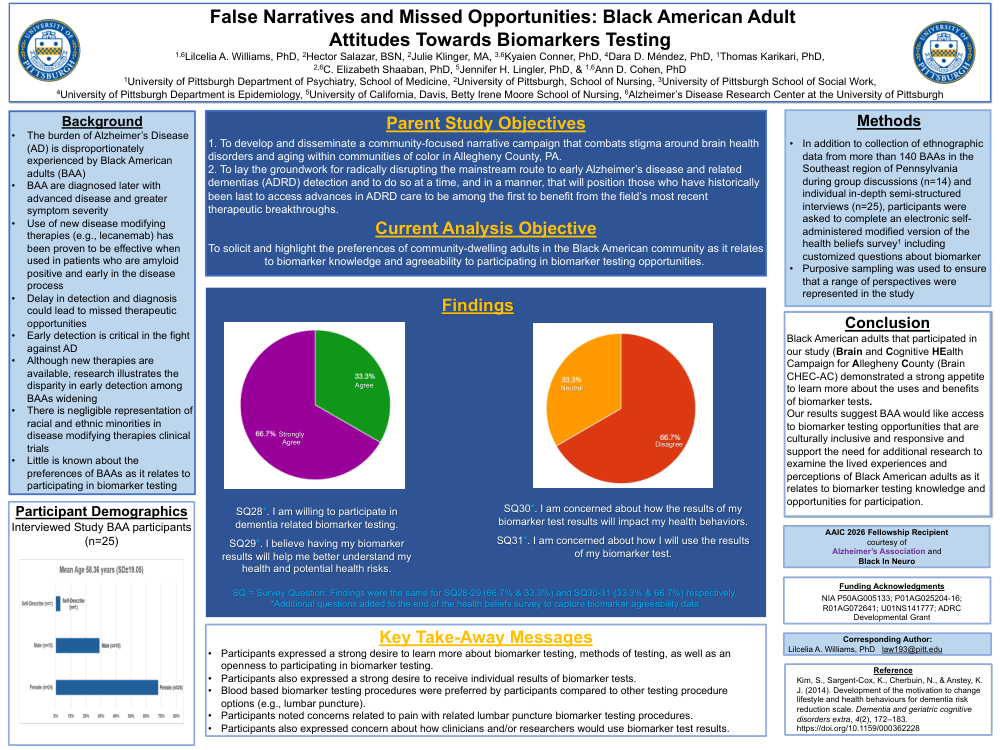
Background: The burden of Alzheimer’s Disease (AD) is disproportionately experienced by Black American adults (BAA). BAA are diagnosed later with advanced disease and greater symptom severity. The use of new disease modifying therapies (e.g., lecanemab) has been proven to be effective when used in patients who are amyloid positive and early in the disease process. Any delay in detection and diagnosis could lead to missed therapeutic opportunities. Thus, early detection is critical in the fight against AD. Although new therapies are available, research illustrates the disparity in early detection among BAAs widening. Further, the representation of racial and ethnic minorities in clinical trials, specifically disease modifying therapies, is negligible. Yet, little is known about the preferences of BAAs as it relates to participating in biomarker testing. The use of blood biomarkers is the first step to exploring avenues to offering biomarker-based testing within the BA community.
Methods: We conducted an exploratory analysis of ethnographic data collected during group discussions (n=14) and individual interviews (n=25) from more than 140 BAAs in the Southeast region of Pennsylvania to assess their knowledge about AD. Purposive sampling was used to ensure that a range of perspectives were represented in the study, Brain and Cognitive HEalth Campaign for Allegheny County (Brain CHEC-AC). Emergent themes were gleaned by coding transcripts from group discussions and semi-structured participant interviews.
Results: All participants self-identified as BAAs; their mean age was 58.36 years old (SD±19.05; range 20-84) and more than 60% were women. Participants expressed a strong desire to learn more about biomarker testing, methods of testing, and an openness to participating in biomarker testing. Participants also expressed concern about how clinicians and/or researchers would use biomarker test results.
Conclusions: BAA have a strong appetite to learn more about the uses and benefits of biomarker tests. Our results suggest they may wish to have access to biomarker testing opportunities that are culturally inclusive and responsive and support the need for additional research to examine the lived experiences and perceptions of BAAs as it relates to biomarker testing knowledge and opportunities for participation.
Comments
Email is required but is not shown publicly.
Loading comments...