4,068 posters, 219 videos, 101 topics, 69 sessions, 14,365 authors, 6,128 institutions
ePostersLive by SciGen Technologies S.A. All rights reserved.
Alzheimer's Association International Conference 2026
July 12-15, 2026 | London, United Kingdom, and Online

2226
Cervical Lymphaticovenous Bypass For Alzheimer’S Disease: Early Safety And Efficacy Outcomes In Singapore (CLyVeB-AD-1 Study)
Poster Presenter
Authors
Jeremy Sun, Kok Pin Ng, Si Ching Lim, Sumeet Kumar, Wanying Xie, Wei Shyan Siow, Chin Kong Goh, Xinyan Zhang, Li Sun, Ratnawati Hassan, Jing Li, Lumin Ren, Brenda Shak, Eng King Tan, Vincent Tay
Affiliations
Plastic, Reconstructive & Aesthetic Surgery, Changi General Hospital, Singapore., Neurology, National Neuroscience Institute, Singapore., Geriatric Medicine, Changi General Hospital, Singapore., Neuroradiology, National Neuroscience Institute, Singapore., Nuclear Medicine, Singapore General Hospital, Singapore., Anaesthesia & Surgical Intensive Care, Changi General Hospital, Singapore., Radiology, Changi General Hospital, Singapore., Operating Theatre, Changi General Hospital, Singapore., Ward 27, Changi General Hospital, Singapore., Clinical Trials & Research Unit, Changi General Hospital, Singapore.
Part of Topic
INTRODUCTION
Alzheimer's disease (AD) remains the leading cause of dementia worldwide, with progressive accumulation of amyloid-β and tau driving neuroinflammation, synaptic dysfunction, and cognitive decline1,2. Despite disease-modifying anti-amyloid immunotherapies, scalable mechanism-informed interventions that target the disease process remain limited.
Foundational work established the glymphatic system as a perivascular pathway for CSF–interstitial fluid exchange and amyloid-β clearance3. Louveau et al. identified functional meningeal lymphatic vessels draining to deep cervical lymph nodes, reframing CNS waste clearance as biologically continuous with extracranial lymphatics. Experimental and human evidence has since implicated dysfunction of these pathways in AD pathophysiology, including impaired Aqp4 polarisation, reduced glymphatic imaging indices, and accelerated amyloid pathology after meningeal lymphatic ablation5-7.
Cervical lymphaticovenous bypass (LVB) — a repurposing of microsurgery applied to extremity lymphoedema — has been proposed to augment downstream cervical lymphatic outflow and enhance brain waste clearance9. Existing reports10-12 originate entirely from a single geographic region and are limited by retrospective designs, absent or heterogeneous biomarker confirmation, and variable safety oversight. Independent prospective data under regulatory-grade oversight are lacking.
The CLyVeB-AD-1 study (NCT06965062) is a prospective single-arm pilot clinical trial of bilateral deep cervical LVB in adults with biomarker-confirmed mild-to-moderate AD, conducted at Changi General Hospital, Singapore, under independent Data Safety Monitoring Board (DSMB) oversight, with Singhealth Institutional Review Board (IRB) approval, and in compliance with ICH-GCP E6(R3).
METHODS
Participants
Adults aged 50–80 years with mild-to-moderate AD meeting 2024 NIA-AA criteria, confirmed by Flutemetamol amyloid PET(centiloid quantification) and Roche Elecsys® CSF biomarkers (Aβ42, total tau, p-tau181), and assessed by multidisciplinary team to be surgical fit (ASA I–II) are selected to participate after IRB approved consent process. Key exclusions: non-AD cognitive decline, significant cerebrovascular/cardiovascular disease, prior cervical neck surgery or irradiation, current anti-amyloid monoclonal antibody therapy.
Intervention
Participants underwent bilateral deep cervical LVB in a single operative session by two reconstructive microsurgeons. Anaesthesia:propofol–dexmedetomidine monitored anaesthesia care (MAC)13 with high-flow nasal oxygen and spontaneous ventilation; endotracheal intubation avoided. A vascularised cervical lymphatic flap was elevated within Robbins levels II–Va, and viable lymph nodes with level II ICG drainage were anastomosed side-to-side to the mobilised external jugular vein (×15–30 magnification, 8-9/0 nylon sutures).
Endpoints
Co-primary: Procedural feasibility; adverse events, mortality, postoperative delirium, study discontinuation; recipient external jugular vein patency on serial Doppler ultrasonography to week 24.
Exploratory: MMSE, MoCA, CDR-SB, NPI, GDS, QoL-AD, Zarit Burden Interview at baseline and postoperative weeks 1, 2, 6, 12, 24; paired CSF biomarkers (Roche Elecsys®) at baseline and postoperative day 7; bilateral MRI DTI-ALPS (3T Philips Ingenia; MRtrix3) at baseline, day 7 and week 12; FDG-PET CT (GE Discovery MI Gen-2; MIM Neuro 6.9.9) at baseline and week 12.
Analysis: Pre-specified descriptive and exploratory; no inferential hypothesis testing. All findings are hypothesis-generating.
RESULTS
Participants and Operative Course
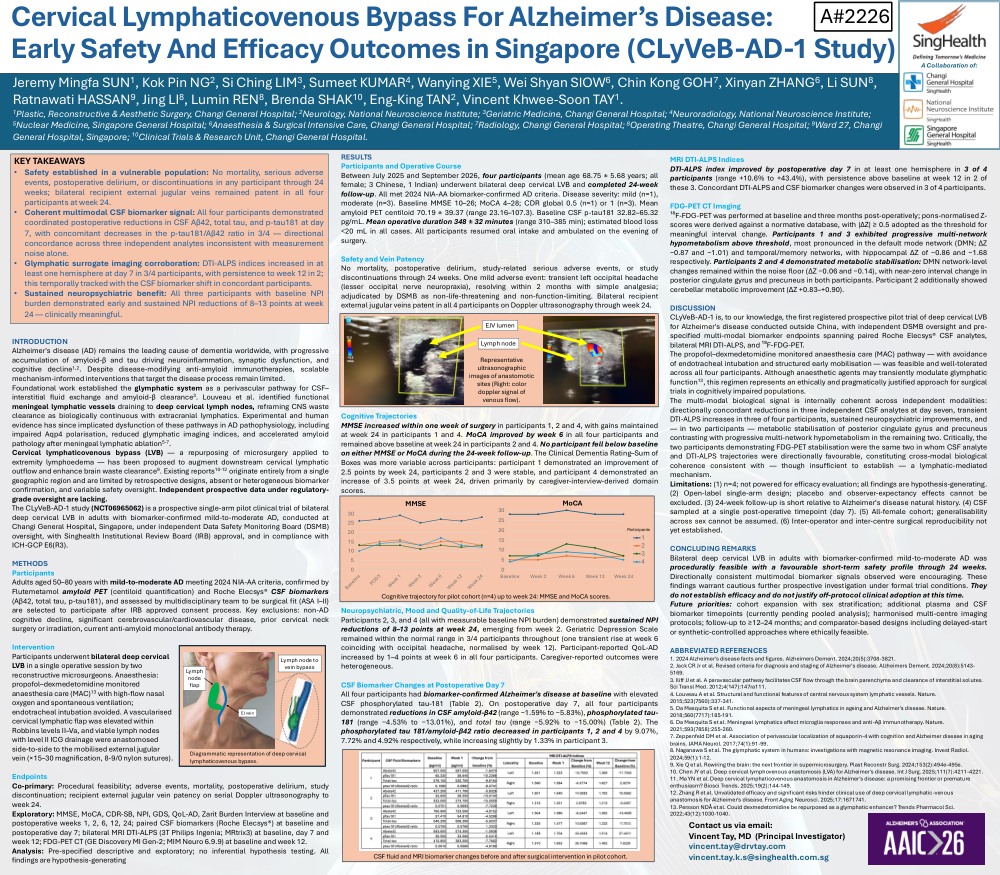
Between July 2025 and September 2026, four participants (mean age 68.75 ± 5.68 years; all female; 3 Chinese, 1 Indian) underwent bilateral deep cervical LVB and completed 24-week follow-up. All met 2024 NIA-AA biomarker-confirmed AD criteria. Disease severity: mild (n=1), moderate (n=3). Baseline MMSE 10–26; MoCA 4–28; CDR global 0.5 (n=1) or 1 (n=3). Mean amyloid PET centiloid 70.19 ± 39.37 (range 23.16–107.3). Baseline CSF p-tau181 32.82–65.32 pg/mL. Mean operative duration 348 ± 32 minutes (range 310–385 min); estimated blood loss <20 mL in all cases. All participants resumed oral intake and ambulated on the evening of surgery.
Safety and Vein Patency
No mortality, postoperative delirium, study-related serious adverse events, or study discontinuations through 24 weeks. One mild adverse event: transient left occipital headache (lesser occipital nerve neuropraxia), resolving within 2 months with simple analgesia; adjudicated by DSMB as non-life-threatening and non-function-limiting. Bilateral recipient external jugular veins patent in all 4 participants on Doppler ultrasonography through week 24.
Cognitive Trajectories
MMSE increased within one week of surgery in participants 1, 2 and 4, with gains maintained at week 24 in participants 1 and 4. MoCA improved by week 6 in all four participants and remained above baseline at week 24 in participants 2 and 4. No participant fell below baseline on either MMSE or MoCA during the 24-week follow-up. The Clinical Dementia Rating–Sum of Boxes was more variable across participants: participant 1 demonstrated an improvement of 2.5 points by week 24, participants 2 and 3 were stable, and participant 4 demonstrated an increase of 3.5 points at week 24, driven primarily by caregiver-interview-derived domain scores.
Neuropsychiatric, Mood and Quality-of-Life Trajectories
Participants 2, 3, and 4 (all with measurable baseline NPI burden) demonstrated sustained NPI reductions of 8–13 points at week 24,emerging from week 2. Geriatric Depression Scale remained within the normal range in 3/4 participants throughout (one transient rise at week 6 coinciding with occipital headache, normalised by week 12). Participant-reported QoL-AD increased by 1–4 points at week 6 in all four participants. Caregiver-reported outcomes were heterogeneous.
CSF Biomarker Changes at Postoperative Day 7
All four participants had biomarker-confirmed Alzheimer's disease at baseline with elevated CSF phosphorylated tau-181 (Table 2). On postoperative day 7, all four participants demonstrated reductions in CSF amyloid-β42 (range −1.59% to −5.83%), phosphorylated tau-181 (range −4.53% to −13.01%), and total tau (range −5.92% to −15.00%) (Table 2). The phosphorylated tau 181/amyloid-β42 ratio decreased in participants 1, 2 and 4 by 9.07%, 7.72% and 4.92% respectively, while increasing slightly by 1.33% in participant 3.
MRI DTI-ALPS Indices
DTI-ALPS index improved by postoperative day 7 in at least one hemisphere in 3 of 4 participants (range +10.6% to +43.4%), with persistence above baseline at week 12 in 2 of these 3. Concordant DTI-ALPS and CSF biomarker changes were observed in 3 of 4 participants.
FDG-PET CT Imaging
¹⁸F-FDG-PET was performed at baseline and three months post-operatively; pons-normalised Z-scores were derived against a normative database, with |ΔZ| ≥ 0.5 adopted as the threshold for meaningful interval change. Participants 1 and 3 exhibited progressive multi-network hypometabolism above threshold, most pronounced in the default mode network (DMN; ΔZ −0.87 and −1.01) and temporal/memory networks, with hippocampal ΔZ of −0.86 and −1.68 respectively. Participants 2 and 4 demonstrated metabolic stabilisation: DMN network-level changes remained within the noise floor (ΔZ −0.06 and −0.14), with near-zero interval change in posterior cingulate gyrus and precuneus in both participants. Participant 2 additionally showed cerebellar metabolic improvement (ΔZ +0.83–+0.90).
DISCUSSION
CLyVeB-AD-1 is, to our knowledge, the first registered prospective pilot trial of deep cervical LVB for Alzheimer's disease conducted outside China, with independent DSMB oversight and pre-specified multi-modal biomarker endpoints spanning paired Roche Elecsys® CSF analytes, bilateral MRI DTI-ALPS, and ¹⁸F-FDG-PET.
The propofol–dexmedetomidine monitored anaesthesia care (MAC) pathway — with avoidance of endotracheal intubation and structured early mobilisation — was feasible and well-tolerated across all four participants. Although anaesthetic agents may transiently modulate glymphatic function13, this regimen represents an ethically and pragmatically justified approach for surgical trials in cognitively impaired populations.
The multi-modal biological signal is internally coherent across independent modalities: directionally concordant reductions in three independent CSF analytes at day seven, transient DTI-ALPS increases in three of four participants, sustained neuropsychiatric improvements, and — in two participants — metabolic stabilisation of posterior cingulate gyrus and precuneus contrasting with progressive multi-network hypometabolism in the remaining two. Critically, the two participants demonstrating FDG-PET stabilisation were the same two in whom CSF analyte and DTI-ALPS trajectories were directionally favourable, constituting cross-modal biological coherence consistent with — though insufficient to establish — a lymphatic-mediated mechanism.
Limitations: (1) n=4; not powered for efficacy evaluation; all findings are hypothesis-generating. (2) Open-label single-arm design; placebo and observer-expectancy effects cannot be excluded. (3) 24-week follow-up is short relative to Alzheimer's disease natural history. (4) CSF sampled at a single post-operative timepoint (day 7). (5) All-female cohort; generalisability across sex cannot be assumed. (6) Inter-operator and inter-centre surgical reproducibility not yet established.
CONCLUDING REMARKS
Bilateral deep cervical LVB in adults with biomarker-confirmed mild-to-moderate AD was procedurally feasible with a favourable short-term safety profile through 24 weeks. Directionally consistent multimodal biomarker signals observed were encouraging. These findings warrant cautious further prospective investigation under formal trial conditions. They do not establish efficacy and do not justify off-protocol clinical adoption at this time.
Future priorities: cohort expansion with sex stratification; additional plasma and CSF biomarker timepoints (currently pending pooled analysis); harmonised multi-centre imaging protocols; follow-up to ≥12–24 months; and comparator-based designs including delayed-start or synthetic-controlled approaches where ethically feasible.
ABBREVIATED REFERENCES
1. 2024 Alzheimer's disease facts and figures. Alzheimers Dement. 2024;20(5):3708-3821.
2. Jack CR Jr et al. Revised criteria for diagnosis and staging of Alzheimer's disease. Alzheimers Dement. 2024;20(8):5143-5169.
3. Iliff JJ et al. A paravascular pathway facilitates CSF flow through the brain parenchyma and clearance of interstitial solutes. Sci Transl Med. 2012;4(147):147ra111.
4. Louveau A et al. Structural and functional features of central nervous system lymphatic vessels. Nature. 2015;523(7560):337-341.
5. Da Mesquita S et al. Functional aspects of meningeal lymphatics in ageing and Alzheimer's disease. Nature. 2018;560(7717):185-191.
6. Da Mesquita S et al. Meningeal lymphatics affect microglia responses and anti-Aβ immunotherapy. Nature. 2021;593(7858):255-260.
7. Zeppenfeld DM et al. Association of perivascular localization of aquaporin-4 with cognition and Alzheimer disease in aging brains. JAMA Neurol. 2017;74(1):91-99.
8. Naganawa S et al. The glymphatic system in humans: investigations with magnetic resonance imaging. Invest Radiol. 2024;59(1):1-12.
9. Xie Q et al. Rewiring the brain: the next frontier in supermicrosurgery. Plast ReconstrSurg. 2024;153(2):494e-495e.
10. Chen JY et al. Deep cervical lymphovenous anastomosis (LVA) for Alzheimer's disease. Int J Surg. 2025;111(7):4211-4221.
11. Ma YN et al. Deep cervical lymphaticovenous anastomosis in Alzheimer's disease: a promising frontier or premature enthusiasm? Biosci Trends. 2025;19(2):144-149.
12. Zhang R et al. Unvalidated efficacy and significant risks hinder clinical use of deep cervical lymphatic-venous anastomosis for Alzheimer's disease. Front Aging Neurosci. 2025;17:1671741.
13. Persson NDÅ et al. Could dexmedetomidine be repurposed as a glymphatic enhancer? Trends Pharmacol Sci. 2022;43(12):1030-1040.
Comments
Email is required but is not shown publicly.
Loading comments...