4,068 posters, 219 videos, 101 topics, 69 sessions, 14,365 authors, 6,128 institutions
ePostersLive by SciGen Technologies S.A. All rights reserved.
Alzheimer's Association International Conference 2026
July 12-15, 2026 | London, United Kingdom, and Online

3124
Responsible Communication On Dementia Risk Reduction: An Empirical-Ethical Analysis
Poster Presenter
Authors
Dominique Paauw, Kay Deckers, Leonie N.C. Visser, Sebastian Köhler, Dorothee Horstkötter
Affiliations
Alzheimer Centre Limburg, Department of Psychiatry and Neuropsychology, Mental Health and Neuroscience Research Institute (MHeNs), Maastricht University, Maastricht, the Netherlands, Department of Medical Psychology, Academic Medical Centre location AMC, University of Amsterdam, The Netherlands; Department of Bioethics & Medical Humanities, University Medical Center Utrecht, Utrecht, The Netherlands, Alzheimer Centre Limburg, Department of Psychiatry and Neuropsychology, Mental Health and Neuroscience Research Institute (MHeNs), Maastricht University, Maastricht, the Netherlands;, Department of Health, Ethics and Society; Mental Health and Neuroscience Research Institute (MHeNs), Maastricht University, Maastricht, the Netherlands
Part of Topic
Background:
•About 45% dementia cases are preventable by addressing 14 modifiable risk factors.
•Public health campaigns should raise awareness about dementia risk reduction.
•Alongside increasing popularity, campaigns have been met with ethical scrutiny:
•Medicalize everyday activities during midlife
•Place high responsibility on individuals,
•Address mainly advantaged groups, while ignoring socially disadvantaged populations
•Research involving these target groups can identify context sensitive perceptions and priorities on healthy ageing and dementia risk reduction.
•Meaningful communication with and for disadvantaged groups is one critical tool to address key ethical questions and develop ethical public health campaigns
Methods:
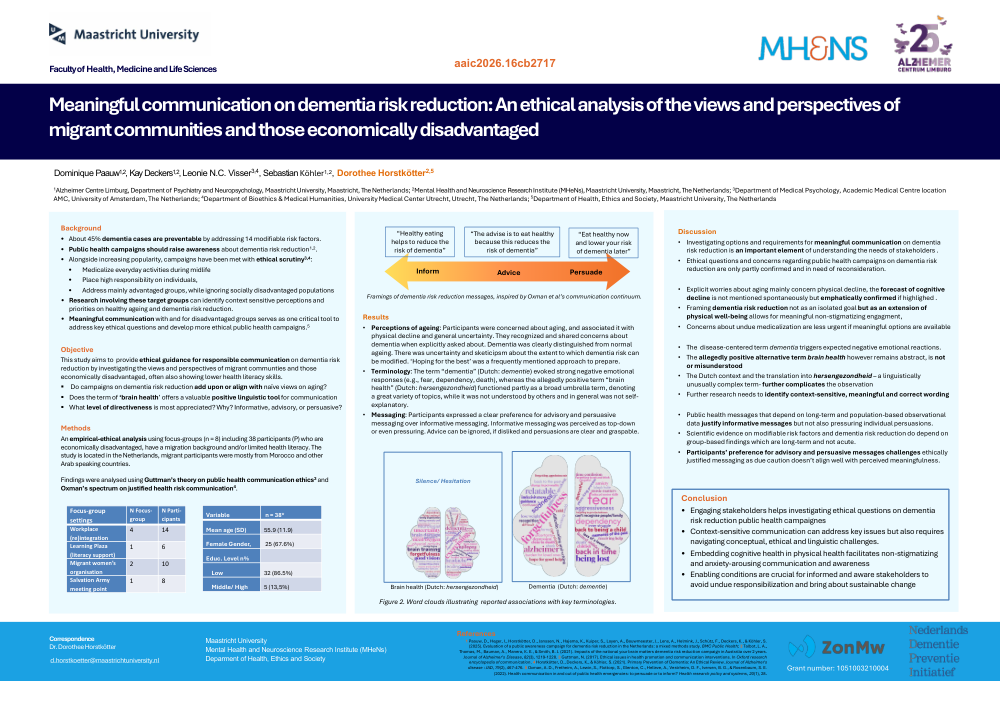
An empirical-ethical analysis was conducted of focus group interviews, considering theories on ageing and ethical risk communication. Eight focus groups were held between April and July 2024 (n = 4–8 participants per group; aged 28–74). Participants were recruited via local community organisations serving the target groups. Semi-structured discussions explored (1) meanings attributed to (healthy) ageing, (2) associations with the terms brain health (Dutch: hersengezondheid) and dementia, and (3) reasons for preferences regarding dementia risk reduction messaging framed as informative, advisory, or persuasive.
Results:
Ageing was primarily associated with physical decline, loss of independence, and uncertainty about the future. Dementia was not generally perceived as a normal part of ageing, and was strongly linked to fear, forgetfulness, and dependency. The term hersengezondheid (Dutch translatin of brain health) was often considered unclear, associated with a broad range of neurological conditions, and not consistently viewed as a more neutral alternative to the term dementia. The advisory message was perceived as clear and supportive while allowing choice, and the persuasive message was valued for being direct and motivating. However, the informative message was perceived as more distant, top-down, and less engaging.
Conclusion:
•Engaging stakeholders helps investigating ethical questions on dementia risk reduction public health campaignes
•Context-sensitive communication can address key issues but also requires navigating conceptual, ethical and linguistic challenges.
•Embedding cognitive health in physical health facilitates non-stigmatizing and anxiety-arousing communication and awareness
•Enabling conditions are crucial for informed and aware stakeholders to avoid undue responsibilization and bring about sustainable change
Comments
Email is required but is not shown publicly.
Loading comments...