4,068 posters, 219 videos, 101 topics, 69 sessions, 14,365 authors, 6,128 institutions
ePostersLive by SciGen Technologies S.A. All rights reserved.
Alzheimer's Association International Conference 2026
July 12-15, 2026 | London, United Kingdom, and Online

8636
REFER-MCI: Enriching referrals of patients to memory clinics for Mild Cognitive Impairment (MCI)
Poster Presenter
Authors
Emrah Duezel, Jochen René Thyrian, Vanessa Kurth, Nadine Diersch, Anne Boehlen, Agnes Flöel, Anja Schneider, Wenzel Glanz, Kathrin Reetz, Jörg B. Schulz, Christine von Arnim, Lucrezia Hausner, Johannes Levin, Jens Wiltfang, David Berron, Frank Jessen, Annika Spottke, Stefan Teipel
Affiliations
German Center for Neurodegenerative Diseases (DZNE), Magdeburg, Germany, DZNE, Greifswald, Germany, Lilly Germany GmbH, Bad Homburg, Germany, neotiv GmbH, Magdeburg, Germany, DZNE, Bonn, Germany, Department of Neurology, RWTH Aachen University, Germany, Department of Geriatrics, University Medicine Göttingen, Germany, Department of Gerontopsychiatry, Central Institute of Mental Health, Mannheim, Germany, DZNE, Munich, Germany, DZNE, Göttingen, Germany, DZNE, Cologne, Germany, DZNE, Rostock, Germany
Part of Topic
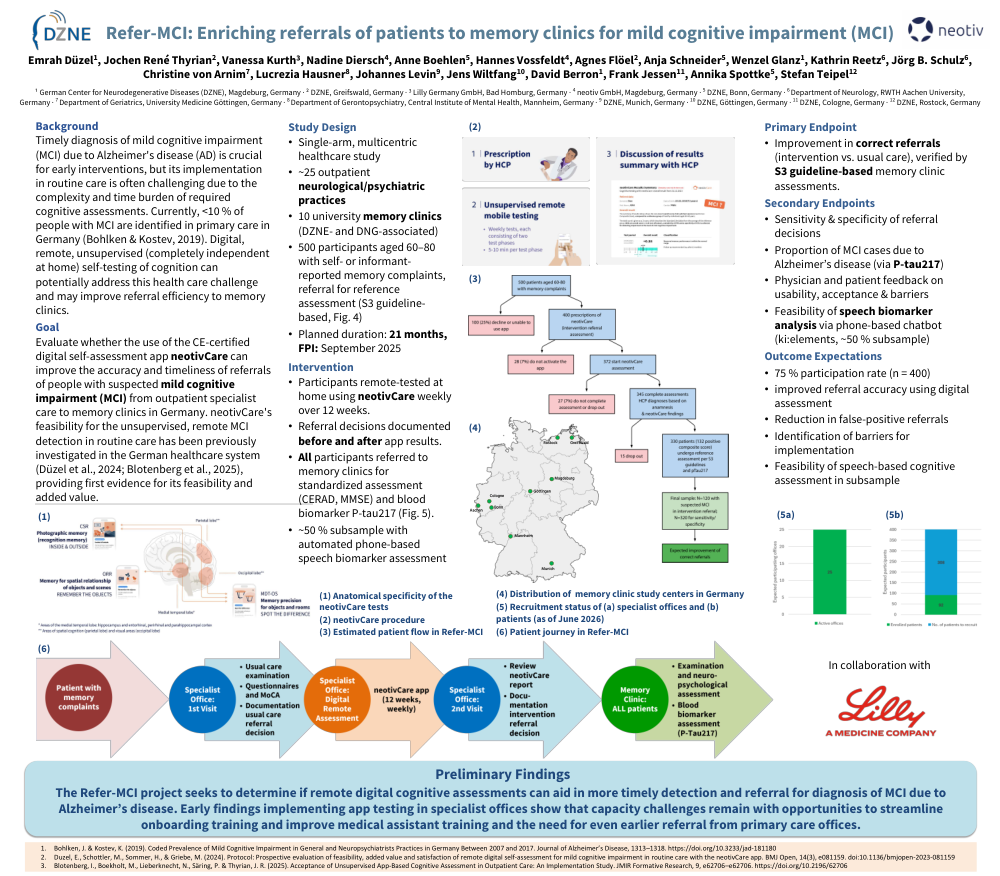
Fewer than 10% of MCI cases due to Alzheimer's disease are currently identified in primary care in Germany. Refer-MCI evaluates whether the CE-certified digital self-assessment app neotivCare can improve the accuracy and timeliness of referrals from outpatient specialist care to memory clinics.
In this multicentric study, 500 participants (aged 60–80) with memory complaints are recruited across ~25 specialist practices and referred to 10 university memory clinics. Participants complete unsupervised, remote weekly neotivCare testing at home over 12 weeks, with referral decisions documented before and after app-based results. All undergo standardized reference assessment (CERAD, MMSE) and blood biomarker testing (P-tau217); a subsample completes phone-based speech biomarker assessment from k:i elements.
The primary endpoint is improvement in correct referrals versus usual care. Preliminary findings show capacity challenges in specialist offices, highlighting the need for streamlined onboarding and earlier referral from primary care.
Comments
Email is required but is not shown publicly.
Loading comments...