4,068 posters, 219 videos, 101 topics, 69 sessions, 14,365 authors, 6,128 institutions
ePostersLive by SciGen Technologies S.A. All rights reserved.
Alzheimer's Association International Conference 2026
July 12-15, 2026 | London, United Kingdom, and Online

2335
Physiological markers of agitation risk in Alzheimer’s disease
Poster Presenter
Authors
Roeland Heerema, Harry Costello, Wanjun Lin, Anishka Agarwal, Nina Foley, Kathy Liu
Affiliations
Max Planck UCL Centre for Computational Psychiatry and Ageing Research, University College London, London, UK, Division of Psychiatry, University College London, London, UK, Department of Clinical Medicine Center of Functionally Integrative Neuroscience, Aarhus University, Aarhus, Denmark, University College London, London, UK, North London NHS Foundation Trust, London, UK
Part of Topic
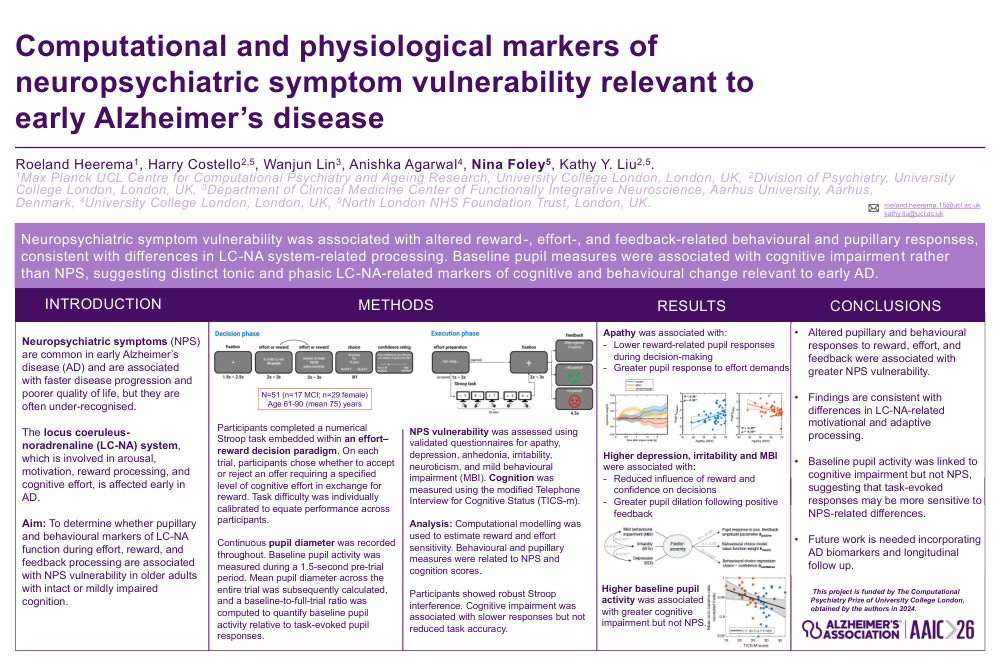
Computational and physiological markers of neuropsychiatric symptom vulnerability relevant to early Alzheimer’s disease
INTRODUCTION
Neuropsychiatric symptoms (NPS) are common in early Alzheimer’s disease (AD) and are associated with faster disease progression and poorer quality of life, but they are often under-recognised.
The locus coeruleus-noradrenaline (LC-NA) system, which is involved in arousal, motivation, reward processing, and cognitive effort, is affected early in AD.
Aim: To determine whether pupillary and behavioural markers of LC-NA function during effort, reward, and feedback processing are associated with NPS vulnerability in older adults with intact or mildly impaired cognition.
METHODS
Participants completed a numerical Stroop task embedded within an effort–reward decision paradigm. On each trial, participants chose whether to accept or reject an offer requiring a specified level of cognitive effort in exchange for reward. Task difficulty was individually calibrated to equate performance across participants.
Continuous pupil diameter was recorded throughout. Baseline pupil activity was measured during a 1.5-second pre-trial period. Mean pupil diameter across the entire trial was subsequently calculated, and a baseline-to-full-trial ratio was computed to quantify baseline pupil activity relative to task-evoked pupil responses.
NPS vulnerability was assessed using validated questionnaires for apathy, depression, anhedonia, irritability, neuroticism, and mild behavioural impairment (MBI). Cognition was measured using the modified Telephone Interview for Cognitive Status (TICS-m).
Analysis: Computational modelling was used to estimate reward and effort sensitivity. Behavioural and pupillary measures were related to NPS and cognition scores.
Participants showed robust Stroop interference. Cognitive impairment was associated with slower responses but not reduced task accuracy.
RESULTS
Apathy was associated with:
Higher depression, irritability and MBI were associated with:
Higher baseline pupil activity was associated with greater cognitive impairment but not NPS.
CONCLUSIONS
•Findings are consistent with differences in LC-NA-related motivational and adaptive processing.
•Future work is needed incorporating AD biomarkers and longitudinal follow up.
Comments
Email is required but is not shown publicly.
Loading comments...