4,068 posters, 219 videos, 101 topics, 69 sessions, 14,365 authors, 6,128 institutions
ePostersLive by SciGen Technologies S.A. All rights reserved.
Alzheimer's Association International Conference 2026
July 12-15, 2026 | London, United Kingdom, and Online

5298
Allocentric Navigation Deficits Predict Clinical Progression In Subjective Cognitive Decline And Amnestic Mild Cognitive Impairment
Poster Presenter
Authors
Natalia Daniskova, Martina Laczó, Sarka Borovska, Hana Horakova, Veronika Matuskova, Katerina Veverova, Martin Vyhnalek, Jakub Hort, Jan Laczó
Affiliations
, This study was supported by the Ministry of Health of the Czech Republic, grant nr. NW25-04-00337, the Grant Agency of Charles University (Grant No. 40125), the Institutional Support of Excellence 3 2. LF UK (Grant No. 6980382), the Ministry of Health of the Czech Republic—conceptual development of research organisation, University Hospital Motol, Prague, Czech Republic grant nr. 00064203, and the Czech Science Foundation (GACR) registration number 26-21480S.
Part of Topic
Abstract:
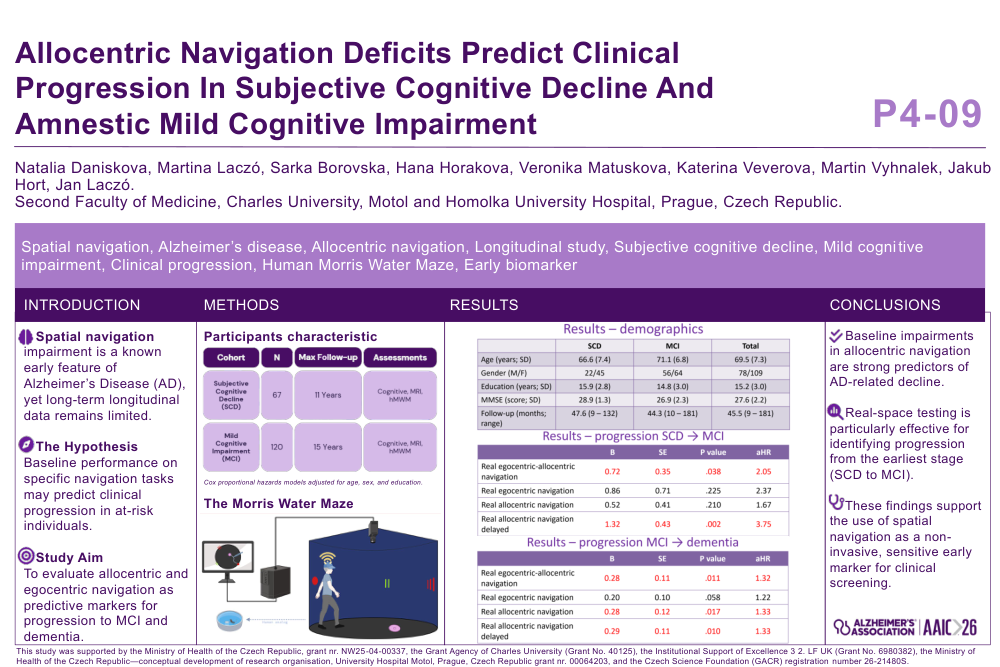
Background: Spatial navigation impairment is an early feature of Alzheimer’s disease (AD), but evidence from long-term longitudinal studies remains limited. We examined whether baseline spatial navigation performance predicts clinical progression in older adults at risk for AD with subjective cognitive decline (SCD) or mild cognitive impairment (MCI).
Methods: This study involved 187 participants from the Czech Brain Aging Study (67 SCD, 120 MCI) followed for up to 11 and 15 years, respectively. Participants underwent baseline and longitudinal cognitive assessments, brain MRI, and spatial navigation testing using real-space and computerized versions of a human analog of the Morris Water Maze (hMWM). The hMWM included four tasks assessing allocentric-egocentric, egocentric, allocentric, and delayed allocentric navigation. Cox proportional hazards models adjusted for age, sex, and education were used to evaluate the ability of each task to predict progression from SCD to MCI and from MCI to dementia.
Results: Mean time to progression was 7.6 years from SCD to MCI and 5.6 years from MCI to dementia. Progression from MCI to dementia was predicted by poorer performance on real-space and computerized allocentric-egocentric, allocentric, and delayed allocentric tasks (adjusted hazard ratios [aHRs] 1.28-1.42, all p≤0.032), but not by egocentric navigation. In addition, worse performance on real-space allocentric-egocentric (aHR=2.05, p=0.038) and delayed allocentric tasks (aHR=3.75, p=0.002) predicted progression from SCD to MCI.
Conclusion: Baseline impairments in allocentric spatial navigation predict clinical progression from MCI to dementia and, in real-space testing, from SCD to MCI, supporting spatial navigation as a sensitive early marker of AD-related cognitive decline.
Comments
Email is required but is not shown publicly.
Loading comments...