4,068 posters, 219 videos, 101 topics, 69 sessions, 14,365 authors, 6,128 institutions
ePostersLive by SciGen Technologies S.A. All rights reserved.
Alzheimer's Association International Conference 2026
July 12-15, 2026 | London, United Kingdom, and Online

3300
EEG Measures Of Arousal And Capacity For Consciousness In Alzheimer’S Disease
Poster Presenter
Authors
Affiliations
Part of Topic
Introduction
Consciousness is relevant in dementia, as unlike discrete states such as general anaesthetic and light sleep one cannot intuit consciousness from observation alone, especially in more severe cases (1, 2).
Observations of patients with dementia seem to show reduced awareness and arousal, however clinically there is significant variability and fluctuation (2).
Data exists comparing patients with mild cognitive impairment in AD to patients without AD, typically showing an increase in slow-speed brainwaves, similar to that seen in sleep-like states (3).
EEG markers of wakefulness (the Alpha Theta ratio) and complexity (e.g. Lempel Ziv Complexity) provide surrogate measures of aspects of consciousness (4, 5).
Changes in brain network properties and types of interactions have also been observed in people with undergoing a general anaesthetic (6).
There is little to no evidence on the changes observed in these markers of consciousness in more advanced and severe dementia highlighting a key area of research.
Methods
This research used 47 participants which were categorised in to 3 groups: Control (no-AD), Mild AD and Severe AD based on their Global Dementia Rating (GDR). The patients were sitting, mostly still throughout the recording and EEG recordings were all over a minute-long.
Preprocessing When EEG data is recorded, it is filled with noise from the surroundings. Preprocessing attempts to remove this. This was done in Python (7).
Alpha Theta Ratio The most basic measure of wakefulness is the proportion of slow waves to faster waves. Theta waves represent slow lower frequency oscillations and these predominate in sleep, whereas higher frequencies typically predominate in wakeful consciousness (8, 9).
Signal Entropy (e.g. Lempel Ziv Complexity) This is a measure of temporal signal complexity. “Capacity for consciousness” has often been described as having more complex EEG activity. This has been found to be reduced in mild cognitive impairment patients (10).
Connectivity and Network Analysis The brain forms connections between different regions (11). All these individual connections can be put together to create a larger network or graph (11). Changes in the layout and type of connection formed in these graphs has been shown to change in suppressive anaesthesia with loss of consciousness (8, 9, 12). As part of our research we used multiple methods of estimating connectivity to isolate different types of interactions between brain regions.
Statistical Analysis This was carried out using R (13).
Results
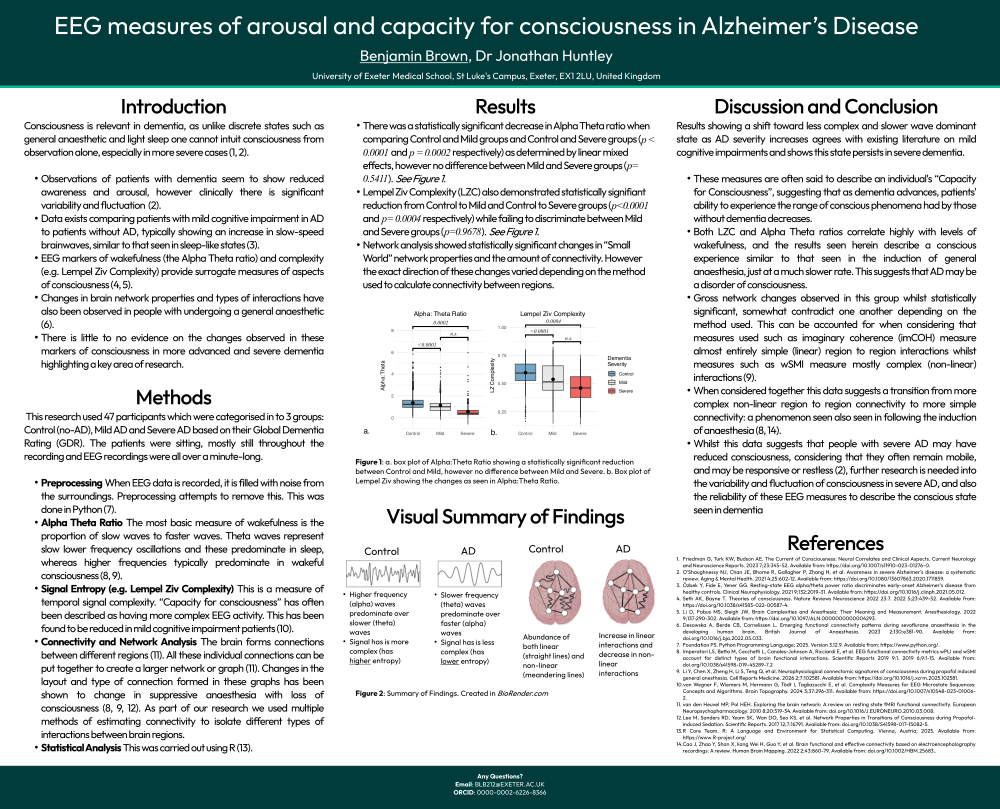
There was a statistically significant decrease in Alpha Theta ratio when comparing Control and Mild groups and Control and Severe groups (p < 0.0001 and p = 0.0002 respectively) as determined by linear mixed effects, however no difference between Mild and Severe groups (p= 0.5411). See Figure 1.
Lempel Ziv Complexity (LZC) also demonstrated statistically signifiant reduction from Control to Mild and Control to Severe groups (p<0.0001 and p= 0.0004 respectively) while failing to discriminate between Mild and Severe groups (p=0.9678). See Figure 1.
Network analysis showed statistically significant changes in “Small World” network properties and the amount of connectivity. However the exact direction of these changes varied depending on the method used to calculate connectivity between regions.
Discussion and Conclusion
Results showing a shift toward less complex and slower wave dominant state as AD severity increases agrees with existing literature on mild cognitive impairments and shows this state persists in severe dementia.
These measures are often said to describe an individual's “Capacity for Consciousness”, suggesting that as dementia advances, patients' ability to experience the range of conscious phenomena had by those without dementia decreases.
Both LZC and Alpha Theta ratios correlate highly with levels of wakefulness, and the results seen herein describe a conscious experience similar to that seen in the induction of general anaesthesia, just at a much slower rate. This suggests that AD may be a disorder of consciousness.
Gross network changes observed in this group whilst statistically significant, somewhat contradict one another depending on the method used. This can be accounted for when considering that measures used such as imaginary coherence (imCOH) measure almost entirely simple (linear) region to region interactions whilst measures such as wSMI measure mostly complex (non-linear) interactions (9).
When considered together this data suggests a transition from more complex non-linear region to region connectivity to more simple connectivity: a phenomenon seen also seen in following the induction of anaesthesia (8, 14).
Whilst this data suggests that people with severe AD may have reduced consciousness, considering that they often remain mobile, and may be responsive or restless (2), further research is needed into the variability and fluctuation of consciousness in severe AD, and also the reliability of these EEG measures to describe the conscious state seen in dementia
References
Friedman G, Turk KW, Budson AE. The Current of Consciousness: Neural Correlates and Clinical Aspects. Current Neurology and Neuroscience Reports. 2023 7;23:345-52. Available from: https://doi.org/10.1007/s11910-023-01276-0.
O’Shaughnessy NJ, Chan JE, Bhome R, Gallagher P, Zhang H, et al. Awareness in severe Alzheimer’s disease: a systematic review. Aging & Mental Health. 2021 4;25:602-12. Available from: https://doi.org/10.1080/13607863.2020.1711859.
Özbek Y, Fide E, Yener GG. Resting-state EEG alpha/theta power ratio discriminates early-onset Alzheimer’s disease from healthy controls. Clinical Neurophysiology. 2021 9;132:2019-31. Available from: https://doi.org/10.1016/j.clinph.2021.05.012.
Seth AK, Bayne T. Theories of consciousness. Nature Reviews Neuroscience 2022 23:7. 2022 5;23:439-52. Available from: https://doi.org/10.1038/s41583-022-00587-4.
Li D, Fabus MS, Sleigh JW. Brain Complexities and Anesthesia: Their Meaning and Measurement. Anesthesiology. 2022 9;137:290-302. Available from: https://doi.org/10.1097/ALN.0000000000004293.
Desowska A, Berde CB, Cornelissen L. Emerging functional connectivity patterns during sevoflurane anaesthesia in the developing human brain. British Journal of Anaesthesia. 2023 2;130:e381-90. Available from: doi.org/10.1016/j.bja.2022.05.033.
Foundation PS. Python Programming Language; 2025. Version 3.12.9. Available from: https://www.python.org/.
Imperatori LS, Betta M, Cecchetti L, Canales-Johnson A, Ricciardi E, et al. EEG functional connectivity metrics wPLI and wSMI account for distinct types of brain functional interactions. Scientific Reports 2019 9:1. 2019 6;9:1-15. Available from: doi.org/10.1038/s41598-019-45289-7.2
Li Y, Chen X, Zheng H, Li S, Teng Q, et al. Neurophysiological connectomic signatures of consciousness during propofol induced general anesthesia. Cell Reports Medicine. 2026 2;7:102581. Available from: https://doi.org/10.1016/j.xcrm.2025.102581.
von Wegner F, Wiemers M, Hermann G, Tödt I, Tagliazucchi E, et al. Complexity Measures for EEG Microstate Sequences: Concepts and Algorithms. Brain Topography. 2024 3;37:296-311. Available from: https://doi.org/10.1007/s10548-023-01006-2.
van den Heuvel MP, Pol HEH. Exploring the brain network: A review on resting state fMRI functional connectivity. European Neuropsychopharmacology. 2010 8;20:519-34. Available from: doi.org/10.1016/J.EURONEURO.2010.03.008.
Lee M, Sanders RD, Yeom SK, Won DO, Seo KS, et al. Network Properties in Transitions of Consciousness during Propofol-induced Sedation. Scientific Reports. 2017 12;7:16791. Available from: doi.org/10.1038/S41598-017-15082-5.
R Core Team. R: A Language and Environment for Statistical Computing. Vienna, Austria; 2025. Available from: https://www.R-project.org/
Cao J, Zhao Y, Shan X, liang Wei H, Guo Y, et al. Brain functional and effective connectivity based on electroencephalography recordings: A review. Human Brain Mapping. 2022 2;43:860-79. Available from: doi.org/10.1002/HBM.25683..
Comments
Email is required but is not shown publicly.
Loading comments...