4,068 posters, 219 videos, 101 topics, 69 sessions, 14,365 authors, 6,128 institutions
ePostersLive by SciGen Technologies S.A. All rights reserved.
Alzheimer's Association International Conference 2026
July 12-15, 2026 | London, United Kingdom, and Online

2266
Digital Cognitive Profiling Of Mild Cognitive Impairment In Primary Care: Evidence From The Altoida Neuromarker Platform
Poster Presenter
Authors
Adrià Tort-Merino, M. Florencia Iulita, Axel Rigol, Miquel Massons, Victoria Brugada Ramentol, Emmanuel Streel, Guadalupe Fernández Villullas, Bea Bosch, Claudia Morante-Serra, Jaume Torres-Coll, Laura Mir-Sala, Diana Esteller, Isabel Martin-Sobrino, Paula Canasto, Anna Antonell, Neus Falgàs, Raquel Sánchez-Valle, Albert Lladó, Mircea Balasa
Affiliations
Alzheimer’s Disease and other Cognitive Disorders unit, Hospital Clínic de Barcelona, Fundació de Recerca Clínic Barcelona – Institut d’Investigacions Biomèdiques August Pi i Sunyer (IDIBAPS), Universitat de Barcelona, Barcelona, Spain, Alzheimer’s Disease and other Cognitive Disorders unit, Hospital Clínic de Barcelona, Fundació de Recerca Clínic Barcelona – Institut d’Investigacions Biomèdiques August Pi i Sunyer (IDIBAPS), Universitat de Barcelona, Barcelona, Spain and Centro de Investigación Biomédica en Red en Enfermedades Neurodegenerativas (CIBERNED), Madrid, Spain, Altoida Inc. 80 M Street SE, Suite 100, Washington, DC 20003 - USA
Part of Topic
Digital Cognitive Profiling of Mild Cognitive Impairment in Primary Care: evidence from the Altoida NeuroMarker Platform
Adrià Tort-Merino1,2, M. Florencia Iulita3, Axel Rigol1, Miquel Massons1, Victoria Brugada Ramentol3, Emmanuel Streel3, Guadalupe Fernández-Villullas1,2, Bea Bosch1,2, Claudia Morante-Serra1, Jaume Torres-Coll1, Laura Mir1, Diana Esteller1,Isabel Martin1, Paula Canasto1, Anna Antonell1,2, Neus Falgàs1,2, Raquel Sánchez-Valle1,2, Albert Lladó1,2, Mircea Balasa1,2
1 Alzheimer’s Disease and other Cognitive Disorders unit, Hospital Clínic de Barcelona, Fundació de Recerca Clínic Barcelona – Institut d’Investigacions Biomèdiques August Pi i Sunyer (IDIBAPS), Universitat de Barcelona, Barcelona, Spain
2 Centro de Investigación Biomédica en Red en Enfermedades Neurodegenerativas (CIBERNED), Madrid, Spain
3Altoida Inc. 80 M Street SE, Suite 100, Washington, DC 20003 - USA
Background: Digital cognitive assessments may provide a scalable solution in primary care to differentiate Mild Cognitive Impairment (MCI) from Subjective Cognitive Decline (SCD). We evaluated whether the Altoida NeuroMarker detects global and domain-specific cognitive differences between SCD and MCI in a primary care setting, and examined its convergent validity.
Methods: The Altoida NeuroMarker platform is a 10-minute cognitive test battery conducted on an iOS device. It evaluates instrumental activities of daily living via motoric and augmented reality tasks, including tapping, tracing, and placing/finding virtual objects in a real environment. The platform generates a global composite score reflecting overall cognitive performance, and scores of cognitive domains mapped to DSM-V. These domains comprise 14 task-derived cognitive subdomains. We included 48 participants with cognitive complaints recruited in a primary care setting in Barcelona (Spain), classified as SCD (n=10; age=71.9±8.5; MMSE=28.1±1.4) or MCI (n=38; age=79.9±6.8; MMSE=23.8±3.1). Participants with MCI were subclassified based on their clinical and plasma ptau217 profile into MCI-AD (n=22; age=80.4±5.5; MMSE=23.1±3.1) or non-degenerative MCI (nd-MCI; n=11; age=79.6±6.9; MMSE=24.7±3.1).
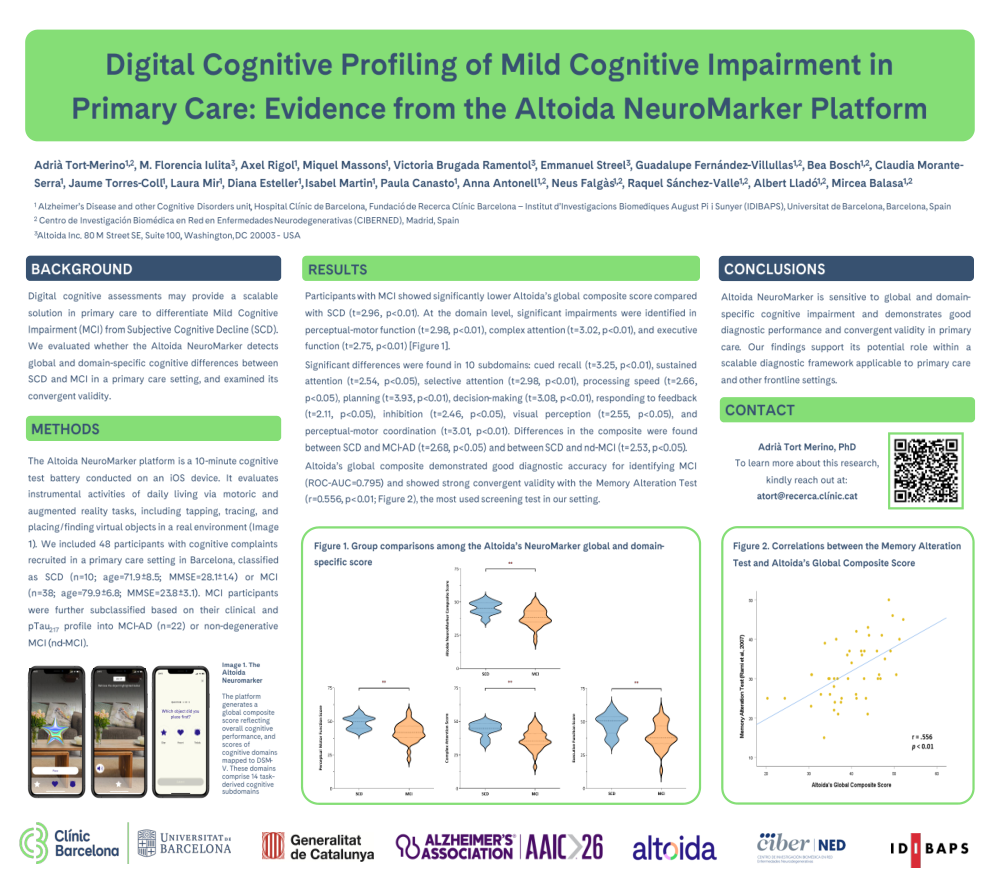
Results: Participants with MCI showed significantly lower Altoida’s global composite score compared with SCD (t=2.96, p<0.01). At the domain level, significant impairments were identified in perceptual-motor function (t=2.98, p<0.01), complex attention (t=3.02, p<0.01), and executive function (t=2.75, p<0.01) [Figure 1]. Furthermore, significant differences were found in 10 subdomains: cued recall (t=3.25, p<0.01), sustained attention (t=2.54, p<0.05), selective attention (t=2.98, p<0.01), processing speed (t=2.66, p<0.05), planning (t=3.93, p<0.01), decision-making (t=3.08, p<0.01), responding to feedback (t=2.11, p<0.05), inhibition (t=2.46, p<0.05), visual perception (t=2.55, p<0.05), and perceptual-motor coordination (t=3.01, p<0.01). Differences in the global composite were found between SCD and MCI-AD (t=2.68, p<0.05) and between SCD and nd-MCI (t=2.53, p<0.05). Altoida’s global composite demonstrated good diagnostic accuracy for identifying MCI (ROC-AUC=0.795) and showed strong convergent validity with the Memory Alteration Test (r=0.556, p<0.01; Figure 2), which is the most used screening test in our setting.
Conclusions: Altoida NeuroMarker is sensitive to global and domain-specific cognitive impairment and demonstrates good diagnostic performance and convergent validity in primary care. Our findings support its potential role within a scalable diagnostic framework applicable to primary care and other frontline settings.
Comments
Email is required but is not shown publicly.
Loading comments...