4,068 posters, 219 videos, 101 topics, 69 sessions, 14,365 authors, 6,128 institutions
ePostersLive by SciGen Technologies S.A. All rights reserved.
Alzheimer's Association International Conference 2026
July 12-15, 2026 | London, United Kingdom, and Online

8666
Verbal Learning Patterns In Cognitive Decline: A Preliminary Study
Part of Topic
Verbal learning patterns in cognitive decline: a preliminary study
TAKE AWAY: Newly discovered memory ability scores based on learning processes allow for the creation of statistical models useful in the differential diagnosis between different cognitive decline etiologies.
Introduction: Alzheimer's disease (AD) and vascular dementia (VaD) are the most common etiologies underlying cognitive decline in individuals over 65, with mixed pathologies being highly prevalent. In early stages, AD patients perform worse on learning tasks than VaD patients and show poorer spatial orientation. VaD subjects show greater executive and verbal fluency difficulties than AD and may exhibit recall difficulties, helped by verbal cues. Breaking down the learning process into summary scores recently extracted from a commonly used test (RAVLT) (Almkvist et al., 2025), opens the possibility of efficiently refining the differential diagnosis. This study aims to explore whether learning process measures might help differentiate AD, VaD and mixed patients and whether combining learning measures with other cognitive measures, it is possible to construct an effective diagnostic model.
Methods: Four groups of patients were recruited: 18 AD, 17 VaD, 13 mixed and 21 Subjective Cognitive Decline (SCD) as a control group. They were compared on neuropsychological and functional measures: MMSE, RAVLT, Verbal fluency test, visual and verbal span, FAB, ADL, IADL, and Hospital Anxiety and Depression Scale. Measures of learning process were derived from the RAVLT, such as difference method, early and late learning measures. To assess the impact of cognitive variables on patient categorization, a Multinomial Logistic Regression model was applied, using test results and measures from the RAVLT as variables.
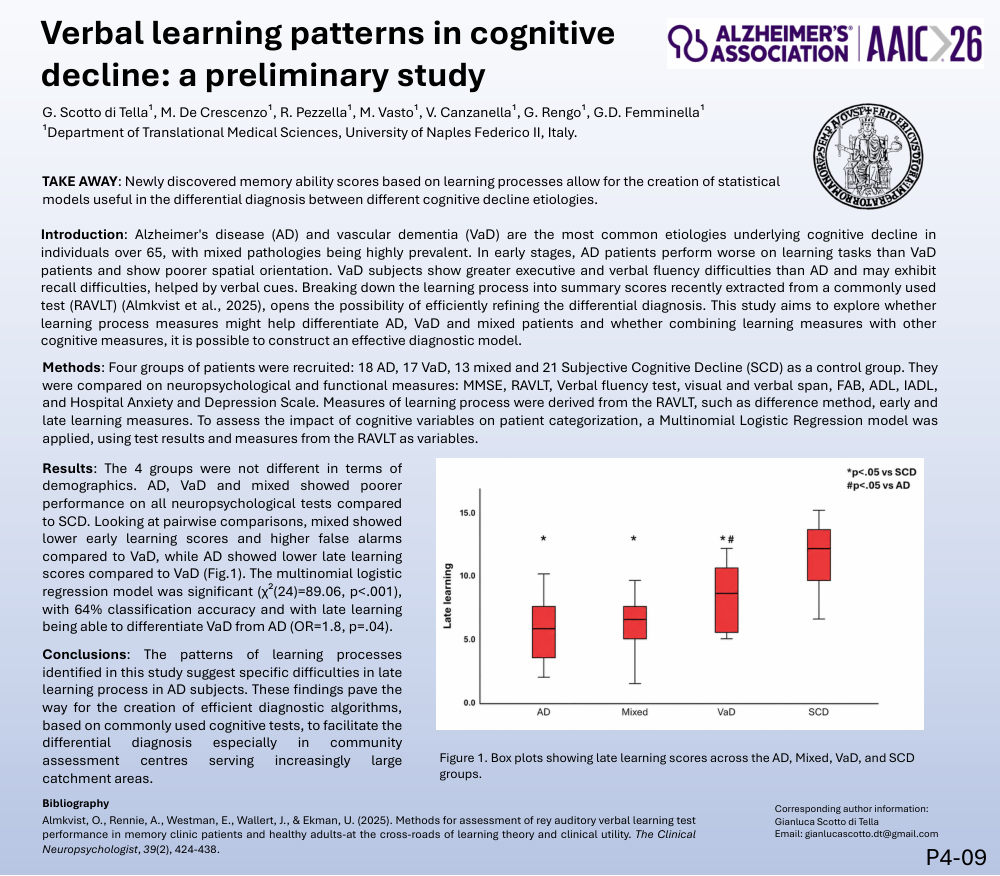
Results: The 4 groups were not different in terms of demographics. AD, VaD and mixed showed poorer performance on all neuropsychological tests compared to SCD. Looking at pairwise comparisons, mixed showed lower early learning scores and higher false alarms compared to VaD, while AD showed lower late learning scores compared to VaD (Fig.1). The multinomial logistic regression model was significant (χ²(24)=89.06, p<.001), with 64% classification accuracy and with late learning being able to differentiate VaD from AD (OR=1.8, p=.04).
Conclusions: The patterns of learning processes identified in this study suggest specific difficulties in late learning process in AD subjects. These findings pave the way for the creation of efficient diagnostic algorithms, based on commonly used cognitive tests, to facilitate the differential diagnosis especially in community assessment centres serving increasingly large catchment areas.
Comments
Email is required but is not shown publicly.
Loading comments...