4,068 posters, 219 videos, 101 topics, 69 sessions, 14,365 authors, 6,128 institutions
ePostersLive by SciGen Technologies S.A. All rights reserved.
Alzheimer's Association International Conference 2026
July 12-15, 2026 | London, United Kingdom, and Online

2959
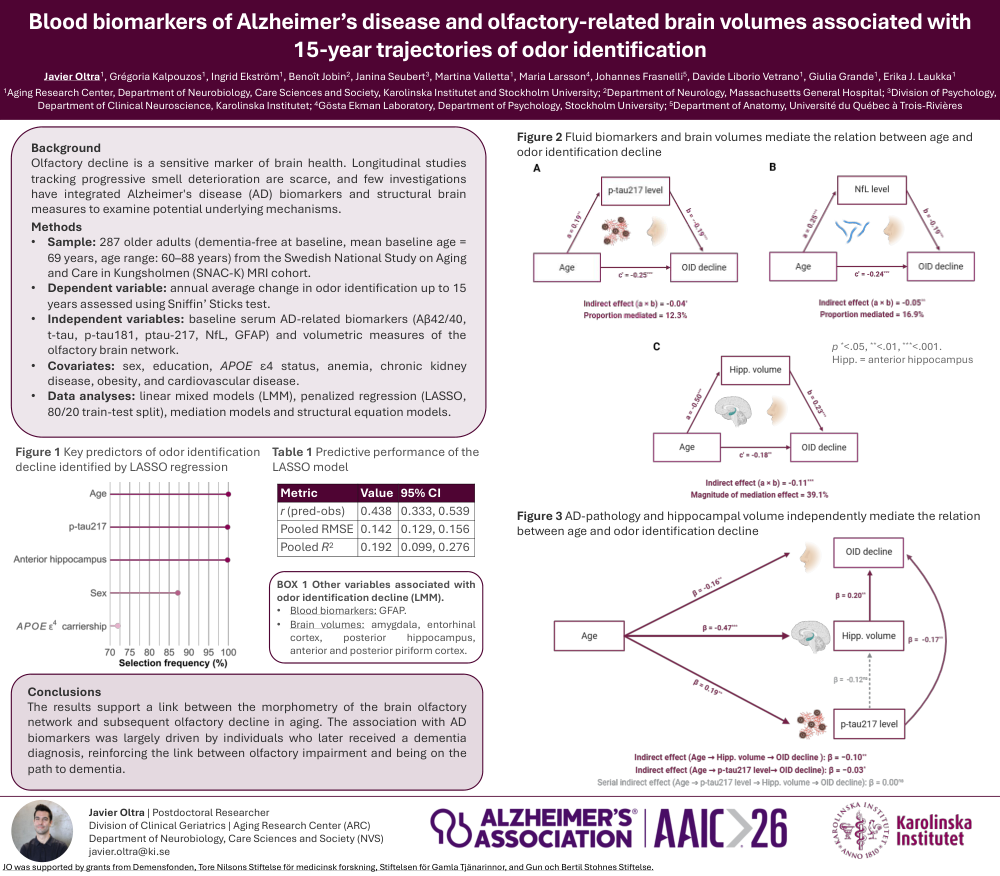
Blood Biomarkers Of Alzheimer’s Disease And Olfactory-related Brain Volumes Associated With 15-year Trajectories Of Odor Identification
Poster Presenter
Authors
Javier Oltra, Grégoria Kalpouzos, Ingrid Ekström, Benoît Jobin, Janina Seubert, Martina Valletta, Maria Larsson, Johannes Frasnelli, Davide Liborio Vetrano, Giulia Grande, Erika J. Laukka
Affiliations
Aging Research Center, Department of Neurobiology, Care Sciences and Society, Karolinska Institutet and Stockholm University, Department of Neurology, Massachusetts General Hospital, Division of Psychology, Department of Clinical Neuroscience, Karolinska Institutet, Gösta Ekman Laboratory, Department of Psychology, Stockholm University, Department of Anatomy, Université du Québec à Trois-Rivières
Part of Topic
Background: Olfactory decline is a sensitive marker of brain health. Longitudinal studies tracking progressive smell deterioration are scarce, and few investigations have integrated Alzheimer's disease (AD) biomarkers and structural brain measures to examine potential underlying mechanisms. Methods: Data from 287 older adults (dementia-free at baseline, mean baseline age = 69 years, age range: 60–88 years) from the Swedish National Study on Aging and Care in Kungsholmen (SNAC-K) MRI cohort were analyzed. Associations between baseline serum biomarkers (AD pathology: Aβ42/40 ratio, t-tau, p-tau181, p-tau217; axonal degeneration: NfL; astroglial activation: GFAP), volumetric measures of the olfactory network (extracted from 1.5 T T1-weighted images preprocessed in SPM12 with 4 mm smoothing, based on regions delineated in a previous SNAC-K MRI study)1, and odor identification (OID, assessed with the Sniffin’ Sticks test) decline (up to 15 years) were examined using linear mixed-effects models. Penalized regression (LASSO, 80/20 train-test split) was applied to identify key predictors of OID decline. Mediation and structural equation models were tested to examine possible pathways linking age to OID decline. Results: Higher p-tau217 and smaller anterior hippocampal volume at baseline were associated with faster OID decline after accounting for other markers. LASSO regression confirmed the predictive value of p-tau217 and anterior hippocampal volume. Mediation analyses revealed that both markers partly explained age-related olfactory decline. A structural equation model with serial mediation showed that anterior hippocampal volume mediated the effect of age on OID decline, whereas the indirect path through p-tau217 and hippocampal volume was not significant. After excluding incident dementia cases, anterior hippocampal volume remained independently associated and mediated the effect of age on olfactory decline. Lower amygdala and posterior piriform cortex volumes were also associated with a steeper decline. Conclusions: The results support a link between the morphometry of the brain olfactory network and subsequent olfactory decline in aging. The association with AD biomarkers was largely driven by individuals who later received a dementia diagnosis, reinforcing the link between olfactory impairment and being on the path to dementia.
References
1. Seubert, J., Kalpouzos, G., Larsson, et al. (2020). Temporolimbic cortical volume is associated with semantic odor memory performance in aging. NeuroImage. 2020; 211:116600.
Comments
Email is required but is not shown publicly.
Loading comments...