4,068 posters, 219 videos, 101 topics, 69 sessions, 14,365 authors, 6,128 institutions
ePostersLive by SciGen Technologies S.A. All rights reserved.
Alzheimer's Association International Conference 2026
July 12-15, 2026 | London, United Kingdom, and Online

2659
Ptau217 And Cognitive Testing Relate To Performance On A Novel Smartphone App: Assessment Of Smartphone Everyday Tasks
Poster Presenter
Authors
Part of Topic
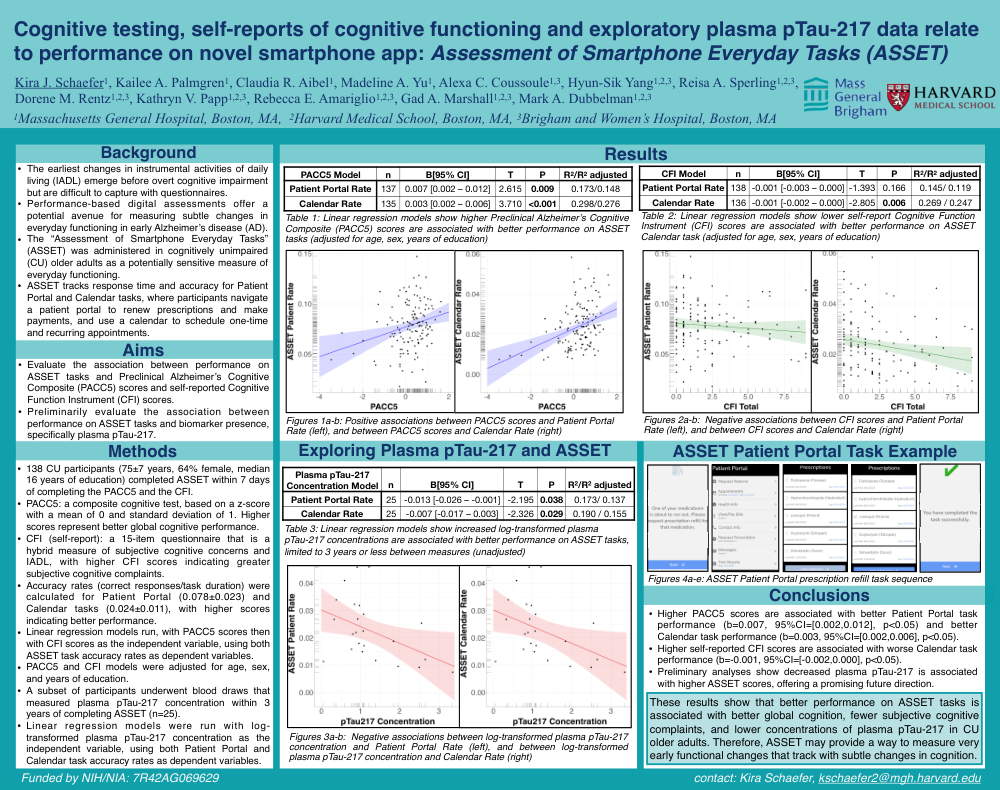
Cognitive testing, self-reports of cognitive functioning and exploratory plasma pTau-217 data relate to performance on novel smartphone app: Assessment of Smartphone Everyday Tasks (ASSET)
Background
- The earliest changes in instrumental activities of daily living (IADL) emerge before overt cognitive impairment but are difficult to capture with questionnaires.
- Performance-based digital assessments offer a potential avenue for measuring subtle changes in everyday functioning in early Alzheimer’s disease (AD).
- The “Assessment of Smartphone Everyday Tasks” (ASSET) was administered in cognitively unimpaired (CU) older adults as a potentially sensitive measure of everyday functioning.
- ASSET tracks response time and accuracy for Patient Portal and Calendar tasks, where participants navigate a patient portal to renew prescriptions and make payments, and use a calendar to schedule one-time and recurring appointments.
Aims
- Evaluate the association between performance on ASSET tasks and Preclinical Alzheimer’s Cognitive Composite (PACC5) scores and self-reported Cognitive Function Instrument (CFI) scores.
- Preliminarily evaluate the association between performance on ASSET tasks and biomarker presence, specifically plasma pTau-217.
Methods
- 138 CU participants (75±7 years, 64% female, median 16 years of education) completed ASSET within 7 days of completing the PACC5 and the CFI.
- PACC5: a composite cognitive test, based on a z-score with a mean of 0 and standard deviation of 1. Higher scores represent better global cognitive performance.
- CFI (self-report): a 15-item questionnaire that is a hybrid measure of subjective cognitive concerns and IADL, with higher CFI scores indicating greater subjective cognitive complaints.
- Accuracy rates (correct responses/task duration) were calculated for Patient Portal (0.078±0.023) and Calendar tasks (0.024±0.011), with higher scores indicating better performance.
- Linear regression models run, with PACC5 scores then with CFI scores as the independent variable, using both ASSET task accuracy rates as dependent variables.
- PACC5 and CFI models were adjusted for age, sex, and years of education.
- A subset of participants underwent blood draws that measured plasma pTau-217 concentration within 3 years of completing ASSET (n=25).
- Linear regression models were run with log-transformed plasma pTau-217 concentration as the independent variable, using both Patient Portal and Calendar task accuracy rates as dependent variables.
Results
Table 1: Linear regression models show higher Preclinical Alzheimer’s Cognitive Composite (PACC5) scores are associated with better performance on ASSET tasks (adjusted for age, sex, years of education)
Table 2: Linear regression models show lower self-report Cognitive Function Instrument (CFI) scores are associated with better performance on ASSET Calendar task (adjusted for age, sex, years of education)
Table 3: Linear regression models show increased log-transformed plasma pTau-217 concentrations are associated with better performance on ASSET tasks, limited to 3 years or less between measures (unadjusted)
Conclusions
- Higher PACC5 scores are associated with better Patient Portal task performance (b=0.007, 95%CI=[0.002,0.012], p<0.05) and better Calendar task performance (b=0.003, 95%CI=[0.002,0.006], p<0.05).
- Higher self-reported CFI scores are associated with worse Calendar task performance (b=-0.001, 95%CI=[-0.002,0.000], p<0.05).
- Preliminary analyses show decreased plasma pTau-217 is associated with higher ASSET scores, offering a promising future direction.
These results show that better performance on ASSET tasks is associated with better global cognition, fewer subjective cognitive complaints, and lower concentrations of plasma pTau-217 in CU older adults. Therefore, ASSET may provide a way to measure very early functional changes that track with subtle changes in cognition.
Comments
Email is required but is not shown publicly.
Loading comments...