4,068 posters, 219 videos, 101 topics, 69 sessions, 14,365 authors, 6,128 institutions
ePostersLive by SciGen Technologies S.A. All rights reserved.
Alzheimer's Association International Conference 2026
July 12-15, 2026 | London, United Kingdom, and Online

8894
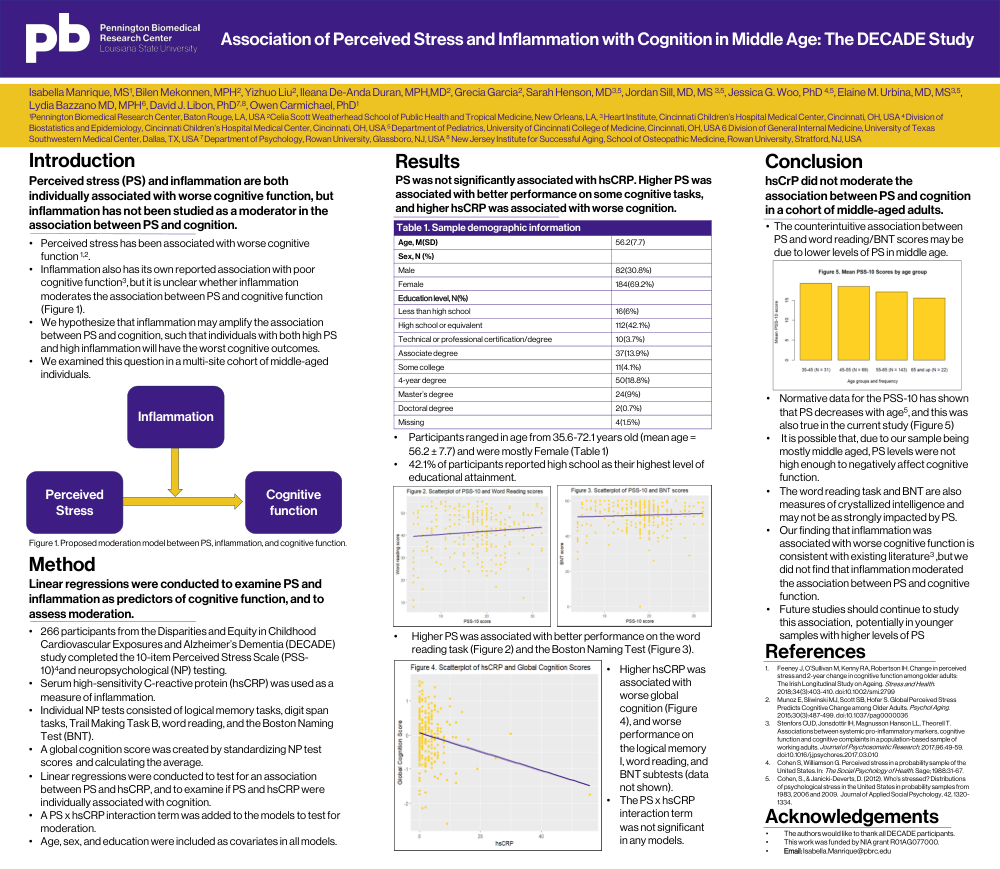
Association Of Perceived Stress And Inflammation With Cognition In Middle Age: The DECADE Study
Poster Presenter
Authors
Isabella Manrique, Bilen Mekonnen, Yizhuo Liu, Ileana De-Anda Duran, Grecia Garcia, Sarah Henson, Jordan Sill, Jessica G Woo, Elaine M. Urbina, Lydia Bazzano, David Libon, Owen Carmichael
Affiliations
Pennington Biomedical Research Center, Celia Scott Weatherhead School of Public Health and Tropical Medicine, Tulane University, Heart Institute, Cincinnati Children’s Hospital Medical Center, Department of Pediatrics, University of Cincinnati College of Medicine, Division of Biostatistics and Epidemiology, Cincinnati Children’s Hospital Medical Center, Department of Pediatrics, University of Cincinnati College of Medicine, Division of General Internal Medicine, University of Texas, Southwestern Medical Center, Department of Psychology, Rowan University, New Jersey Institute for Successful Aging, School of Osteopathic Medicine, Rowan University
Part of Topic
Introduction
Perceived stress (PS) and inflammation are both individually associated with worse cognitive function, but inflammation has not been studied as a moderator in the association between PS and cognition.
• Perceived stress has been associated with worse cognitive function 1,2.
• Inflammation also has its own reported association with poor cognitive function3, but it is unclear whether inflammation moderates the association between PS and cognitive function (Figure 1).
• We hypothesize that inflammation may amplify the association between PS and cognition, such that individuals with both high PS and high inflammation will have the worst cognitive outcomes.
• We examined this question in a multi-site cohort of middle-aged individuals
Method
Linear regressions were conducted to examine PS and inflammation as predictors of cognitive function, and to assess moderation
.• 266 participants from the Disparities and Equity in Childhood Cardiovascular Exposures and Alzheimer’s Dementia (DECADE) study completed the 10-item Perceived Stress Scale (PSS 10)4and neuropsychological (NP) testing.
• Serum high-sensitivity C-reactive protein (hsCRP) was used as a measure of inflammation.
• Individual NP tests consisted of logical memory tasks, digit span tasks, Trail Making Task B, word reading, and the Boston Naming Test (BNT).
• A global cognition score was created by standardizing NP test scores and calculating the average. • Linear regressions were conducted to test for an association between PS and hsCRP, and to examine if PS and hsCRP were individually associated with cognition.
• A PS x hsCRP interaction term was added to the models to test for moderation.
• Age, sex, and education were included as covariates in all models
Results
PS was not significantly associated with hsCRP. Higher PS was associated with better performance on some cognitive tasks, and higher hsCRP was associated with worse cognition.
• Participants ranged in age from 35.6-72.1 years old (mean age = 56.2 ± 7.7) and were mostly Female (Table 1)
• 42.1% of participants reported high school as their highest level of educational attainment.
• Higher PS was associated with better performance on the word reading task (Figure 2) and the Boston Naming Test (Figure 3)
• Higher hsCRP was associated with worse global cognition (Figure 4), and worse performance on the logical memory I, word reading, and BNT subtests (data not shown).
• The PS x hsCRP interaction term was not significant in any models
Conclusion
hsCrP did not moderate the association between PS and cognition in a cohort of middle-aged adults.
Normative data for the PSS-10 has shown that PS decreases with age5, and this was also true in the current study (Figure 5)
• It is possible that, due to our sample being mostly middle aged, PS levels were not high enough to negatively affect cognitive function.
• The word reading task and BNT are also measures of crystallized intelligence and may not be as strongly impacted by PS.
• Our finding that inflammation was associated with worse cognitive function is consistent with existing literature3 ,but we did not find that inflammation moderated the association between PS and cognitive function.
• Future studies should continue to study this association, potentially in younger samples with higher levels of PS
Comments
Email is required but is not shown publicly.
Loading comments...