4,068 posters, 219 videos, 101 topics, 69 sessions, 14,365 authors, 6,128 institutions
ePostersLive by SciGen Technologies S.A. All rights reserved.
Alzheimer's Association International Conference 2026
July 12-15, 2026 | London, United Kingdom, and Online

6437
Processing Of Real-world Soundscapes In Alzheimer’s Disease And Primary Progressive Aphasia
Part of Topic
Background:
The hippocampus and its connections work together to bind sensory data and their evolution over time into scenes, or ‘episodes’, as a core function of episodic memory [1-4].
Sounds always evolve over time, and are often ambiguous especially when embedded in scenes [1-2]. This suggests that auditory scene recognition might tap into processes at the interface of perception, episodic and semantic memory. However, naturalistic sound scene perception has not been studied much in relation to the hippocampus and its connections.
Syndromes of Alzheimer’s disease (AD) and language-led dementias (primary progressive aphasia, PPA) differentially affect regions of the hippocampus and its connections that would be involved in the temporal tracking and binding of sensory data into scenes [1,5,6-9].
Here, we assessed soundscape (naturalistic sound scene) processing and episodic memory retrieval in people with AD and PPA, and identified behavioural phenotypes in these canonical dementias.
Methods:
Participants: 19 AD, 7 logopenic variant PPA (LV), 7 semantic variant PPA (SV), 5 nonfluent variant PPA (NFV), and 15 age-matched healthy controls. Patients met diagnostic consensus criteria [10-11].
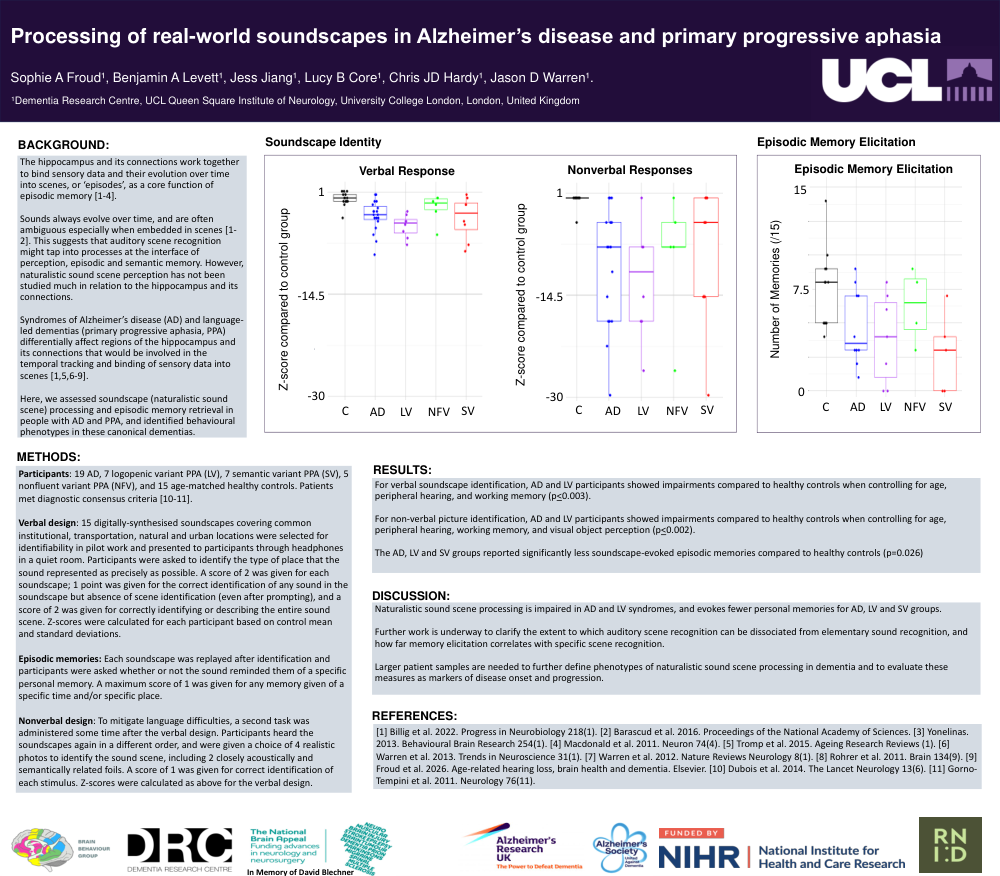
Verbal design: 15 digitally-synthesised soundscapes covering common institutional, transportation, natural and urban locations were selected for identifiability in pilot work and presented to participants through headphones in a quiet room. Participants were asked to identify the type of place that the sound represented as precisely as possible. A score of 2 was given for each soundscape; 1 point was given for the correct identification of any sound in the soundscape but absence of scene identification (even after prompting), and a score of 2 was given for correctly identifying or describing the entire sound scene. Z-scores were calculated for each participant based on control mean and standard deviations.
Episodic memories: Each soundscape was replayed after identification and participants were asked whether or not the sound reminded them of a specific personal memory. A maximum score of 1 was given for any memory given of a specific time and/or specific place.
Nonverbal design: To mitigate language difficulties, a second task was administered some time after the verbal design. Participants heard the soundscapes again in a different order, and were given a choice of 4 realistic photos to identify the sound scene, including 2 closely acoustically and semantically related foils. A score of 1 was given for correct identification of each stimulus. Z-scores were calculated as above for the verbal design.
Results:
For verbal soundscape identification, AD and LV participants showed impairments compared to healthy controls when controlling for age, peripheral hearing, and working memory (p<0.003).
For non-verbal picture identification, AD and LV participants showed impairments compared to healthy controls when controlling for age, peripheral hearing, working memory, and visual object perception (p<0.002).
The AD, LV and SV groups reported significantly less soundscape-evoked episodic memories compared to healthy controls (p=0.026)
Discussion:
Naturalistic sound scene processing is impaired in AD and LV syndromes, and evokes fewer personal memories for AD, LV and SV groups.
Further work is underway to clarify the extent to which auditory scene recognition can be dissociated from elementary sound recognition, and how far memory elicitation correlates with specific scene recognition.
Larger patient samples are needed to further define phenotypes of naturalistic sound scene processing in dementia and to evaluate these measures as markers of disease onset and progression.
References:
[1] Billig et al. 2022. Progress in Neurobiology 218(1). [2] Barascud et al. 2016. Proceedings of the National Academy of Sciences. [3] Yonelinas. 2013. Behavioural Brain Research 254(1). [4] Macdonald et al. 2011. Neuron 74(4). [5] Tromp et al. 2015. Ageing Research Reviews (1). [6] Warren et al. 2013. Trends in Neuroscience 31(1). [7] Warren et al. 2012. Nature Reviews Neurology 8(1). [8] Rohrer et al. 2011. Brain 134(9). [9] Froud et al. 2026. Age-related hearing loss, brain health and dementia. Elsevier. [10] Dubois et al. 2014. The Lancet Neurology 13(6). [11] Gorno-Tempini et al. 2011. Neurology 76(11).
Comments
Email is required but is not shown publicly.
Loading comments...