4,068 posters, 219 videos, 101 topics, 69 sessions, 14,365 authors, 6,128 institutions
ePostersLive by SciGen Technologies S.A. All rights reserved.
Alzheimer's Association International Conference 2026
July 12-15, 2026 | London, United Kingdom, and Online

8825
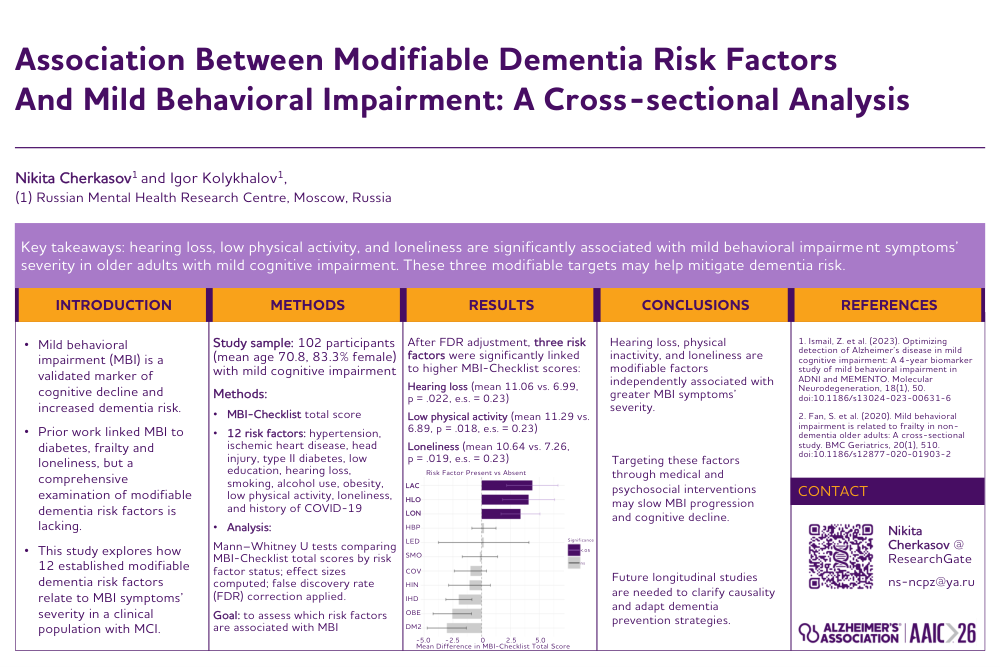
Association Between Modifiable Dementia Risk Factors And Mild Behavioral Impairment: A Cross-sectional Analysis
Poster Presenter
Authors
Affiliations
Part of Topic
Background: Mild behavioral impairment (MBI), characterized by persistent neuropsychiatric symptoms emerging in later life, has been established as a marker of cognitive decline and increased dementia risk (Ismail et al., 2016). Previous studies have identified associations between MBI and somatic factors such as diabetes, hearing loss, hyperlipidemia, and frailty (Soo et al., 2021; Gosselin et al., 2023; Fan et al., 2020), as well as loneliness (Matsuoka et al., 2024). However, the relationship between MBI and a comprehensive set of modifiable dementia risk factors remains underexplored. This study examines the relationship between twelve modifiable dementia risk factors and MBI severity in a clinical population.
Methods: We analyzed data from 102 elderly participants (age mean=70.8, SD=7.8 years; 83.3% female) with mild cognitive impairment (Petersen et al., 2004 criteria) assessed for dementia risk factors and MBI-Checklist. Twelve modifiable risk factors were evaluated: hypertension (HBP), ischemic heart disease (IHD), head injury (HIN), type 2 diabetes (DM2), low education (LED), hearing loss (HLO), smoking (SMO), alcohol use (ALC), obesity (OBE), low physical activity (LAC), loneliness (LON), and history of COVID-19 (COV). Non-parametric Mann-Whitney U tests assessed group differences in MBI scores by risk factor status, with effect sizes calculated and p-values adjusted for multiple comparisons using false discovery rate correction.
Results: Three risk factors demonstrated significant associations with elevated MBI-Checklist total scores after FDR adjustment. Participants with hearing loss (HLO) showed substantially higher MBI scores (mean=11.06, SD=9.03) compared to those without (mean=6.99, SD=8.39; p=.022, effect size=0.23). Similarly, low physical activity (LAC: mean=11.29 vs. 6.89; p=.018, effect size=0.23) and loneliness (LON: mean=10.64 vs. 7.26; p=.019, effect size=0.23) were associated with significantly higher MBI-Checklist scores.
Conclusion: Hearing loss, low physical activity, and loneliness demonstrate significant associations with increased MBI severity, highlighting potentially modifiable targets for behavioral interventions in populations at risk for dementia. Future longitudinal studies should examine whether addressing these risk factors modifies MBI progression and subsequent cognitive decline, potentially informing dementia prevention strategies.
Comments
Email is required but is not shown publicly.
Loading comments...