4,068 posters, 219 videos, 101 topics, 69 sessions, 14,365 authors, 6,128 institutions
ePostersLive by SciGen Technologies S.A. All rights reserved.
Alzheimer's Association International Conference 2026
July 12-15, 2026 | London, United Kingdom, and Online

6869
Cognitive Assessments Provide Limited Value In Predicting Progression To Amyloid Positivity In Cognitively Unimpaired aί- Older Adults
Poster Presenter
Authors
Bhargav Tallapragada, Shaun Markovic, Rosita Shishegar, Brook Galna, Belinda Brown, Simon Laws, Tenielle Porter, Yen Ying Lim, Samantha Burnham, Vincent Dore, Pierrick Bourgeat, Liang Jin, Christopher Rowe, Jurgen Fripp, James Doecke, Michael Weiner, Ralph Martins, John Morris, Colin Masters, Paul Maruff, Hamid Sohrabi
Affiliations
Centre for Healthy Ageing, Health Futures Institute, Murdoch University, Murdoch, Western Australia, Australia, Discipline of Psychology, Counselling and Criminology, Edith Cowan University, Joondalup, Western Australia, Australia, The Australian e-Health Research Centre, CSIRO, Melbourne, Australia, Collaborative Genomics and Translation Group, School of Medical and Health Sciences, Edith Cowan University, Joondalup, Western Australia, Australia, School of Psychological Sciences and Turner Institute for Brain and Mental Health, Monash University, Melbourne, Australia, The Australian e-Health Research Centre, CSIRO, Brisbane, Australia, Florey Institute of Neuroscience and Mental Health, Parkville, Melbourne, VIC, Australia, Department of Medicine, Austin Health, Heidelberg, VIC, Australia, Center for Imaging of Neurodegenerative Diseases, University of California-San Francisco, San Francisco, CA, USA, Department of Biomedical Sciences, Macquarie University, Sydney, New South Wales, Australia; Alzheimer’s Research Australia, Sarich Neuroscience Research Institute, Nedlands, Western Australia, Washington University School of Medicine, St. Louis, Missouri, USA, University of Western Australia Medical School, University of Western Australia, 35 Stirling Highway, Perth, WA, 6009, Australia; Alzheimer’s Research Australia, Sarich Neuroscience Research Institute, Nedlands, Western Australia, Florey Institute of Neuroscience and Mental Health, Parkville, Melbourne, VIC, Australia; Cogstate Ltd, Melbourne, VIC, Australia, Centre for Healthy Ageing, Health Futures Institute, Murdoch University, Murdoch, Western Australia, Australia; Alzheimer’s Research Australia, Sarich Neuroscience Research Institute, Nedlands, Western Australia
Part of Topic
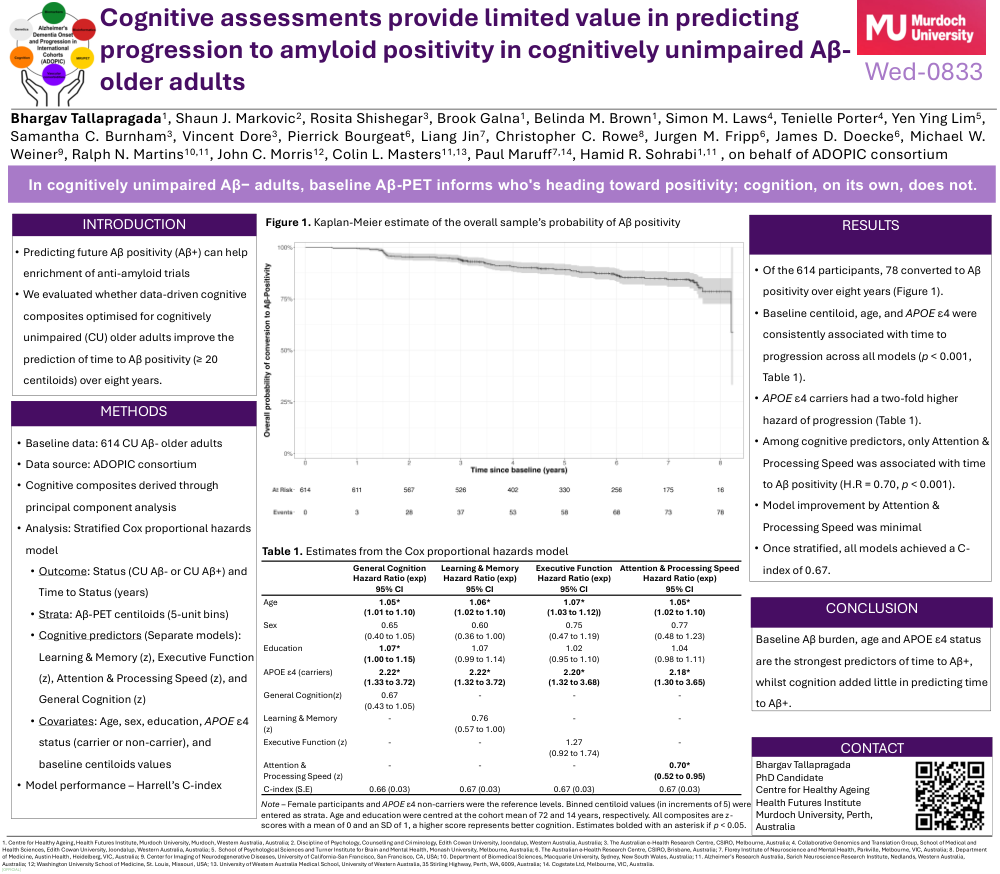
Background: Predicting progression to Amyloid-β (Aβ) positivity in cognitively unimpaired (CU) Aβ- older adults can facilitate enrichment of the emerging anti-amyloid trials. We evaluated whether data-driven cognitive composites are associated with the hazard of progression to Aβ positivity (≥20 centiloids) over eight years.
Methods: Baseline data of 614 CU Aβ- older adults was obtained from the ADOPIC consortium. Complete data consisted of event status (converted to Aβ+, remained Aβ- [censored]) and time to event (years). Covariates included age, sex, education, APOE ε4 status, baseline centiloid values, and four cognitive composites (learning and memory, executive function, attention and processing speed, and general cognition) derived from principal component analysis. To assess the independent contribution of cognition to progression risk while accounting for baseline Aβ burden, stratified Cox models were with centiloid values binned in 5-unit increments as strata. Separate models were fit for each cognitive composite along with demographics and APOE ε4 status. Model discriminatory performance for time to progression to Aβ positivity was assessed using the Concordance index (C-index).
Results: Of the 614 participants, 78 converted to Aβ-positivity over eight years (Figure 1). After stratifying by baseline centiloid, age and APOE ε4 status were consistently associated with time to progression across all models (p < 0.001, Table 1). Each additional year of age increased the hazard of progression by (HR = 1.05 to 1.07). APOE ε4 carriers showed approximately two-fold higher hazard of progression. Among cognitive composites, attention and processing speed was significantly associated with reduced progression risk. A 1-SD increase in the baseline attention and processing speed reduced the hazard by 30% (HR = 0.70, p < 0.001). Learning and memory showed a trend towards reduced hazard (HR = 0.76, p = 0.05). General cognition and executive function were not significantly associated with progression risk. All models achieved a C-index of 0.67.
Conclusion: After accounting for baseline Aβ burden, most cognitive measures showed no associations in predicting the hazard of progression to Aβ positivity in CU older adults beyond age and APOE ε4. However, attention and processing speed emerged as a significant protective factor, though its incremental value appears modest.
Comments
Email is required but is not shown publicly.
Loading comments...