4,068 posters, 219 videos, 101 topics, 69 sessions, 14,365 authors, 6,128 institutions
ePostersLive by SciGen Technologies S.A. All rights reserved.
Alzheimer's Association International Conference 2026
July 12-15, 2026 | London, United Kingdom, and Online

5537
Scam Susceptibility, Objective Subtle Cognitive Difficulties, And Mild Cognitive Impairment
Poster Presenter
Part of Topic
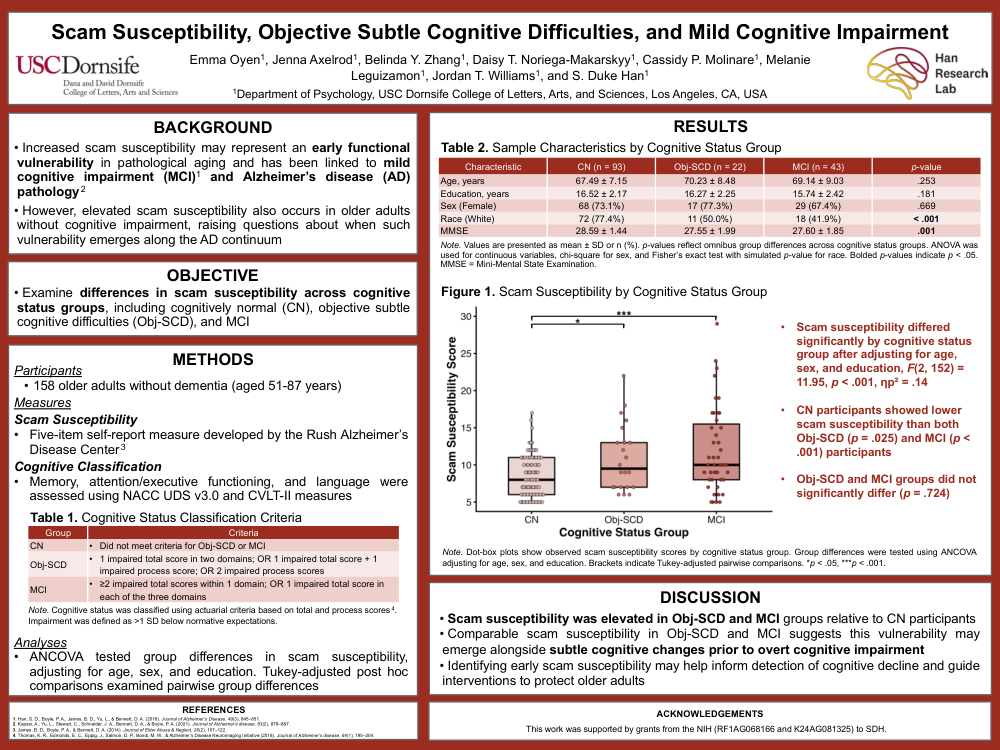
Background: Increased susceptibility to scams may represent an early functional vulnerability due to pathological aging. Prior work has linked scam susceptibility to mild cognitive impairment (MCI) and to Alzheimer’s disease (AD)-related neurodegeneration. However, many older adults show elevated scam susceptibility in the absence of cognitive impairment, raising questions about when such vulnerability emerges along the AD continuum. To address this, we examined group differences in scam susceptibility across cognitive status groups, including cognitively normal (CN), objective subtle cognitive difficulties (obj-SCD), and MCI.
Method: One hundred fifty-eight community-dwelling, non-demented older adults (mean age = 68.3±7.9 years; mean education = 16.3±2.3 years; 72.2% female; 63.9% White, 16.5% Asian, 10.8% Black or African American, 5.1% Mixed Race, 3.8% Other; mean MMSE = 28.2±1.7) completed a five-item self-report measure of susceptibility to scams and a neuropsychological battery assessing domains of memory, attention/executive functioning, and language. Cognitive status was classified using actuarial criteria, with impairment defined as >1 standard deviation below normative expectations. Participants were classified as MCI if they had at least two impaired test scores within a domain or one impaired test score across all three domains. Participants were classified as obj-SCD if they had one impaired test score in two different domains, one impaired test score and one impaired process score, or two impaired process scores. Group differences in scam susceptibility were examined using ANCOVA adjusting for age, sex, and education, with Tukey-adjusted post hoc comparisons.
Results: There was a significant effect of cognitive group on scam susceptibility after adjusting for covariates (p<.001). Post hoc Tukey comparisons indicated that CN participants exhibited significantly lower scam susceptibility than both the obj-SCD (p=.025) and MCI (p<.001) groups, whereas the obj-SCD and MCI groups did not significantly differ (p=.724).
Conclusion: Scam susceptibility was elevated in the obj-SCD group and remained comparably high in the MCI group, relative to CN participants, suggesting that increased scam susceptibility may emerge in the obj-SCD stage prior to clinical cognitive impairment. Identifying such changes may inform early detection of future cognitive decline and guide interventions to protect older adults from financial and emotional consequences of scams.
Comments
Email is required but is not shown publicly.
Loading comments...