4,068 posters, 219 videos, 101 topics, 69 sessions, 14,365 authors, 6,128 institutions
ePostersLive by SciGen Technologies S.A. All rights reserved.
Alzheimer's Association International Conference 2026
July 12-15, 2026 | London, United Kingdom, and Online

1419
Prospective Memory Predicts Everyday Functioning Over And Above Retrospective Memory In Mild Cognitive Impairment
Poster Presenter
Authors
Jordan Kozuki, Lily Wilkin, Omar Alcaraz, Ling Sar, Chris Miller, Matthew Wright, Nupur Hajela, Ellen Woo
Affiliations
University of California, San Diego; California State University, Fresno, California State University, Fresno, California State University, Fresno; University of California, San Francisco
Part of Topic
Background: Prospective memory (PM) the ability to remember to carry out a planned action in the future (e.g., taking medication before or after a meal), is important for maintaining independence in everyday life. Retrospective memory, which involves recalling information from the past, also impacts everyday functioning in mild Alzheimer's disease. Individuals with mild cognitive impairment (MCI) often experience difficulties with PM. The current study examines the role of PM subtypes in everyday functioning, beyond retrospective memory, in healthy aging and MCI.
Participants: Participants included healthy older adults (n = 58) and persons with MCI (n = 52). There were no significant group differences in age, F(1, 108) = .71, p > .05, or education, F(1, 108) = .11, p > .05.
Procedures: Before completing a neuropsychological battery, participants were told to request a specific number of pills after each individual test was completed. Simple PM was measured by participants requesting a pill after each test. Complex PM was calculated by the correct number of times participants requested one pill after a memory task and two pills after a non-memory task. A composite score for Retrospective Memory was created using the long-delayed recall trials of the California Verbal Learning Test-II (CVLT-II) and the Brief Visuospatial Memory Test-Revised (BVMT-R). Everyday functioning was measured using the Everyday Cognition Scales (ECog). The ECog organizes everyday functioning into seven domain-specific factors: memory, language, visuo-spatial, planning, organization, divided attention, and information processing speed abilities, as well as total everyday functioning abilities.
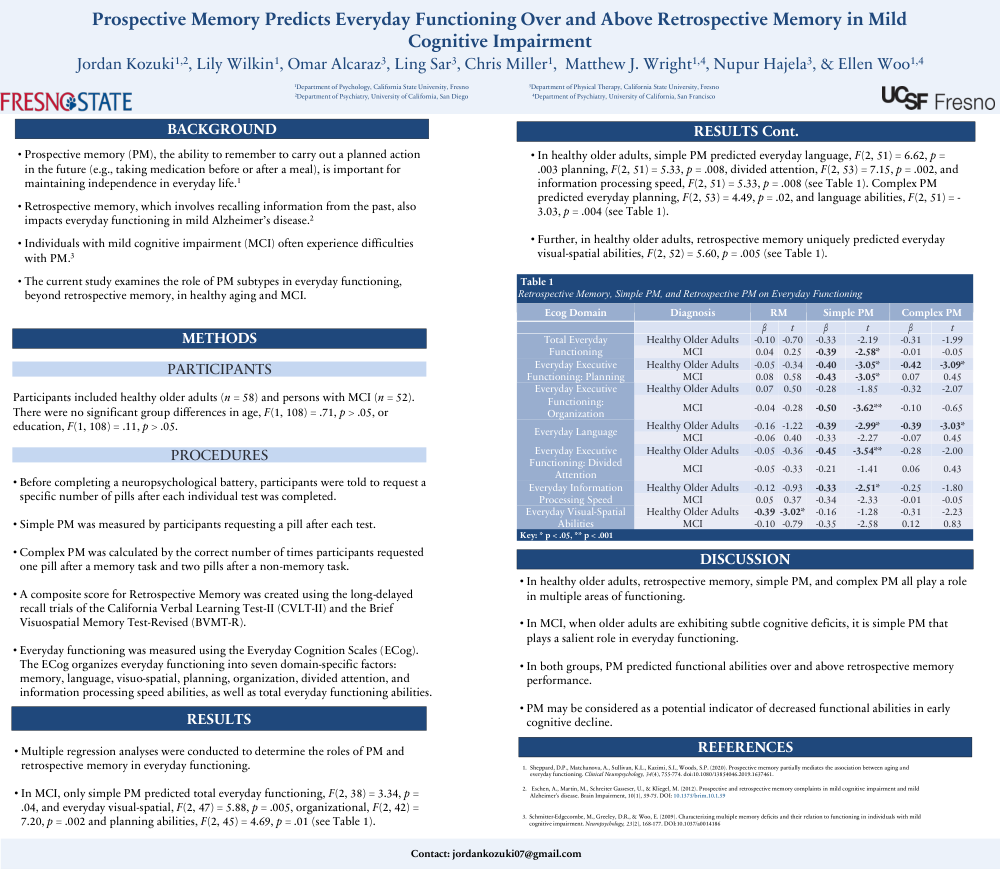
Results: Multiple regression analyses were conducted to determine the roles of PM and retrospective memory in everyday functioning. In MCI, only simple PM predicted total everyday functioning, F(2, 38) = 3.34, p = .04, and everyday visual-spatial, F(2, 47) = 5.88, p = .005, organizational, F(2, 42) = 7.20, p = .002 and planning abilities, F(2, 45) = 4.69, p = .01 (see Table 1). In healthy older adults, simple PM predicted everyday language, F(2, 51) = 6.62, p = .003 planning, F(2, 51) = 5.33, p = .008, divided attention, F(2, 53) = 7.15, p = .002, and information processing speed, F(2, 51) = 5.33, p = .008 (see Table 1). Complex PM predicted everyday planning, F(2, 53) = 4.49, p = .02, and language abilities, F(2, 51) = -3.03, p = .004 (see Table 1). Further, in healthy older adults, retrospective memory uniquely predicted everyday visual-spatial abilities, F(2, 52) = 5.60, p = .005 (see Table 1).
Discussion: In healthy older adults, retrospective memory, simple PM, and complex PM all play a role in multiple areas of functioning. In MCI, when older adults are exhibiting subtle cognitive deficits, it is simple PM that plays a salient role in everyday functioning. In both groups, PM predicted functional abilities over and above retrospective memory performance. PM may be considered as a potential indicator of decreased functional abilities in early cognitive decline.
Comments
Email is required but is not shown publicly.
Loading comments...