4,068 posters, 219 videos, 101 topics, 69 sessions, 14,365 authors, 6,128 institutions
ePostersLive by SciGen Technologies S.A. All rights reserved.
Alzheimer's Association International Conference 2026
July 12-15, 2026 | London, United Kingdom, and Online

4438
Familiar Olfactory Stimulation Enhances Self-consciousness In Alzheimer’s Disease
Part of Topic
Aquí está todo el texto del póster en orden para pegar:
Familiar Olfactory Stimulation Enhances Self-consciousness in Alzheimer's Disease
María Alejandra Castro Arbeláez¹,², Eva María Arroyo-Anlló¹,², María Leonor Rengifo³, Ivanovna Milqueya de La Cruz⁴
¹ University of Salamanca, ² Institute of Neurosciences of Castilla y León, ³ Universidad de La Sabana, ⁴ Pontificia Universidad Católica Madre y Maestra
Key Message
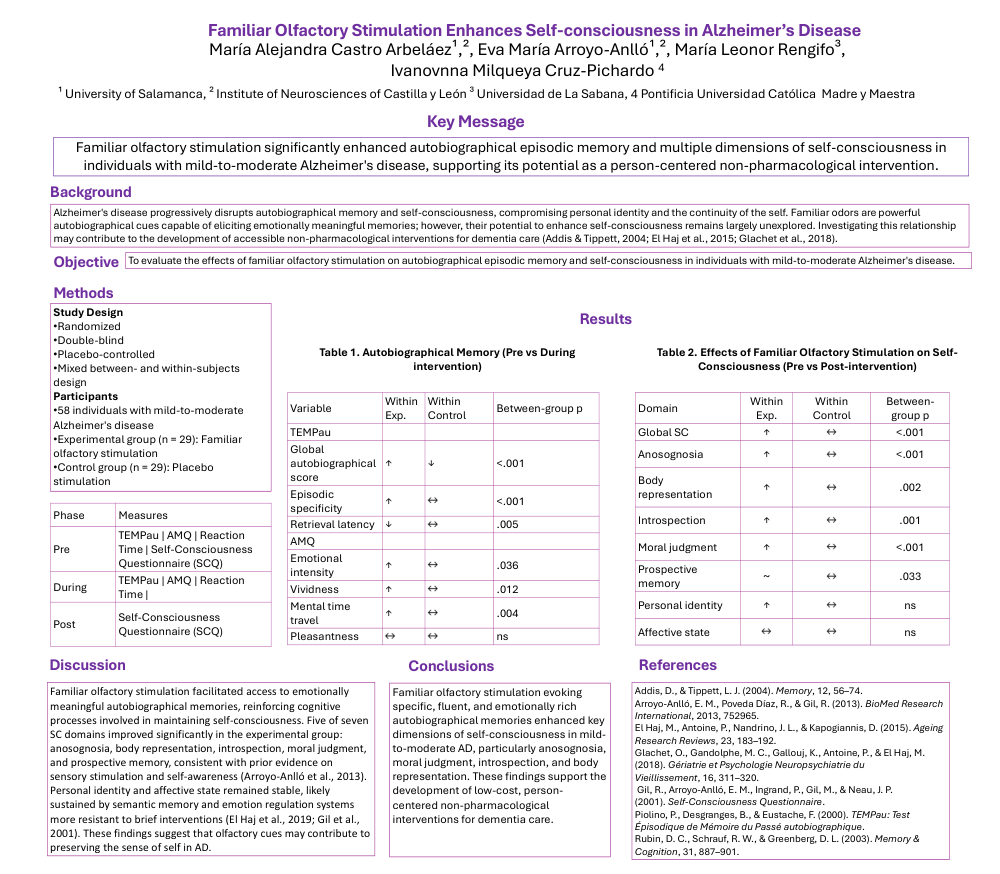
Familiar olfactory stimulation significantly enhanced autobiographical episodic memory and multiple dimensions of self-consciousness in individuals with mild-to-moderate Alzheimer's disease, supporting its potential as a person-centered non-pharmacological intervention.
Background
Alzheimer's disease progressively disrupts autobiographical memory and self-consciousness, compromising personal identity and the continuity of the self. Familiar odors are powerful autobiographical cues capable of eliciting emotionally meaningful memories; however, their potential to enhance self-consciousness remains largely unexplored. Investigating this relationship may contribute to the development of accessible non-pharmacological interventions for dementia care (Addis & Tippett, 2004; El Haj et al., 2015; Glachet et al., 2018).
Objective
To evaluate the effects of familiar olfactory stimulation on autobiographical episodic memory and self-consciousness in individuals with mild-to-moderate Alzheimer's disease.
Methods
Study Design: Randomized, Double-blind, Placebo-controlled, Mixed between- and within-subjects design.
Participants: 58 individuals with mild-to-moderate Alzheimer's disease. Experimental group (n=29): Familiar olfactory stimulation. Control group (n=29): Placebo stimulation.
| Phase | Measures |
|---|---|
| Pre | |TEMPau, AMQ, Reaction Time|Self-Consciousness Questionnaire (SCQ) |
| During | TEMPau, AMQ, Reaction Time |
| Post | Self-Consciousness Questionnaire (SCQ) |
Results
Table 1. Autobiographical Memory (Pre vs During intervention)
| Variable | Within Exp. | Within Control | Between-group p |
|---|---|---|---|
| TEMPau | |||
| Global autobiographical score | ↑ | ↓ | <.001 |
| Episodic specificity | ↑ | ↔ | <.001 |
| Retrieval latency | ↓ | ↔ | .005 |
| AMQ | |||
| Emotional intensity | ↑ | ↔ | .036 |
| Vividness | ↑ | ↔ | .012 |
| Mental time travel | ↑ | ↔ | .004 |
| Pleasantness | ↔ | ↔ | ns |
Table 2. Effects of Familiar Olfactory Stimulation on Self-Consciousness (Pre vs Post-intervention)
| Domain | Within Exp. | Within Control | Between-group p |
|---|---|---|---|
| Global SC | ↑ | ↔ | <.001 |
| Anosognosia | ↑ | ↔ | <.001 |
| Body representation | ↑ | ↔ | .002 |
| Introspection | ↑ | ↔ | .001 |
| Moral judgment | ↑ | ↔ | <.001 |
| Prospective memory | ~ | ↔ | .033 |
| Personal identity | ↑ | ↔ | ns |
| Affective state | ↔ | ↔ | ns |
Discussion
Familiar olfactory stimulation facilitated access to emotionally meaningful autobiographical memories, reinforcing cognitive processes involved in maintaining self-consciousness. Five of seven SC domains improved significantly in the experimental group: anosognosia, body representation, introspection, moral judgment, and prospective memory, consistent with prior evidence on sensory stimulation and self-awareness (Arroyo-Anlló et al., 2013). Personal identity and affective state remained stable, likely sustained by semantic memory and emotion regulation systems more resistant to brief interventions (El Haj et al., 2019; Gil et al., 2001). These findings suggest that olfactory cues may contribute to preserving the sense of self in AD.
Conclusions
Familiar olfactory stimulation evoking specific, fluent, and emotionally rich autobiographical memories enhanced key dimensions of self-consciousness in mild-to-moderate AD, particularly anosognosia, moral judgment, introspection, and body representation. These findings support the development of low-cost, person-centered non-pharmacological interventions for dementia care.
References
Addis, D., & Tippett, L. J. (2004). Memory, 12, 56–74.
Arroyo-Anlló, E. M., Poveda Díaz, R., & Gil, R. (2013). BioMed Research International, 2013, 752965.
El Haj, M., Antoine, P., Nandrino, J. L., & Kapogiannis, D. (2015). Ageing Research Reviews, 23, 183–192.
Glachet, O., Gandolphe, M. C., Gallouj, K., Antoine, P., & El Haj, M. (2018). Gériatrie et Psychologie Neuropsychiatrie du Vieillissement, 16, 311–320.
Gil, R., Arroyo-Anlló, E. M., Ingrand, P., Gil, M., & Neau, J. P. (2001). Self-Consciousness Questionnaire.
Piolino, P., Desgranges, B., & Eustache, F. (2000). TEMPau.
Rubin, D. C., Schrauf, R. W., & Greenberg, D. L. (2003). Memory & Cognition, 31, 887–901.
Comments
Email is required but is not shown publicly.
Loading comments...