4,068 posters, 219 videos, 101 topics, 69 sessions, 14,365 authors, 6,128 institutions
ePostersLive by SciGen Technologies S.A. All rights reserved.
Alzheimer's Association International Conference 2026
July 12-15, 2026 | London, United Kingdom, and Online

5395
Cross-sectional Association Between Components Of MCR Syndrome And Sociodemographic And Neurocognitive Measures
Poster Presenter
Authors
Affiliations
Part of Topic
Abstract:
Background: Motoric Cognitive Risk (MCR) is a syndrome characterized by subjective
cognitive complaints (SCCs) and slow gait speed in the absence of cognitive impairment and
preserved activities of daily living (Verghese et al., 2012). MCR is associated with cognitive
impairment (Doi et al., 2017) and dementia (Verghese et al., 2012). Their individual
components could be independently associated with cognitive decline (Morris et al., 2016;
Pike et al., 2022). The associations between cognition and sociodemographic variables and
MCR components were explored.
Methods: 287 participants from the Compostela Ageing Study in pre-clinical stages were
selected. SCCs presence was confirmed using the short version of “Questionnaire d’autoevaluation
de la Memorie” (QAM; Pereiro et al., 2021a). Gait speed was measured using the
“Timed-Up & Go” test (Pereiro et al., 2021b). Participants were classified into four groups
based on whether or not they met the MCR criteria: A) presence of both MCR criteria (MCR:
yes SCCs, yes Gait-slowed), B) absence of both MCR criteria (no-MCR: no SCCs, no Gaitslowed),
C) only SCCs presence (SCCs-no-MCR: yes SCCs, no Gait-slowed), D) only slowed
Gait (Gait-no-MCR: no SCCs, yes Gait-slowed). Sociodemographic and Cognitive measures
were compared across groups using HKruskal-Wallis.
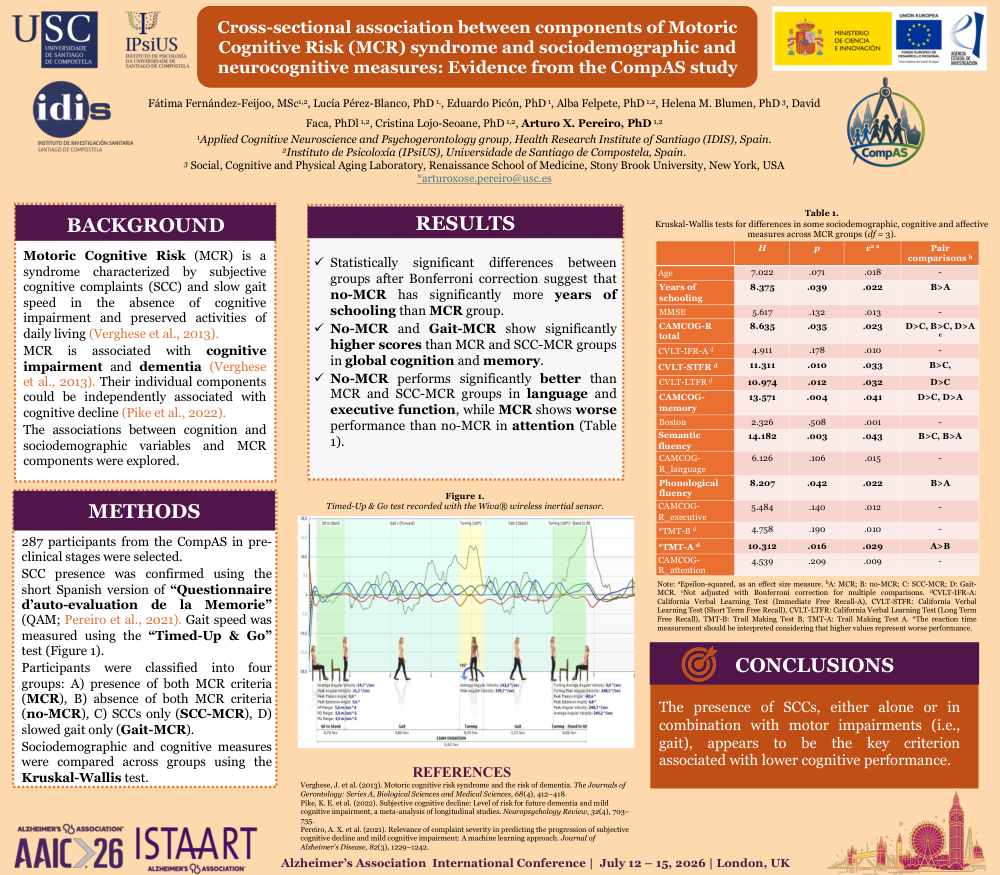
Results: Statistically significant differences between groups after Bonferroni correction
suggest that no-MCR has significantly more years of schooling than MCR group. No-MCR and
Gait-no-MCR show significantly higher scores than MCR and SCC-no-MCR groups in global
cognition and memory. No-MCR performs significantly better than MCR and SCC-no-MCR
groups in language and executive function, while MCR shows a worse performance than no-
MCR in executive function (see Table 1).
Conclusion: Higher levels of years of education were observed in participants with no-MCR
compared to MCR participants. MCR and SCC-no-MCR groups showed lower global cognition,
memory, language, executive function, and attention compared to no-MCR and Gait-no-MCR
groups. The presence of SCCs, even when not accompanied by motor symptoms, seems to be
more determining in characterizing poorer cognitive performance in preclinical stages.
Comments
Email is required but is not shown publicly.
Loading comments...