4,068 posters, 219 videos, 101 topics, 69 sessions, 14,365 authors, 6,128 institutions
ePostersLive by SciGen Technologies S.A. All rights reserved.
Alzheimer's Association International Conference 2026
July 12-15, 2026 | London, United Kingdom, and Online

3338
Assessment Of A Diagnostic Strategy To Detect Cognitive Impairment In Primary Care: A Prospective Multicentric Study
Poster Presenter
Part of Topic
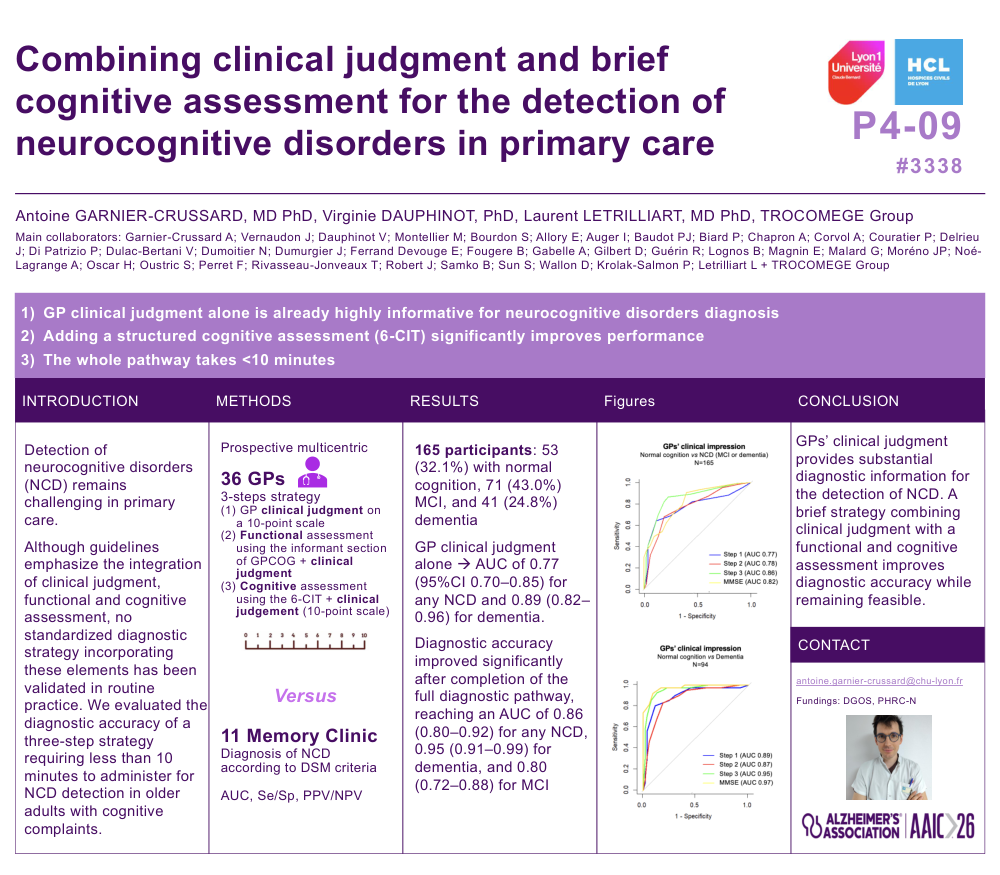
Background: Detection of neurocognitive disorders (NCD) remains challenging in primary care. Although guidelines emphasize the integration of clinical judgment, functional and cognitive assessment, no standardized diagnostic strategy incorporating these elements has been validated in routine practice. We evaluated the diagnostic accuracy of a three-step strategy requiring less than 10 minutes to administer for NCD detection in older adults with cognitive complaints.
Methods: In this prospective multicentre study, 36 general practitioners (GPs) across France enrolled adults aged ≥65 years presenting with cognitive complaints. The diagnostic strategy included: (1) GP clinical judgment assessed on a 10-point scale, (2) functional assessment using the informant section of the General Practitioner Assessment of Cognition (GPCOG), and (3) cognitive assessment using the Six-Item Cognitive Impairment Test (6-CIT). All participants underwent a multidisciplinary assessment in one of 11 tertiary memory clinics. The reference standard was a DSM-5 diagnosis of mild or major NCD. Diagnostic accuracy was assessed using receiver operating characteristic curves and area under the curve (AUC).
Findings: Among 165 participants who completed the study, 53 (32.1%) had normal cognition, 71 (43.0%) had mild cognitive impairment, and 41 (24.8%) had dementia. GP clinical judgment alone achieved an AUC of 0.77 (95% CI 0.70–0.85) for detecting any NCD and 0.89 (0.82–0.96) for detecting dementia. Diagnostic accuracy improved significantly after completion of the full diagnostic pathway, reaching an AUC of 0.86 (0.80–0.92) for any NCD, 0.95 (0.91–0.99) for dementia, and 0.80 (0.72–0.88) for mild cognitive impairment.
Interpretation: GPs’ clinical judgment provides substantial diagnostic information for the detection of NCD. A brief strategy combining clinical judgment with a cognitive assessment further improves diagnostic accuracy while remaining feasible within routine consultations. These findings support a diagnostic approach anchored in GP clinical expertise and may inform future recommendations for NCD detection and referral in primary care.
Comments
Email is required but is not shown publicly.
Loading comments...