4,068 posters, 219 videos, 101 topics, 69 sessions, 14,365 authors, 6,128 institutions
ePostersLive by SciGen Technologies S.A. All rights reserved.
Alzheimer's Association International Conference 2026
July 12-15, 2026 | London, United Kingdom, and Online

10189
Revisiting Modifiable Risk Factors For Alzheimer's Disease: Evidence From Mendelian Randomization
Poster Presenter
Authors
Leona Knüsel, Isabelle F. Foote, Nicolas Goss, Jacques Fellay, Zoltán Kutalik
Affiliations
Department of Computational Biology, University of Lausanne, Lausanne, Switzerland; Swiss Institute of Bioinformatics, Lausanne, Switzerland, Centre for Preventive Neurology, Wolfson Institute of Population Health, Queen Mary University of London, London, UK; Academic Centre for Healthy Ageing, Whipps Cross Hospital, Barts Health NHS Trust, London, UK, Department of Computational Biology, University of Lausanne, Lausanne, Switzerland; Swiss Institute of Bioinformatics, Lausanne, Switzerland; Metabolomics and Lipidomics Platform, University of Lausanne, Lausanne, Switzerland, School of Life Sciences, Ecole Polytechnique Fédérale de Lausanne, Lausanne, Switzerland; Precision Medicine Unit, Lausanne University Hospital and University of Lausanne, Lausanne, Switzerland, Department of Computational Biology, University of Lausanne, Lausanne, Switzerland; Swiss Institute of Bioinformatics, Lausanne, Switzerland; University Center for Primary Care and Public Health, Lausanne, Switzerland
Part of Topic
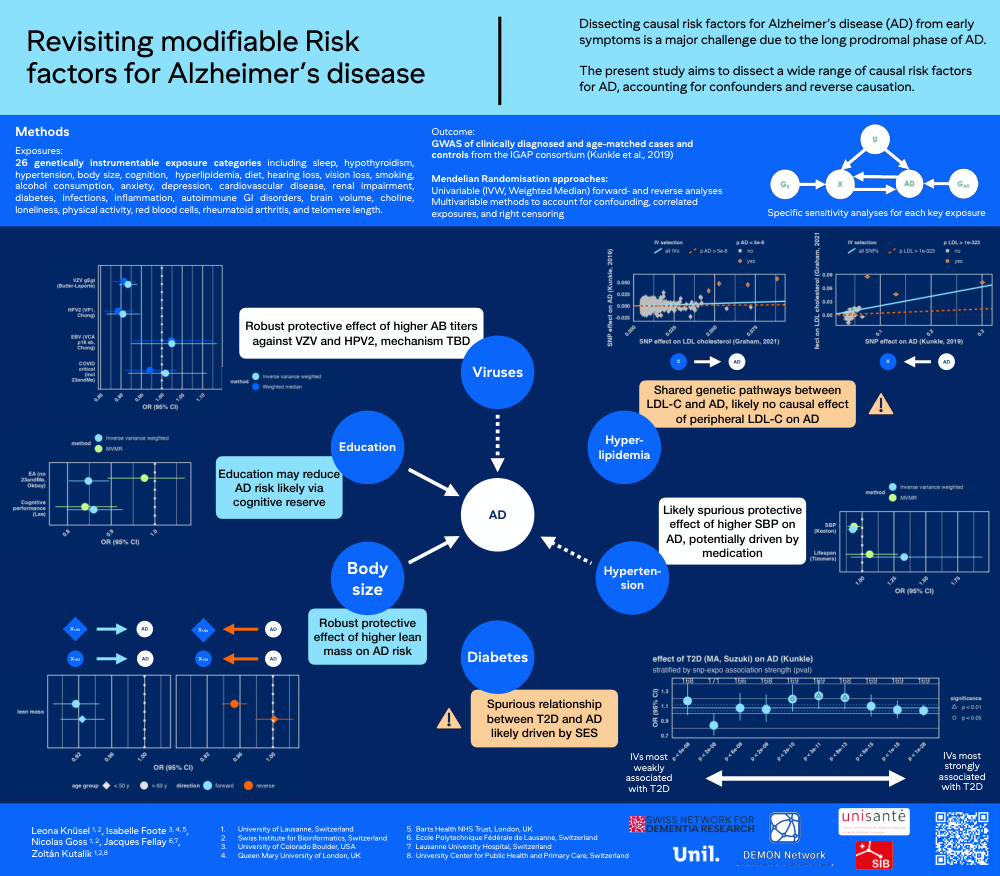
INTRODUCTION: Risk factors for Alzheimer’s disease (AD) remain poorly understood, largely due to confounders, competing risk, and reverse causation. We addressed these challenges using genetically informed methods.
METHODS: We considered 26 risk factors and applied Mendelian Randomization followed by tailored sensitivity analyses for key factors.
RESULTS: We found that higher immunity against the Varicella Zoster Virus and the Human Polyomavirus 2 independently reduce AD risk. Whilst replicating the protective effect of education against AD, we present evidence against a causal effect of numerous other proposed risk factors: Removing four LDL-C instruments attenuated the association between LDL-C and AD to null. The seemingly risk-increasing effect of Type 2 Diabetes is likely driven by socioeconomic confounders, and age-stratified analyses did not yield evidence for obesity increasing AD risk, but for lean mass reducing it.
DISCUSSION: Our results challenge several previously proposed risk factors and confirm, refine or reveal others, advancing AD epidemiology.
Comments
Email is required but is not shown publicly.
Loading comments...