4,068 posters, 219 videos, 101 topics, 69 sessions, 14,365 authors, 6,128 institutions
ePostersLive by SciGen Technologies S.A. All rights reserved.
Alzheimer's Association International Conference 2026
July 12-15, 2026 | London, United Kingdom, and Online

3156
Apathy And Reward Systems In Late-life Depression And Very Mild Alzheimer's Disease
Poster Presenter
Part of Topic
Late-life depression (LLD) increases the risk of Alzheimer’s disease (AD). Apathy is a symptom of LLD that often precedes and co-occurs with AD, and is defined as a reduction in motivation for goal-directed behavior. More recently, apathy has been conceptualized within a reward-processing framework, though its underlying neural mechanisms remain poorly understood. It is also unclear whether apathy in LLD and AD reflect shared or distinct neurobiological substrates. Clarifying these mechanisms has important implications for treating apathy during the earliest stages of AD.
We examined the clinical and neurobiological correlates of apathy in three groups of older adults: (1) seniors with LLD without dementia (n = 22), (2) seniors with mild cognitive impairment (MCI) or very early AD (n = 12), and (3) non-depressed seniors without dementia (n = 22). Subjects completed a detailed clinical evaluation that included reward-related decision making (Iowa Gambling Task; IGT) and the Apathy Evaluation Scale (AES). Participants also completed structural and functional MRI (fMRI), including a decision-making task involving both social and monetary rewards.
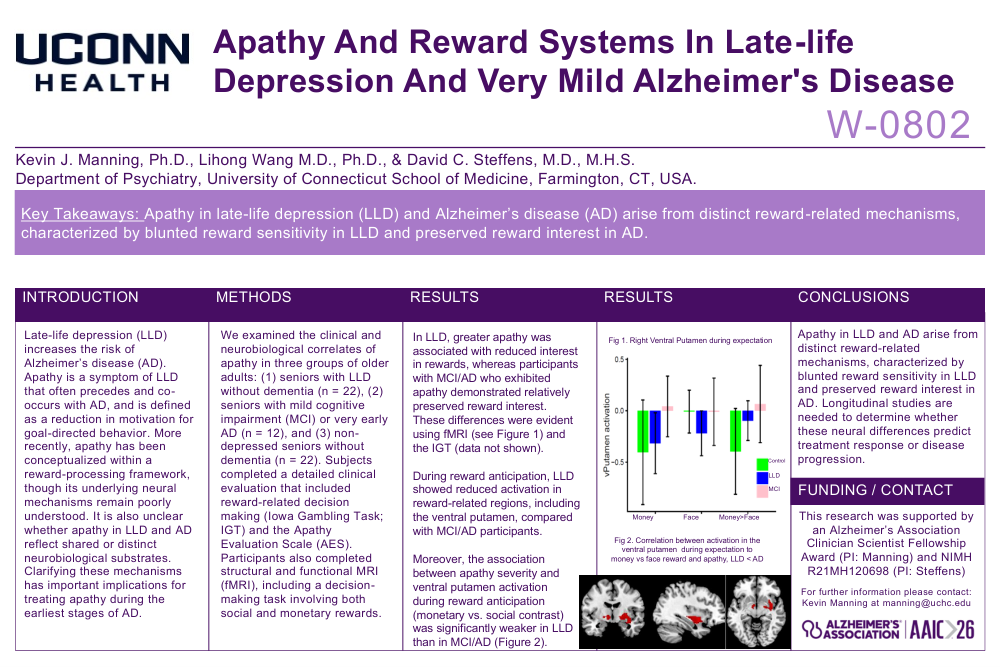
In LLD, greater apathy was associated with reduced interest in rewards, whereas participants with MCI/AD who exhibited apathy demonstrated relatively preserved reward interest. These differences were evident using fMRI (see Figure 1) and the IGT (data not shown).
During reward anticipation, LLD showed reduced activation in reward-related regions, including the ventral putamen, compared with MCI/AD participants.
Moreover, the association between apathy severity and ventral putamen activation during reward anticipation (monetary vs. social contrast) was significantly weaker in LLD than in MCI/AD (Figure 2).
Apathy in LLD and AD arise from distinct reward-related mechanisms, characterized by blunted reward sensitivity in LLD and preserved reward interest in AD. Longitudinal studies are needed to determine whether these neural differences predict treatment response or disease progression.
Comments
Email is required but is not shown publicly.
Loading comments...