4,068 posters, 219 videos, 101 topics, 69 sessions, 14,365 authors, 6,128 institutions
ePostersLive by SciGen Technologies S.A. All rights reserved.
Alzheimer's Association International Conference 2026
July 12-15, 2026 | London, United Kingdom, and Online

5723
Verbal Fluency Performance As A Marker Of Early Cognitive Impairment In Tanzania: A Pilot And Validation Study From The Akili Mali Project
Poster Presenter
Authors
Laura Wright, Roberta Strasenburgh, Joseph Bews, Lachlan Fotheringham, Aloyce Kisoli, Judith Boshe, Damas Andrea, Amour Mkubila, Grace Anderson Saria, Ssenku Safic, Raj Kalaria, Louise Robinson, Bernard Mbwele, Stella Paddick
Affiliations
Newcastle University, Newcastle upon Tyne, United Kingdom, Cumbria, Northumberland, Tyne and Wear NHS Foundation Trust, Newcastle upon Tyne, United Kingdom, Kilimanjaro Clinical Research Institute, Moshi, Tanzania, Mirembe National Mental Health Hospital, Dodoma, Tanzania, Anderson Memorial Rehabilitation and Care Organisation, Moshi, Tanzania, Fight Dementia and Care Organisation, Arusha, Tanzania, University of Dar es Salaam-Mbeya College of Health Sciences, Mbeya, Tanzania, Newcastle University, Newcastle upon Tyne, United Kingdom; Gateshead Health NHS Foundation Trust, Gateshead, United Kingdom
Part of Topic
Video
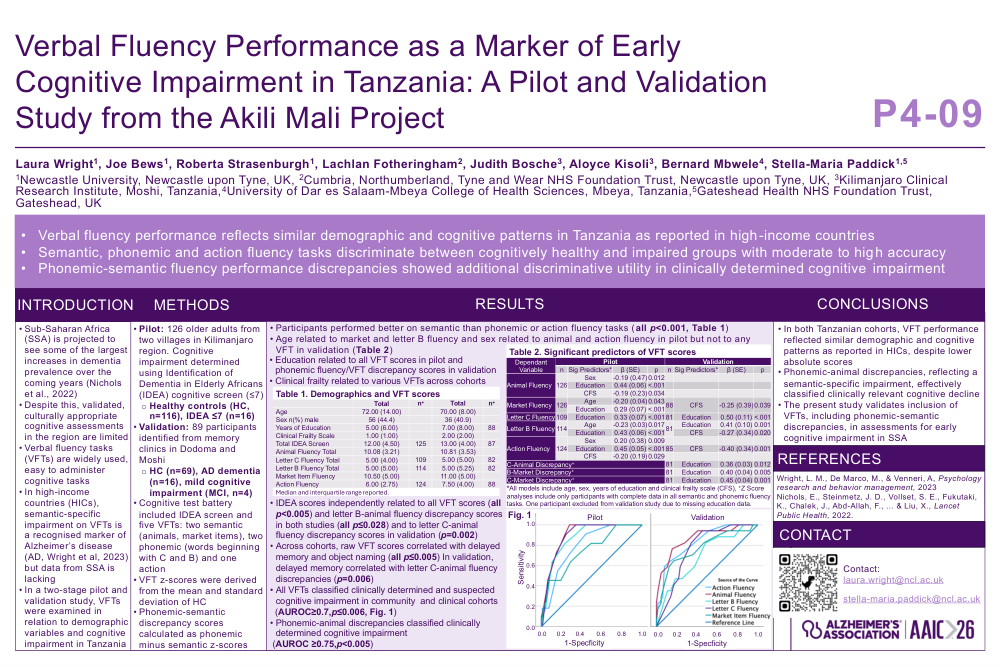
Background: Semantic-specific impairment on verbal fluency tasks (VFTs) is a recognised marker of Alzheimer’s disease. However, most research has been conducted in high-income countries (HICs), with limited data from Sub-Saharan Africa. In a two-stage pilot and validation study, VFTs were examined in relation to demographic variables and cognitive impairment in Tanzania.
Methods: In a community pilot study, older adults (n=131) from the Hai district, Kilimanjaro completed a neuropsychological battery including the IDEA screen and five VFTs: two semantic (animals, market items), two phonemic (words beginning with C and B), one action. Suspected cognitive impairment was determined according to IDEA score cut-offs (≤7). An additional validation cohort including cognitively healthy participants (n=71), patients with mild cognitive impairment (n=4) or probable Alzheimer’s dementia (n=16), were recruited through memory clinics in Dodoma and Moshi. In each study, VFT z-scores were derived from the mean and standard deviation of cognitively healthy participants (IDEA>7) recruited from the same region. Phonemic-semantic discrepancy scores were calculated as phonemic minus semantic z-scores.
Results: Across cohorts, participants performed better on semantic than phonemic or action fluency (p<0.001). All VFTs correlated with education, frailty and total IDEA scores in both cohorts (p<0.015). Age correlated with all VFTs in the community sample (p<0.005) and with animal, market and letter B fluency (p<0.02) in the validation cohort. IDEA scores correlated with letter B-animal fluency discrepancy scores in both cohorts (p≤0.030) and letter C-animal fluency discrepancy scores in the validation cohort (p=0.005). In both cohorts, all raw VFT scores correlated with delayed memory and object naming (p<0.05). Delayed memory additionally correlated with letter C-animal fluency discrepancies in the validation cohort (p=0.007). All VFTs effectively classified both clinically determined and suspected cognitive impairment in community and clinical cohorts (AUROC≥0.7,p≤0.006). Phonemic-animal discrepancies additionally classified clinically determined cognitive impairment (AUROC>0.7,p≤0.005).
Conclusion: In both East African cohorts, VFT performance reflected similar demographic and cognitive patterns as reported in HICs, despite lower absolute scores. Additionally, phonemic-animal discrepancies were an effective marker of clinically relevant cognitive impairment. The present study therefore validates the inclusion of VFTs, including phonemic-semantic discrepancies, in neuropsychological assessments for early cognitive impairment in Sub-Saharan Africa.
Comments
Email is required but is not shown publicly.
Loading comments...