4,068 posters, 219 videos, 101 topics, 69 sessions, 14,365 authors, 6,128 institutions
ePostersLive by SciGen Technologies S.A. All rights reserved.
Alzheimer's Association International Conference 2026
July 12-15, 2026 | London, United Kingdom, and Online

4535
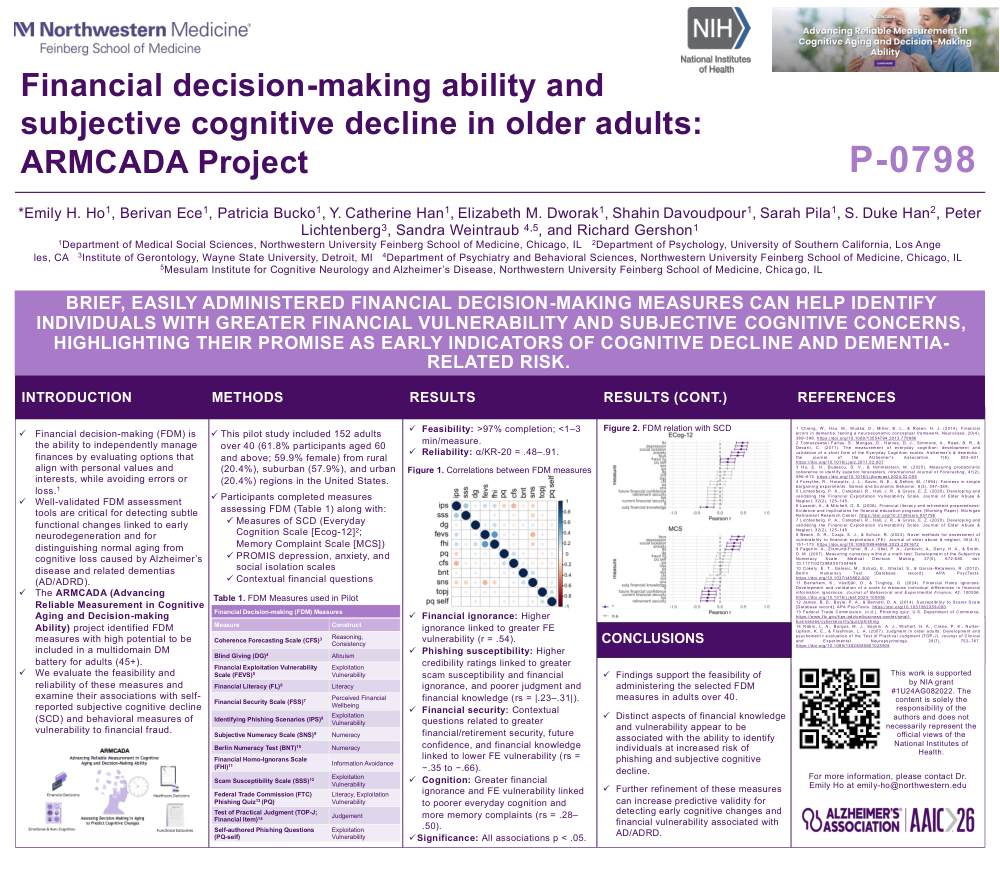
Financial Decision-making Ability And Subjective Cognitive Decline In Older Adults: Armcada Project
Poster Presenter
Authors
Emily H. Ho, Berivan Ece, Patricia Bucko, Y. Catherine Han, Elizabeth M. Dworak, Shahin Davoudpour, Sarah Pila, S. Duke Han, Peter Lichtenberg, Sandra Weintraub, Richard C. Gershon
Affiliations
Department of Medical Social Sciences, Northwestern University Feinberg School of Medicine, Institute of Gerontology, Wayne State University, Department of Psychology, University of Southern California, Mesulam Institute for Cognitive Neurology and Alzheimer’s Disease, Northwestern University Feinberg School of Medicine
Part of Topic
Financial decision-making ability and subjective cognitive decline in older adults: ARMCADA Project
P-0798
*Emily H. Ho1, Berivan Ece1, Patricia Bucko1, Y. Catherine Han1, Elizabeth M. Dworak1, Shahin Davoudpour1, Sarah Pila1, S. Duke Han2, Peter Lichtenberg3, Sandra Weintraub 4,5, and Richard Gershon1
1Department of Medical Social Sciences, Northwestern University Feinberg School of Medicine, Chicago, IL 2Department of Psychology, University of Southern California, Los Ange
les, CA 3Institute of Gerontology, Wayne State University, Detroit, MI 4Department of Psychiatry and Behavioral Sciences, Northwestern University Feinberg School of Medicine, Chicago, IL 5Mesulam Institute for Cognitive Neurology and Alzheimer’s Disease, Northwestern University Feinberg School of Medicine, Chicago, IL
BRIEF, EASILY ADMINISTERED FINANCIAL DECISION-MAKING MEASURES CAN HELP IDENTIFY INDIVIDUALS WITH GREATER FINANCIAL VULNERABILITY AND SUBJECTIVE COGNITIVE CONCERNS, HIGHLIGHTING THEIR PROMISE AS EARLY INDICATORS OF COGNITIVE DECLINE AND DEMENTIA-RELATED RISK.
Feasibility: >97% completion; <1–3 min/measure.
1 Chiong, W., Hsu, M., Wudka, D., Miller, B. L., & Rosen, H. J. (2014). Financial errors in dementia: testing a neuroeconomic conceptual framework. Neurocase, 20(4), 389–396. https://doi.org/10.1080/13554794.2013.770886
2 Tomaszewski Farias, S., Mungas, D., Harvey, D. J., Simmons, A., Reed, B. R., & Decarli, C. (2011). The measurement of everyday cognition: development and validation of a short form of the Everyday Cognition scales. Alzheimer's & dementia : the journal of the Alzheimer's Association, 7(6), 593–601. https://doi.org/10.1016/j.jalz.2011.02.007
3 Ho, E. H., Budescu, D. V., & Himmelstein, M. (2025). Measuring probabilistic coherence to identify superior forecasters. International Journal of Forecasting, 41(2), 596–612. https://doi.org/10.1016/j.ijforecast.2024.02.005
4 Forsythe, R., Horowitz, J. L., Savin, N. E., & Sefton, M. (1994). Fairness in simple bargaining experiments. Games and Economic Behavior, 6(3), 347–369.
5 Lichtenberg, P. A., Campbell, R., Hall, J. R., & Gross, E. Z. (2020). Developing and validating the Financial Exploitation Vulnerability Scale. Journal of Elder Abuse & Neglect, 32(2), 125–145.
6 Lusardi, A., & Mitchell, O. S. (2006). Financial literacy and retirement preparedness: Evidence and implications for financial education programs (Working Paper). Michigan Retirement Research Center. https://doi.org/10.2139/ssrn.957796
7 Lichtenberg, P. A., Campbell, R., Hall, J. R., & Gross, E. Z. (2020). Developing and validating the Financial Exploitation Vulnerability Scale. Journal of Elder Abuse & Neglect, 32(2), 125–145.
8 Beach, S. R., Czaja, S. J., & Schulz, R. (2023). Novel methods for assessment of vulnerability to financial exploitation (FE). Journal of elder abuse & neglect, 35(4-5), 151–173. https://doi.org/10.1080/08946566.2023.2281672
9 Fagerlin, A., Zikmund-Fisher, B. J., Ubel, P. A., Jankovic, A., Derry, H. A., & Smith, D. M. (2007). Measuring numeracy without a math test: Development of the Subjective Numeracy Scale. Medical Decision Making, 27(5), 672-680. doi: 10.1177/0272989X07304449
10 Cokely, E. T., Galesic, M., Schulz, E., Ghazal, S., & Garcia-Retamero, R. (2012). Berlin Numeracy Test [Database record]. APA PsycTests. https://doi.org/10.1037/t45862-000
11 Barrafrem, K., Västfjäll, D., & Tinghög, G. (2024). Financial Homo Ignorans: Development and validation of a scale to measure individual differences in financial information ignorance. Journal of Behavioral and Experimental Finance, 42, 100936. https://doi.org/10.1016/j.jbef.2024.100936
12 James, B. D., Boyle, P. A., & Bennett, D. A. (2014). Susceptibility to Scams Scale [Database record]. APA PsycTests. https://doi.org/10.1037/t62359-000
13 Federal Trade Commission. (n.d.). Phishing quiz. U.S. Department of Commerce. https://www.ftc.gov/tips-advice/business-center/small-businesses/cybersecurity/quiz/phishing
14 Rabin, L. A., Borgos, M. J., Saykin, A. J., Wishart, H. A., Crane, P. K., Nutter-Upham, K. E., & Flashman, L. A. (2007). Judgment in older adults: Development and psychometric evaluation of the Test of Practical Judgment (TOP-J). Journal of Clinical and Experimental Neuropsychology, 29(7), 752–767. https://doi.org/10.1080/13825580601025908
This work is supported by NIA grant #1U24AG082022. The content is solely the responsibility of the authors and does not necessarily represent the official views of the National Institutes of Health.
Comments
Email is required but is not shown publicly.
Loading comments...