4,068 posters, 219 videos, 101 topics, 69 sessions, 14,365 authors, 6,128 institutions
ePostersLive by SciGen Technologies S.A. All rights reserved.
Alzheimer's Association International Conference 2026
July 12-15, 2026 | London, United Kingdom, and Online

1282
Comparing A Brief Performance-based Measure Of Cognition And Daily Functioning In Unhoused And Housed Older Adults
Poster Presenter
Authors
Heather Ross, Emily Reichman, Isabella Valencia, Bonnie Ervin, Lily Willette, Zariya Shams, Jessica Trevino, Sebastian Smith, Triton Johnson, Ahmed Al-Shamari, Sonya Hasthantra, Jennifer Howard, Alexandra Reed, Alisa Squires, Michael Malek-Amadi, Angela Kuramoto, Farah Shaikh, Carla Jooste, Hamzah Al-Jubouriy, Kathy O'Connor, David Coon, Alireza Atri, Sydney Schaefer
Affiliations
Banner Alzheimer's Institute, Arizona State University, Banner Sun Health Research Institute
Part of Topic
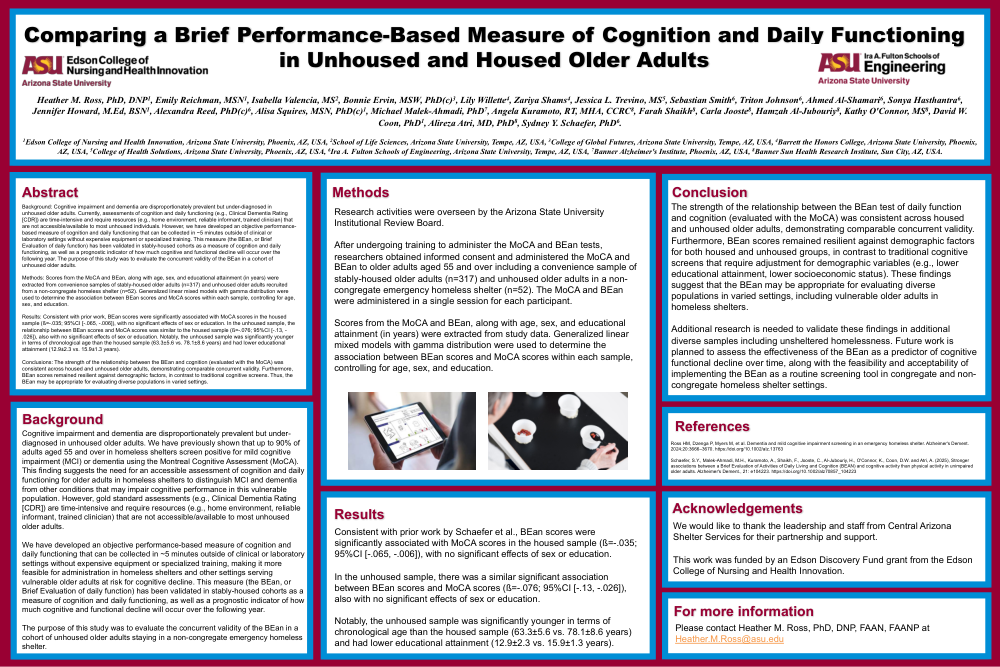
Background: Cognitive impairment and dementia are disproportionately prevalent but under-diagnosed in unhoused older adults. Currently, assessments of cognition and daily functioning (e.g., Clinical Dementia Rating [CDR]) are time-intensive and require resources (e.g., home environment, reliable informant, trained clinician) that are not accessible/available to most unhoused individuals. However, we have developed an objective performance-based measure of cognition and daily functioning that can be collected in ~5 minutes outside of clinical or laboratory settings without expensive equipment or specialized training. This measure (the BEan, or Brief Evaluation of daily function) has been validated in stably-housed cohorts as a measure of cognition and daily functioning, as well as a prognostic indicator of how much cognitive and functional decline will occur over the following year. The purpose of this study was to evaluate the concurrent validity of the BEan in a cohort of unhoused older adults.
Methods: Scores from the MoCA and BEan, along with age, sex, and educational attainment (in years) were extracted from convenience samples of stably-housed older adults (n=317) and unhoused older adults recruited from a non-congregate homeless shelter (n=52). Generalized linear mixed models with gamma distribution were used to determine the association between BEan scores and MoCA scores within each sample, controlling for age, sex, and education.
Results: Consistent with prior work, BEan scores were significantly associated with MoCA scores in the housed sample (β=-.035; 95%CI [-.065, -.006]), with no significant effects of sex or education. In the unhoused sample, the relationship between BEan scores and MoCA scores was similar to the housed sample (β=-.076; 95%CI [-.13, -.026]), also with no significant effects of sex or education. Notably, the unhoused sample was significantly younger in terms of chronological age than the housed sample (63.3±5.6 vs. 78.1±8.6 years) and had lower educational attainment (12.9±2.3 vs. 15.9±1.3 years).
Conclusions: The strength of the relationship between the BEan and cognition (evaluated with the MoCA) was consistent across housed and unhoused older adults, demonstrating comparable concurrent validity. Furthermore, BEan scores remained resilient against demographic factors, in contrast to traditional cognitive screens. Thus, the BEan may be appropriate for evaluating diverse populations in varied settings.
Comments
Email is required but is not shown publicly.
Loading comments...