4,068 posters, 219 videos, 101 topics, 69 sessions, 14,365 authors, 6,128 institutions
ePostersLive by SciGen Technologies S.A. All rights reserved.
Alzheimer's Association International Conference 2026
July 12-15, 2026 | London, United Kingdom, and Online

9873
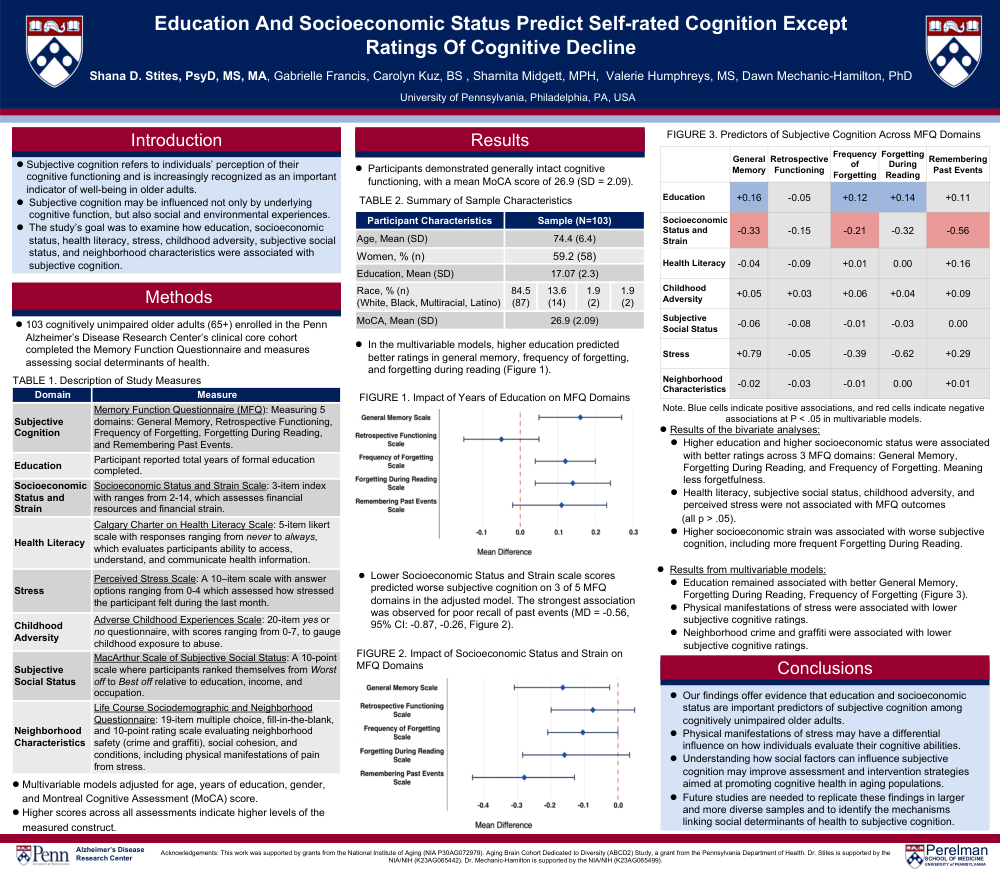
Education And Socioeconomic Status Predict Self-rated Cognition Except Ratings Of Cognitive Decline
Poster Presenter
Part of Topic
Background: Background: Subjective cognition—an individual’s self-perception of their cognitive health or decline—is thought to correlate with socioeconomic status (SES) due to several environmental and psychological mechanisms. Among the top hypothesized explanations are: social comparisons and relative deprivation, cognitive resources and reserve, health literacy, psychological well-being, and neighborhood conditions. The goal of the current study was to investigate the relationships between these social factors and subjective cognition. Better understanding of these associations may help guide the interpretation of cognitive concerns, which is central to characterizing health and illness experiences and determining clinical benefit from interventions.
Methods: Methods: In a sample of older adults (n=103), cross-sectional analyses assessed associations between select covariates and self-rated cognition,measured by Memory Function Questionnairedomains where higher scores indicate better ratings. Covariates included: education, Calgary Charter on Health Literacy Scale, Adverse Childhood Events Scale, Perceived Stress Scale, MacArthur Scale of Subjective Social Status, Socioeconomic Status and Strain scale, and Course Sociodemographic and Neighborhood Questionnaire.Multivariable models controlled for age, gender, and Montreal Cognition Assessment (MoCA).
Results: Results: The sample had a mean age of 74.5 years, mean education of 17 years, was mostly White (85%), and cognitively unimpaired (CDR=0, MoCA=27). In bivariate and multivariable analyses, higher education was associated with higher ratings on 3 of 5 MFQ domains: better general memory, less forgetting, and better remembering past events. Higher SES was also similarly associated with higher ratings on these domains and less forgetting during reading.Subdomain and item-level analyses of SES demonstrated that worse neighborhood features (e.g., crime, graffiti) predicted worse subjective cognition while social features (i.e., belongingness, trust, loneliness) showed no associations. Additionally, physical pain from stress predicted lower subjective cognition. No other associations reached statistical significance.
Conclusion: Conclusions: Of 8 candidate covariates, only education and SES correlated with self-ratings of cognition, challenging common conceptions about what impacts measures of subjective cognition. Moreover, our findings further understanding of associations between stress and subjective cognition, showing physical pain from stress, but not general subjective stress, was associated with lower subjective cognition. Lifespan factors and risk factors can inform interpretation of reports of cognition.
Comments
Email is required but is not shown publicly.
Loading comments...