4,068 posters, 219 videos, 101 topics, 69 sessions, 14,365 authors, 6,128 institutions
ePostersLive by SciGen Technologies S.A. All rights reserved.
Alzheimer's Association International Conference 2026
July 12-15, 2026 | London, United Kingdom, and Online

10846
Adaptation And Validation Of The Latin American Version Of The Dynamic Affect Recognition Test - Latamdart: Preliminary Data
Poster Presenter
Authors
Maria Eugenia Tabernero, Eduardo Leonardelli, Loana De Los Santos, Carolina Ardohain, Florentina Morello-Garcia, Ricardo Allegri, Avila-Funes Jose Alberto, Nilton Custodio, Rosa Montesinos, Diana Matallana, Agustin Ibañez, Claudia Duran Aniotz, Marcelo Maito, Guido Rocatti, Kate Rankin, Nahuel Magrath-Guimet
Affiliations
UCSF, Fleni, Universidad de San Andrés, Instituto Nacional de Ciencias Médicas y Nutrición Salvador Zubirán, Instituto Peruano de Neurociencias, Pontificia Universidad Javeriana, Latin American Brain Health Institute
Part of Topic
Title: Adaptation and Validation of the Latin American Version of the Dynamic Affect Recognition Test (LatAmDART): Preliminary Data
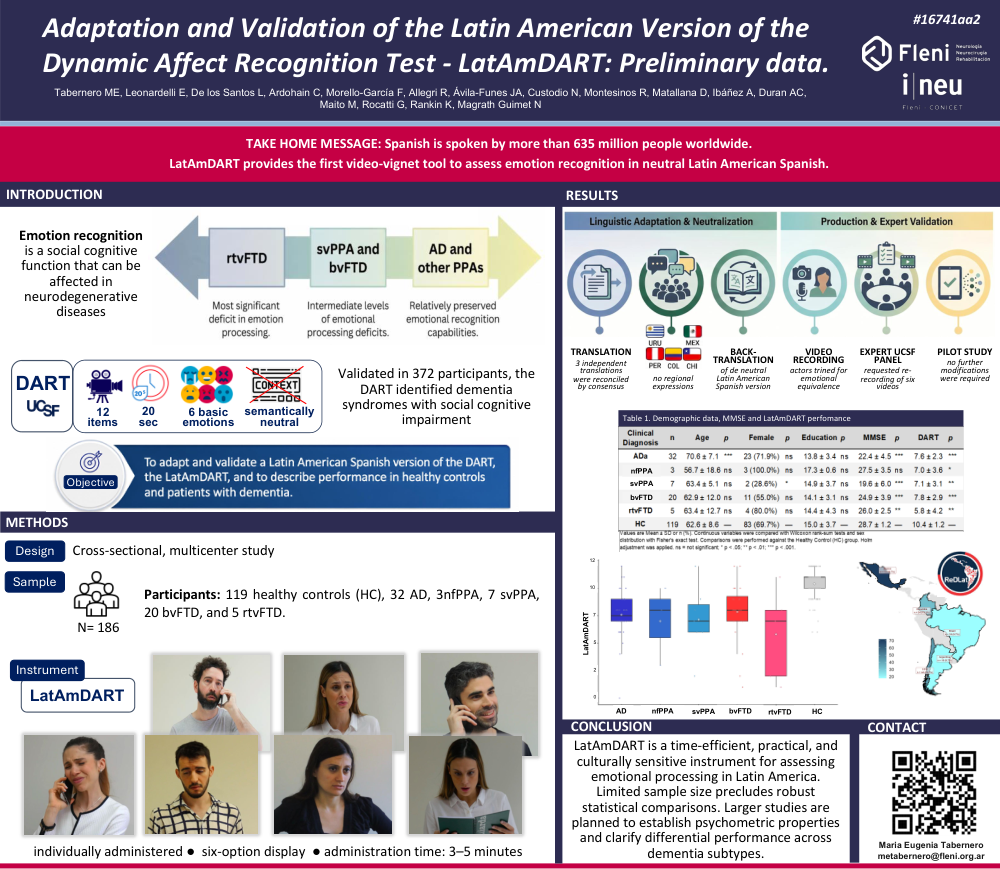
Background: Emotion recognition is a social cognitive function frequently impaired across neurodegenerative diseases. The Dynamic Affect Recognition Test (DART), developed at UCSF and validated in 372 participants, identifies dementia syndromes with social cognitive impairment. However, no culturally and linguistically adapted instrument exists for Latin American Spanish, a language spoken by more than 635 million people worldwide.
Objective: To adapt and validate a Latin American Spanish version of the DART (LatAmDART) and to describe its performance in healthy controls and patients with dementia.
Methods: In this cross-sectional, multicenter study, the LatAmDART comprises 12 video vignettes (20 seconds each) depicting six basic emotions in a semantically neutral context, individually administered using a six-option display (administration time 3–5 minutes). Linguistic adaptation involved three independent translations reconciled by consensus, back-translation into neutral Latin American Spanish free of regional expressions, video recording with actors trained for emotional equivalence, expert UCSF panel review (which requested re-recording of six videos), and a pilot study requiring no further modifications. The sample included 186 participants: 119 healthy controls (HC), 32 AD, 3 nfPPA, 7 svPPA, 20 bvFTD, and 5 rtvFTD. Continuous variables were compared using Wilcoxon rank-sum tests and sex distribution using Fisher's exact test, against the HC group, with Holm adjustment.
Results: LatAmDART scores (mean ± SD; maximum 12) were: HC 10.4 ± 1.2; AD 7.6 ± 2.3; nfPPA 7.0 ± 3.6; svPPA 7.1 ± 3.1; bvFTD 7.8 ± 2.9; and rtvFTD 5.8 ± 4.2. All patient groups scored significantly lower than HC (AD, bvFTD, and rtvFTD, p < .001; svPPA, p < .01; nfPPA, p < .05), with the lowest performance observed in rtvFTD.
Conclusions: LatAmDART is a time-efficient, practical, and culturally sensitive instrument for assessing emotional processing in Latin America. The limited sample size precludes robust statistical comparisons; larger studies are planned to establish its psychometric properties and to clarify differential performance across dementia subtypes.
Comments
Email is required but is not shown publicly.
Loading comments...