4,068 posters, 219 videos, 101 topics, 69 sessions, 14,365 authors, 6,128 institutions
ePostersLive by SciGen Technologies S.A. All rights reserved.
Alzheimer's Association International Conference 2026
July 12-15, 2026 | London, United Kingdom, and Online

4145
Lexical Frequency Characteristics Of Verbal Fluency In Greek-speaking Participants With Dementia And Neurotypical Participants
Poster Presenter
Authors
Nomiki Karpathiou, Xanthi Arampatzi, Anastasia Stathourou, Lydia Papadopoulou, Ioanna Kostara, Rafaela Nikolakaki, Evdoxia Kotsiou, Panagiota Zoi, Paraskevi Sakka
Affiliations
Athens Alzheimer's Association; Speech & Language Therapy Department, University of the Peloponnese, Athens Alzheimer's Association
Part of Topic
Core / Highlights
-
In dementia, semantic fluency shows a selective shift toward higher-frequency words, with little corresponding effect in phonemic fluency, suggesting that lexical frequency captures semantic-system changes partly beyond executive ability.
-
Simple, low-cost lexical measures, such as mean Lg10WF, add diagnostic value beyond traditional word counts.
INTRODUCTION
Verbal fluency draws on both lexical-semantic retrieval and executive control. In dementia, reduced executive resources and/or degradation of semantic networks may constrain lexical search, increasing reliance on more frequent words.
Greek verbal fluency has well-established normative data. Furthermore, in Greek cohorts, strategy analyses (clustering and switching) and qualitative fluency components, such as intrusions and perseverations, have been studied for prognosis and clinical relevance (e.g., HELIAD work, Liampas et al., 2022). However, less is known about whether the lexical frequency of generated words provides additional information about fluency performance in Greek dementia cohorts.
In this study, word frequency was quantified in semantic and phonemic fluency, revealing a marked frequency shift in dementia for semantic, but not phonemic, fluency.
METHODS
Greek-speaking participants were classified as neurotypical controls (n = 153) or participants with dementia (n = 144). Responses in semantic (animals) and phonemic (/p/) fluency were tokenized. Proper nouns and neologisms were excluded, and within-participant repeated words were removed. Participants with fewer than three unique tokens per condition were excluded.
Lexical frequency values for produced words were derived from SUBTLEX-GR (Dimitropoulou et al., 2010). The primary outcome was the mean word frequency Lg10WF of produced items. Only words with a valid frequency value were included in the mean Lg10WF calculations.
Group differences were tested using linear regression adjusted for age, years of education, and sex. Executive ability was evaluated by extending the model to include the Frontal Assessment Battery total score (FAB).
RESULTS
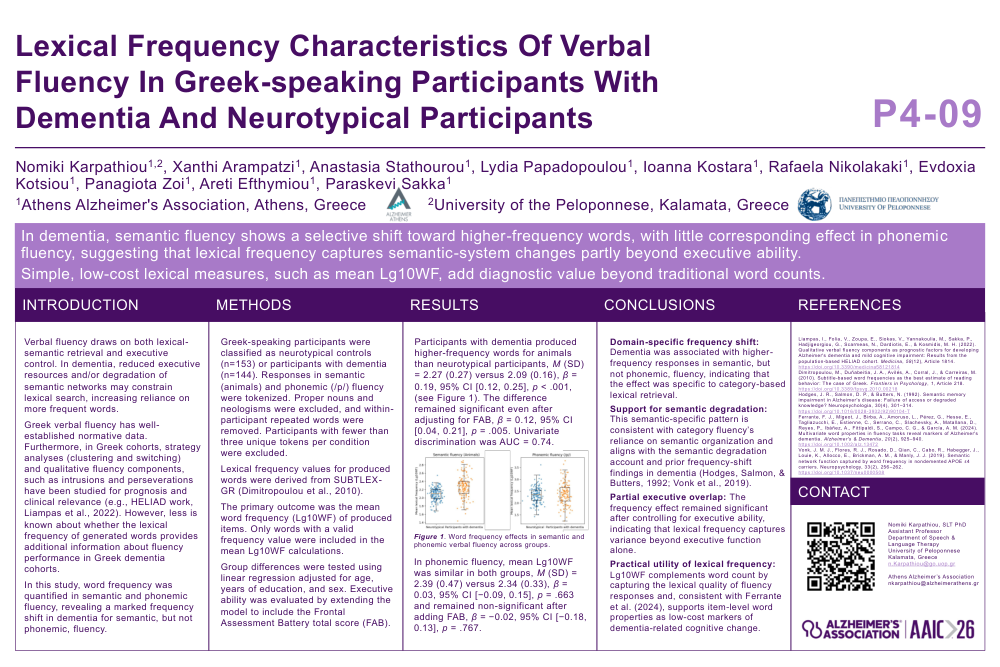
Participants with dementia produced higher-frequency words for animals than neurotypical participants, M (SD) = 2.27 (0.27) versus 2.09 (0.16), β = 0.19, 95% CI [0.12, 0.25], p < .001 (see Figure 1). The difference remained significant even after adjusting for FAB, β = 0.12, 95% CI [0.04, 0.21], p = .005. Univariate discrimination was AUC = 0.74.
In phonemic fluency, mean Lg10WF was similar in both groups, M (SD) = 2.39 (0.47) versus 2.34 (0.33), β = 0.03, 95% CI [-0.09, 0.15], p = .66, and remained non-significant after adding FAB, β = -0.02, 95% CI [-0.18, 0.13], p = .767.
Figure 1. Word frequency effects in semantic and phonemic verbal fluency across groups.
-
Panel A: Semantic fluency
-
Panel B: Phonemic fluency
CONCLUSIONS
-
Domain-specific frequency shift: Dementia was associated with higher-frequency responses in semantic, but not phonemic, fluency, indicating that the effect was specific to category-based lexical retrieval.
-
Support for semantic degradation: This semantic-specific pattern is consistent with category fluency's reliance on semantic organization and aligns with the semantic degradation account and prior frequency-shift findings in dementia (Hodges, Salmon, & Butters, 1992; Vonk et al., 2019).
-
Partial executive overlap: The frequency effect remained significant after controlling for executive ability, indicating that lexical frequency captures variance beyond executive function alone.
-
Practical utility of lexical frequency: Lg10WF complements word count by capturing the lexical quality of fluency responses and, consistent with Ferrante et al. (2024), supports item-level word properties as low-cost markers of dementia-related cognitive change.
REFERENCES
-
Liampas, A., Folia, V., Zoupa, E., Siokas, V., Yannakoulia, M., Sakka, P., Hadjigeorgiou, G., Scarmeas, N., Dardiotis, E., & Kosmidis, M. H. (2022). Qualitative verbal fluency components as prognostic factors for developing Alzheimer's dementia and mild cognitive impairment: Results from the population-based HELIAD cohort. Medicina, 58(12), Article 1814.
-
Dimitropoulou, M., Duñabeitia, J. A., Avilés, A., Corral, J., & Carreiras, M. (2010). SUBTLEX-GR: Subtitle-based word frequencies as the best estimate of reading behavior: The case of Greek. Frontiers in Psychology, 1, Article 218.
-
Hodges, J. R., Salmon, D. P., & Butters, N. (1992). Semantic memory impairment in Alzheimer's disease: Failure of access or degraded knowledge? Neuropsychologia, 30(4), 301-314.
-
Ferrante, F., Birba, A., Amoruso, L., Perez, G., Hesse, E., Tagliazucchi, E., Estienne, C., Serrano, C., Slachevsky, A., Matallana, D., Reyes, P., Ibañez, A., Fittipaldi, S., Campo, C. G., & García, A. M. (2024). Multivariate word properties in fluency tasks reveal markers of Alzheimer's dementia. Alzheimer's & Dementia, 20(2), 935-940.
-
Vonk, J. M. J., Flores, R. J., Rosario, D., Qian, C., Cabo, R., Habegger, J., Louie, K., Aljanco, E., Brickman, A. M., & Manly, J. J. (2019). Semantic network function captured by word frequency in nondemented APOE ε4 carriers. Neuropsychology, 33(2), 256-262.
CONTACT
Nomiki Karpathiou, SLT PhD, Assistant Professor, Department of Speech & Language Therapy
University of Peloponnese, Kalamata, Greece | n.karpathiou@go.uop.gr
Athens Alzheimer's Association | nkarpathiou@alzheimerathens.gr
Comments
Email is required but is not shown publicly.
Loading comments...