4,068 posters, 219 videos, 101 topics, 69 sessions, 14,365 authors, 6,128 institutions
ePostersLive by SciGen Technologies S.A. All rights reserved.
Alzheimer's Association International Conference 2026
July 12-15, 2026 | London, United Kingdom, and Online

3358
Phenotypic Variability In Late-onset Amnestic Mild Cognitive Impairment
Poster Presenter
Part of Topic
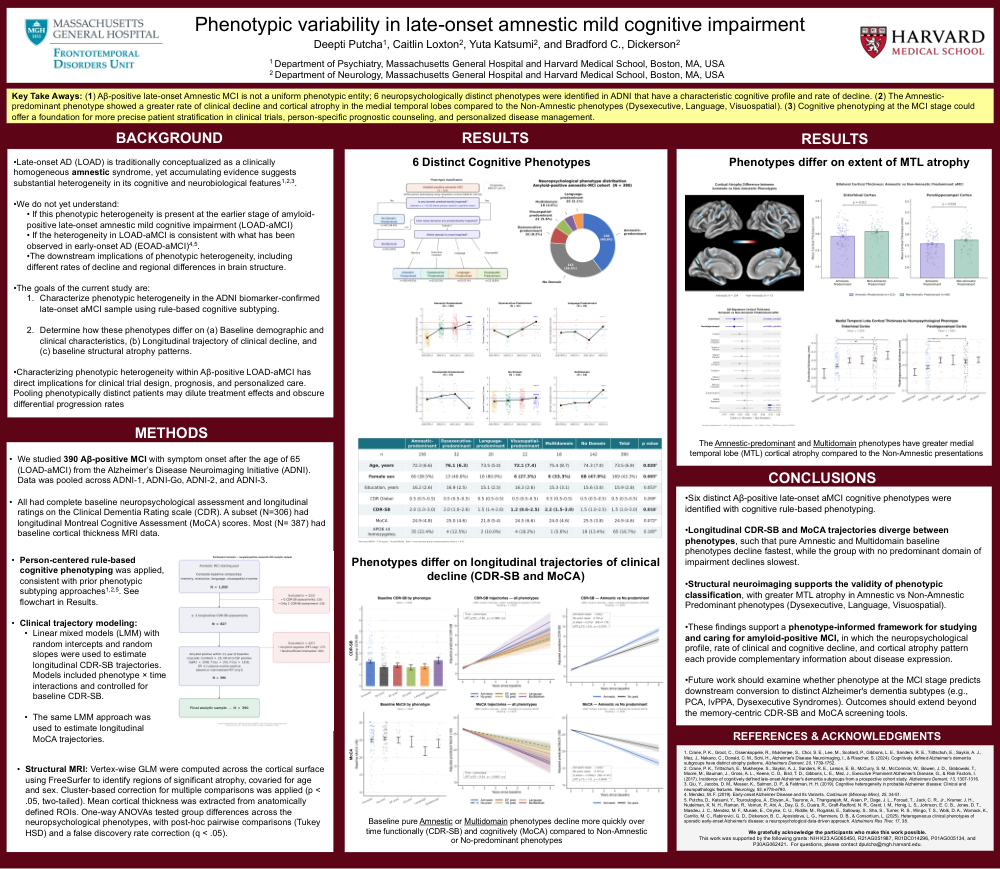
Six distinct cognitive phenotypes were identified: Amnestic-Predominant (40.0%), No-Predominant-Domain (36.4%), Dysexecutive-Predominant (8.2%), Visuospatial-Predominant (5.6%), Language-Predominant (5.1%), and Multidomain (4.6%). Amnestic-Predominant participants declined significantly faster than participants who did not demonstrate any one area of predominant impairment (No-Domain) on both CDR-SB (Δ=+0.27 points/yr, p=0.02) and MoCA (Δ=−0.54 points/yr, p=0.005). Structural neuroimaging revealed that Amnestic-Predominant participants had significantly thinner entorhinal (p=0.003) and parahippocampal (p=0.005) cortices compared to No-Domain participants, and Multidomain participants showed the greatest overall MTL atrophy. Visuospatial-Predominant participants showed the least MTL atrophy, consistent with relative sparing of medial temporal structures in this phenotype.
Amyloid-positive LOAD-aMCI is not a phenotypically uniform entity. Six neuropsychologically distinct subtypes are identifiable at the MCI stage, and the Amnestic-Predominant and Multidomain phenotypes show both faster longitudinal decline and greater MTL cortical atrophy than Non-Amnestic presentations. These findings support a phenotype-informed framework for studying and caring for amyloid-positive MCI, in which the neuropsychological profile, rate of clinical and cognitive decline, and cortical atrophy pattern each provide complementary information about disease expression. Future work should examine whether phenotype at the MCI stage predicts downstream conversion to distinct Alzheimer's dementia subtypes (e.g., posterior cortical atrophy, logopenic variant PPA, dysexecutive syndromes), and extend outcome measures beyond the memory-centric CDR-SB and MoCA to better capture non-amnestic symptom trajectories.
Comments
Email is required but is not shown publicly.
Loading comments...