4,068 posters, 219 videos, 101 topics, 69 sessions, 14,365 authors, 6,128 institutions
ePostersLive by SciGen Technologies S.A. All rights reserved.
Alzheimer's Association International Conference 2026
July 12-15, 2026 | London, United Kingdom, and Online

4337
Visual Processing Speed Measures Differentiate Mild Cognitive Impairment Converter And Non Converter To Alzheimer's Dementia
Part of Topic
Introduction
There is evidence about the utility of visual processing speed tests in the detection of patients with mild cognitive impairment who might convert to probable Alzheimer’s disease dementia (MCI-c). Our aim is to analyze differences across these measures in participants with MCI-c in comparison to MCI non converters (MCI-nc) and healthy controls (HC) and to establish a possible threshold for these measures.
Results
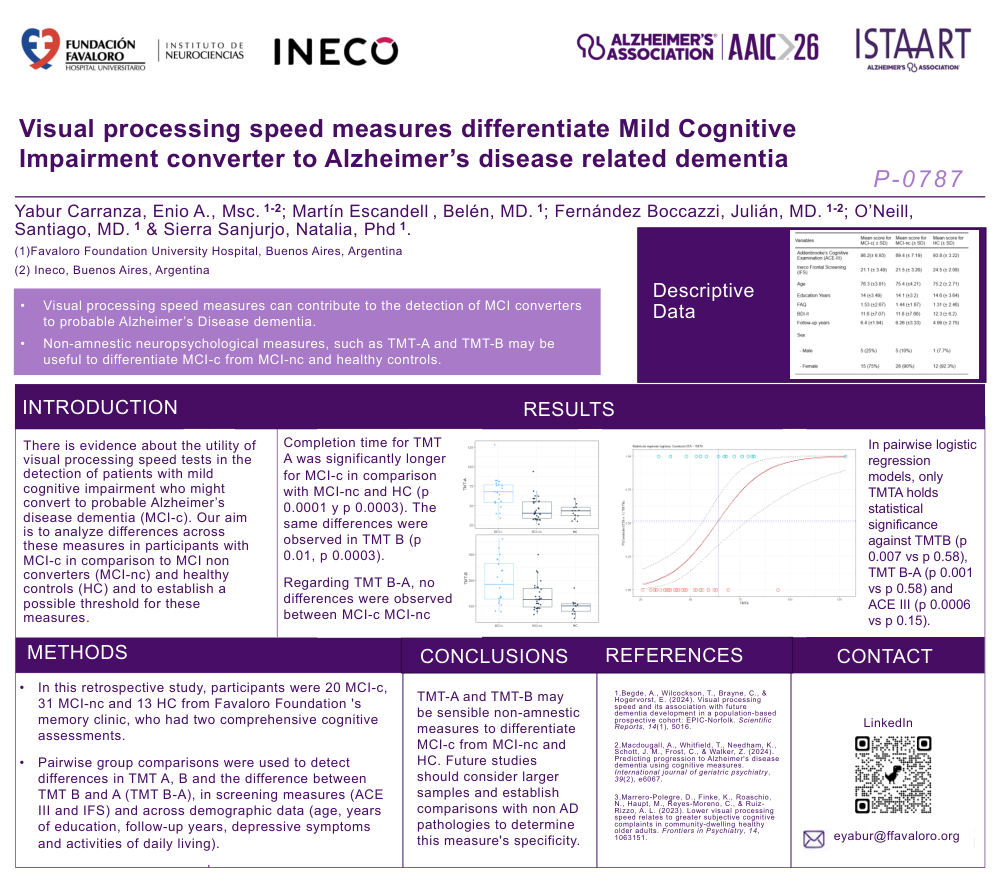
No differences between groups were found across demographic variables. Differences were found between MCI-c and HC in ACE III and IFS (p 0.001, p 0.001). Completion time for TMT A was significantly longer for MCI-c in comparison with MCI-nc and HC (p 0.0001 y p 0.0003). The same differences were observed in TMT B (p 0.01, p 0.0003). Additionally, MCI-nc required significantly more time than HC (p 0.005) to complete this task. Regarding TMT B-A, differences were observed in MCI-c against HC (p 0.002) and in MCI-nc against HC (p 0.003). In pairwise logistic regression models, only TMTA holds statistical significance against TMTB (p 0.007 vs p 0.58), TMT B-A (p 0.001 vs p 0.58) and ACE III (p 0.0006 vs 0.15).
Conclusions
According to our results, TMT-A and TMT-B may be sensible non-amnestic measures to differentiate MCI-c from MCI-nc and HC. However, TMT-A might be the best of these measures to predict dementia conversion. Future studies should consider larger samples and establish comparisons with non AD pathologies to determine this measure's specificity.
Comments
Email is required but is not shown publicly.
Loading comments...