4,068 posters, 219 videos, 101 topics, 69 sessions, 14,365 authors, 6,128 institutions
ePostersLive by SciGen Technologies S.A. All rights reserved.
Alzheimer's Association International Conference 2026
July 12-15, 2026 | London, United Kingdom, and Online

9650
Bayesian Network Modelling Of SCDplus Features, Apoe4 Carriership, And Amyloid Status In A Memory Clinic Population
Poster Presenter
Authors
Elke Butterbrod, Amber Natzijl, Charlotte Teunissen, Elsmarieke van de Giessen, Mardou van Leeuwenstijn van Leeuwenstijn, Betty Tijms, Argonde van Harten, Sietske Sikkes
Affiliations
Vrije Universiteit Amsterdam / Alzheimer Center Amsterdam, Amsterdam University Medical Center, Alzheimer Center Amsterdam, Amsterdam University Medical Center, Department of Clinical Chemistry, Amsterdam University Medical Center, Department of Radiology and Nuclear Medicine, Amsterdam University Medical Center
Part of Topic
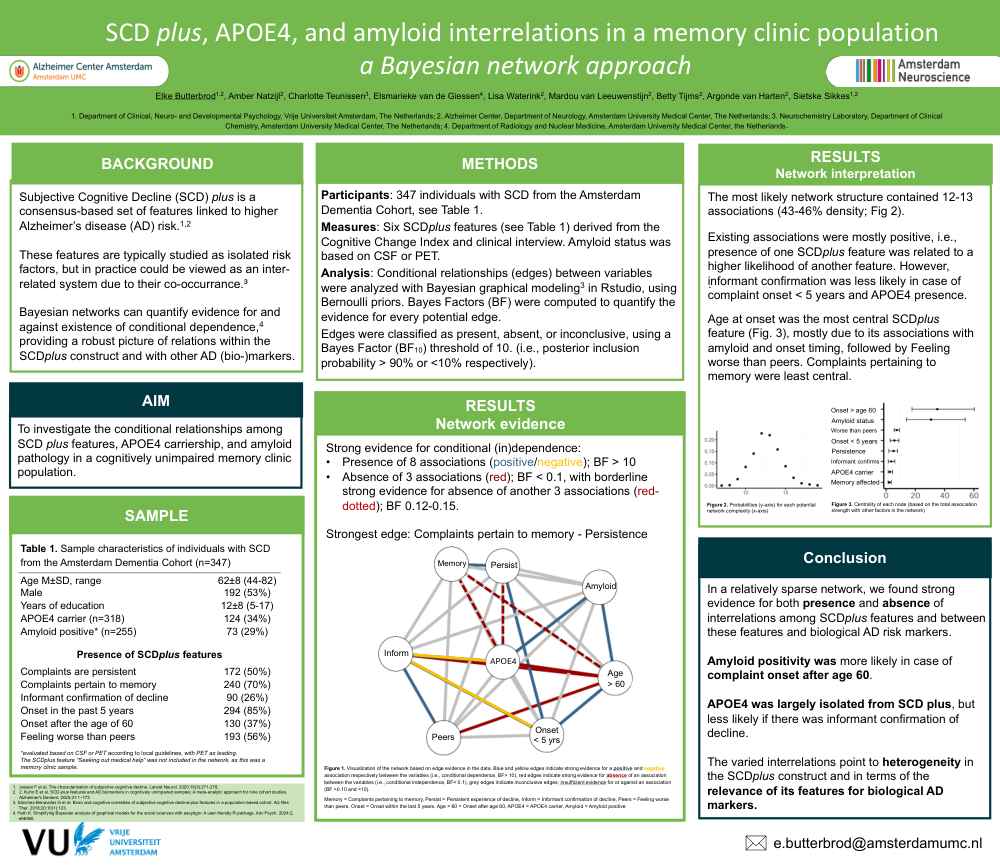
Subjective Cognitive Decline (SCD) plus is a consensus-based set of features linked to higher Alzheimer’s disease (AD) risk. These features are typically studied as isolated risk factors, but in practice could be viewed as an inter-related system due to their co-occurrance. Bayesian networks can quantify evidence for and against existence of conditional dependence, providing a robust picture of relations within the SCDplus construct and with other AD (bio-)markers.
This study aims to investigate the conditional relationships among SCD plus features, APOE4 carriership, and amyloid pathology in a cognitively unimpaired memory clinic population.
In a relatively sparse network, we found strong evidence for both presence and absence of interrelations among SCDplus features and between these features and biological AD risk markers. Amyloid positivity was more likely in case of complaint onset after age 60. APOE4 was largely isolated from SCD plus, but less likely if there was informant confirmation of decline. The varied interrelations point to heterogeneity in the SCDplus construct and in terms of the relevance of its features for biological AD markers.
Comments
Email is required but is not shown publicly.
Loading comments...