4,068 posters, 219 videos, 101 topics, 69 sessions, 14,365 authors, 6,128 institutions
ePostersLive by SciGen Technologies S.A. All rights reserved.
Alzheimer's Association International Conference 2026
July 12-15, 2026 | London, United Kingdom, and Online

3236
Multicultural Innovations In Neuropsychological Dementia Assessment To Reduce Diagnostic Inequities
Poster Presenter
Part of Topic
Multicultural Challenges and Innovations in the Neuropsychological Assessment of
Dementia: Addressing Diagnostic Inequities Across Diverse Populations
Theme: Clinical Manifestations
Sub-theme: Neuropsychology
Topic Area: Multicultural Considerations in Neuropsychological Assessment
Presenting Author:
Donna de Levante Raphael, PhD
Director of Research, Alzheimer’s Foundation of America, USA
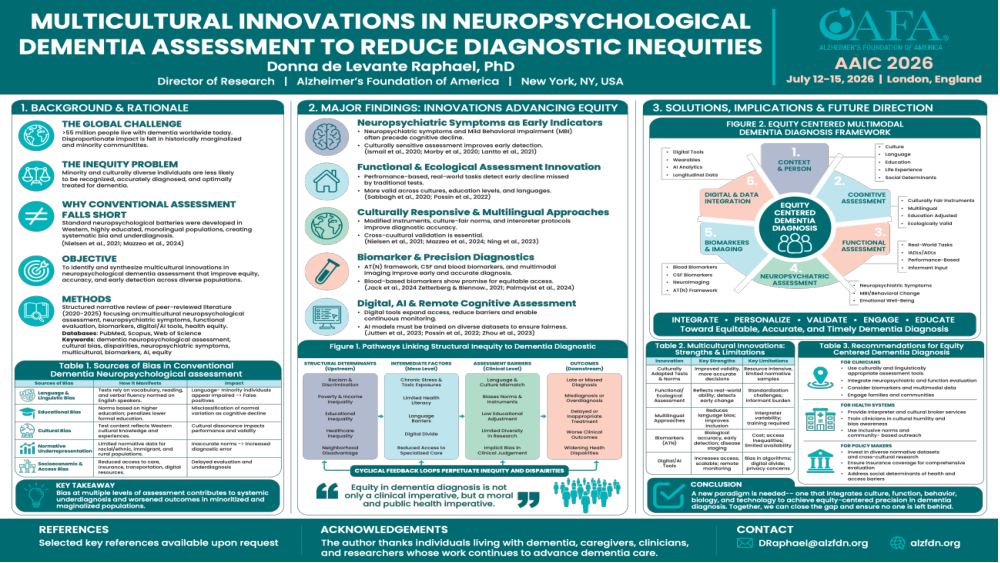
Background
Neuropsychological assessment is essential for identifying and characterizing Alzheimer’s
disease (AD), mild cognitive impairment (MCI), and related dementias. However, most
commonly used cognitive instruments are normed on Western, English-speaking, and highly
educated populations, limiting validity across multicultural, multilingual, and socioeconomically
diverse groups. These structural limitations contribute to systematic misclassification of
cognitive impairment, particularly among Black, Latino, Caribbean, and immigrant populations,
resulting in delayed diagnosis, inappropriate labeling, inequitable access to care, and
underrepresentation in research. As global dementia prevalence increases, addressing cultural
and linguistic inequities in neuropsychological assessment has become an urgent clinical and
scientific priority.
Objective
To examine key multicultural challenges affecting the accuracy of neuropsychological
assessment in dementia and to evaluate emerging innovations designed to improve cross-cultural
validity and diagnostic equity.
Methods
A structured integrative review of 112 peer-reviewed studies published between 2010 and 2025
was conducted using PubMed, PsycINFO, Scopus, CINAHL, and Google Scholar. Included
studies focused on multicultural or cross-linguistic neuropsychological assessment in AD, MCI,
or related dementias. Findings were synthesized across domains of language and educational
bias, cultural conceptualizations of cognition and aging, and assessment innovations, including
culturally adapted instruments, digital platforms, and artificial intelligence (AI)–supported
analytic approaches.
Results
Widely used cognitive screening tools, including the MMSE and MoCA, demonstrated persistent
education- and language-related bias, particularly among individuals with limited formal
education or non-English primary languages. Adjusted norms improved specificity modestly but
remained insufficient without culturally tailored test content. In contrast, culturally adapted
batteries and AI-assisted approaches integrating speech-based, performance-based, and digital
biomarkers demonstrated improved diagnostic accuracy, interpretive confidence, and clinical
relevance across diverse populations.Conclusions
Redefining neuropsychological assessment frameworks within multicultural and multilingual
contexts is essential for achieving equitable diagnosis of AD and related dementias. Culturally
responsive and technology-enhanced approaches are critical to ensuring that advances in early
detection translate equitably across diverse populations.
Keywords: Alzheimer’s disease; dementia; neuropsychological assessment
Comments
Email is required but is not shown publicly.
Loading comments...