4,068 posters, 219 videos, 101 topics, 69 sessions, 14,365 authors, 6,128 institutions
ePostersLive by SciGen Technologies S.A. All rights reserved.
Alzheimer's Association International Conference 2026
July 12-15, 2026 | London, United Kingdom, and Online

10119
Machine Learning And Artificial Intelligence-based Tools For Screening And Early Detection Of Cognitive Impairment: A Systematic Review
Poster Presenter
Authors
Yash Kamdar, Cynthia Zou, Diana Summanwar, Andrew Breithaupt, Ambar Kulshreshtha
Affiliations
Department of Family and Preventive Medicine, Emory University School of Medicine, Atlanta, GA, USA, School of Medicine and Health Sciences, George Washington University, Washington DC, USA, Department of Family Medicine, Indiana University School of Medicine, Indianapolis, IN, USA, Goizueta Institute at Emory Brain Health, Department of Neurology, Emory University School of Medicine, Atlanta, GA, USA
Part of Topic
Background: Cognitive impairment and dementia are major global health challenges, yet early
identification remains inconsistent across clinical and community settings. Conventional
screening tools often require substantial time and staffing and perform variably across linguistic,
educational, and cultural contexts. AI/ML-based tools may enable scalable, low burden cognitive
screening using speech, gait, sensor-derived signals, and electronic health record data. We aim
to systematically review AI/ML-based tools for cognitive screening and early detection in adults,
focusing on performance by cognitive stage, modality, and study setting.
Methods: Following PRISMA guidelines, we searched PubMed, Web of Science, and Embase for
peer-reviewed studies (2010-2025) evaluating AI/ML-enabled cognitive screening tools in
adults ≥ 18. Eligible studies recruited participants from community, primary care, outpatient, or
memory-clinic settings. Studies were required to report screening-relevant outcomes using an
appropriate comparator. We extracted data on study design, population, AI modality, reference
standard, and performance or implementation outcomes. Findings were synthesized
descriptively due to heterogeneity in study metrics.
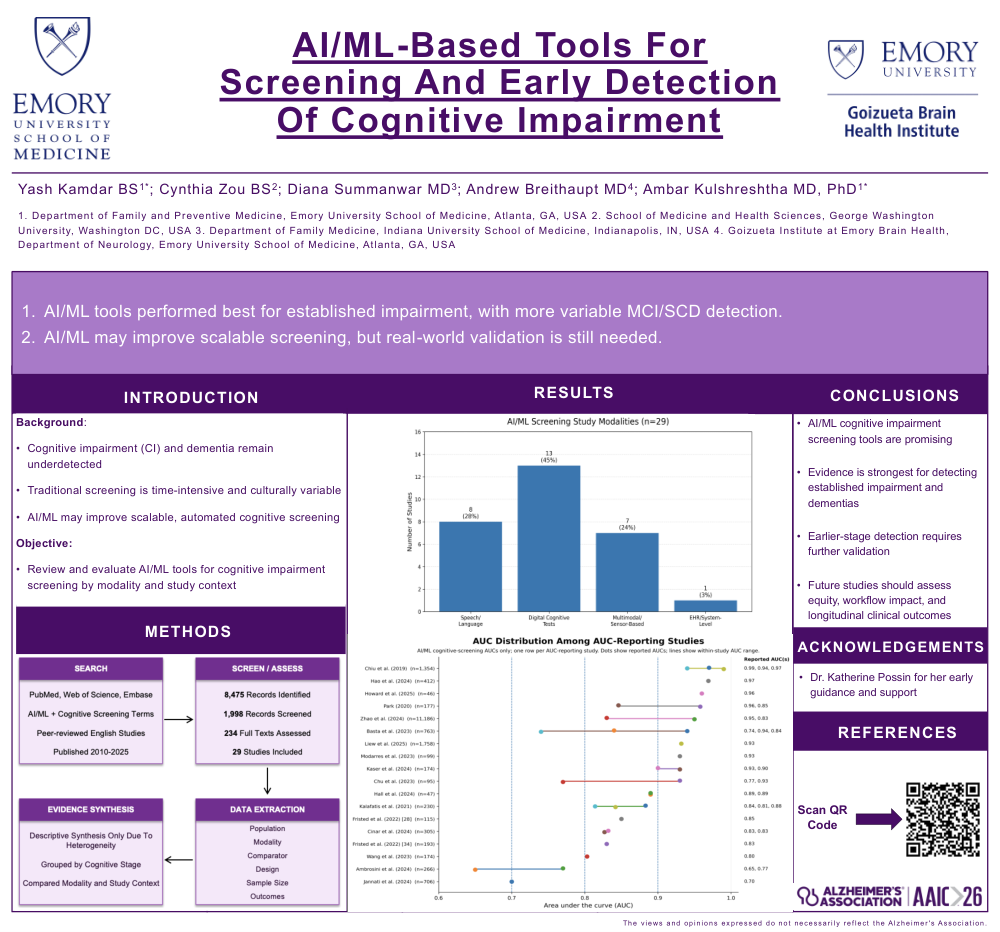
Results: Of 8,475 studies identified, 29 studies met inclusion criteria. Across modalities, AI-
enabled tools demonstrated moderate to high discrimination (AUC 0.70-0.99) for cognitive
impairment, with the strongest performance observed when distinguishing cognitively
unimpaired individuals from dementia. Performance for earlier stages, including mild cognitive
impairment and subjective cognitive decline, was more variable. Speech and language-based
models and digitally administered cognitive tests with automated scoring were the most
frequently evaluated modalities and demonstrated consistent screening performance across
diverse populations and settings. Multimodal and sensor-based approaches (e.g. gait and eye
tracking, motor function tests, EHR-based ML) leveraged non-traditional digital signals but were
evaluated in fewer studies with smaller samples. Only one study evaluated clinical outcomes in
routine care, reporting higher rates of incident ADRD diagnoses and diagnostic assessments
using a combined patient-facing and EHR-based approach, whereas the EHR-based algorithm
alone did not improve outcomes relative to usual care.
Conclusion: AI/ML-based screening tools show promising potential for detecting cognitive
impairment, including mild cognitive impairment and dementia. However, evidence supporting
earlier-stage detection and real-world clinical impact remains limited. These findings highlight
the need for standardized reporting, longitudinal validation, and multi-site external evaluation
to support translation into routine care.
Comments
Email is required but is not shown publicly.
Loading comments...