4,068 posters, 219 videos, 101 topics, 69 sessions, 14,365 authors, 6,128 institutions
ePostersLive by SciGen Technologies S.A. All rights reserved.
Alzheimer's Association International Conference 2026
July 12-15, 2026 | London, United Kingdom, and Online

5717
Better Living With Non-memory-led Dementia (belide) Randomised Controlled Trial: Recruitment And Baseline Characteristics
Poster Presenter
Part of Topic
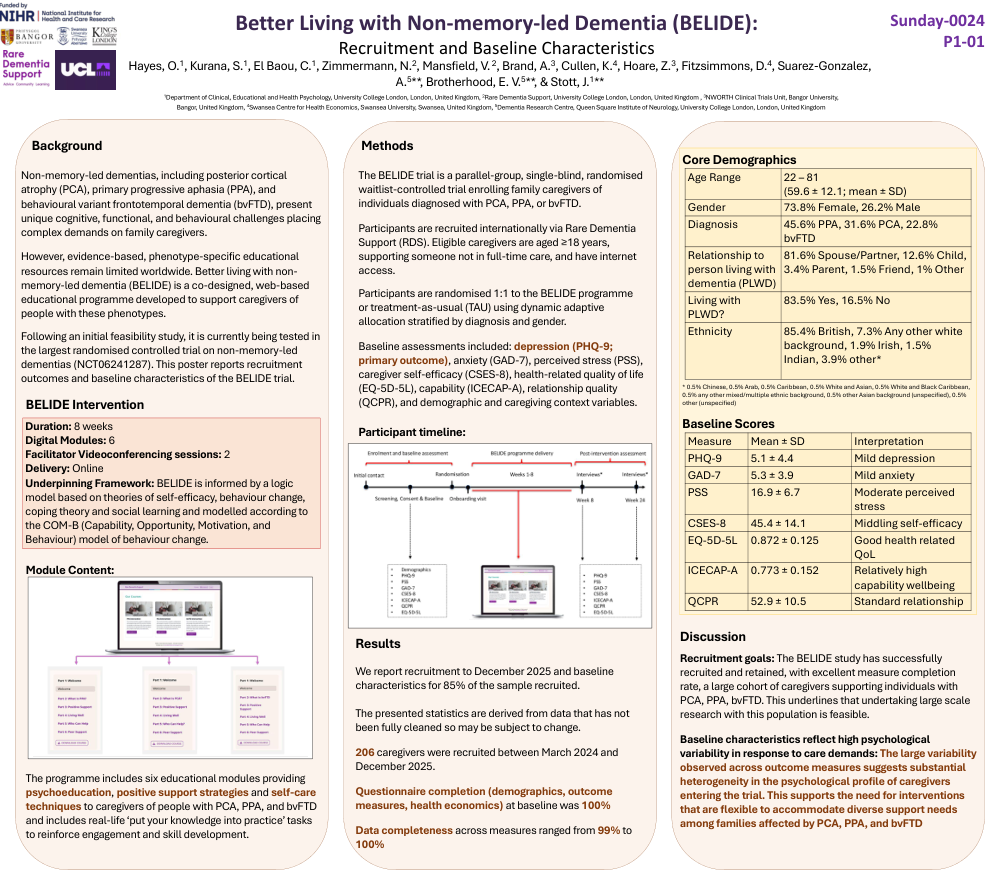
Better Living with Non-memory-led Dementia (BELIDE): Recruitment and Baseline Characteristics
Background
Non-memory-led dementias, including posterior cortical atrophy (PCA), primary progressive aphasia (PPA), and behavioural variant frontotemporal dementia (bvFTD), present unique cognitive, functional, and behavioural challenges placing complex demands on family caregivers.
However, evidence-based, phenotype-specific educational resources remain limited worldwide. Better living with non-memory-led dementia (BELIDE) is a co-designed, web-based educational programme developed to support caregivers of people with these phenotypes.
Following an initial feasibility study, it is currently being tested in the largest randomised controlled trial on non-memory-led dementias (NCT06241287). This poster reports recruitment outcomes and baseline characteristics of the BELIDE trial.
BELIDE Intervention
Duration: 8 weeks
Digital Modules: 6
Facilitator Videoconferencing sessions: 2
Delivery: Online
Underpinning Framework: BELIDE is informed by a logic model based on theories of self-efficacy, behaviour change, coping theory and social learning and modelled according to the COM-B (Capability, Opportunity, Motivation, and Behaviour) model of behaviour change.
Module Content:
The programme includes six educational modules providing psychoeducation, positive support strategies and self-care techniques to caregivers of people with PCA, PPA, and bvFTD and includes real-life ‘put your knowledge into practice’ tasks to reinforce engagement and skill development.
Methods
The BELIDE trial is a parallel-group, single-blind, randomised waitlist-controlled trial enrolling family caregivers of individuals diagnosed with PCA, PPA, or bvFTD.
Participants are recruited internationally via Rare Dementia Support (RDS). Eligible caregivers are aged ≥18 years, supporting someone not in full-time care, and have internet access.
Participants are randomised 1:1 to the BELIDE programme or treatment-as-usual (TAU) using dynamic adaptive allocation stratified by diagnosis and gender.
Baseline assessments included: depression (PHQ-9; primary outcome), anxiety (GAD-7), perceived stress (PSS), caregiver self-efficacy (CSES-8), health-related quality of life (EQ-5D-5L), capability (ICECAP-A), relationship quality (QCPR), and demographic and caregiving context variables.
Results
We report recruitment to December 2025 and baseline characteristics for 85% of the sample recruited. 206 caregivers were recruited between March 2024 and December 2025. Questionnaire completion (demographics, outcome measures, health economics) at baseline was 100%. Data completeness across measures ranged from 99% to 100%
The presented statistics are derived from data that has not been fully cleaned so may be subject to change.
Participants ranged in age from 22 to 81 (59.6 ± 12.1; mean ± SD), 73.8% were female, and cared for someone with PCA (31.6%), PPA (45.6%), or bvFTD (22.8%).Most caregivers were spouses/partners (81.6%) and lived with the person with dementia (83.5%). Most participants were British: 85.4% British, 7.3% Any other white background, 1.9% Irish, 1.5% Indian, 3.9% other.
Baseline scores (mean ± SD) were: PHQ-9 5.1 ± 4.4; GAD-7 5.3 ± 3.9; PSS 16.9 ± 6.7; CSES-8 45.4 ± 14.1; EQ-5D-5L index 0.872 ± 0.125; ICECAP-A 0.773 ± 0.152; and QCPR 52.9 ± 10.5. Questionnaire completion at baseline was 100%
Discussion
Recruitment goals: The BELIDE study has successfully recruited and retained, with excellent measure completion rate, a large cohort of caregivers supporting individuals with PCA, PPA, bvFTD. This underlines that undertaking large scale research with this population is feasible.
Baseline characteristics reflect high psychological variability in response to care demands: The large variability observed across outcome measures suggests substantial heterogeneity in the psychological profile of caregivers entering the trial. This supports the need for interventions that are flexible to accommodate diverse support needs among families affected by PCA, PPA, and bvFTD
Comments
Email is required but is not shown publicly.
Loading comments...