4,068 posters, 219 videos, 101 topics, 69 sessions, 14,365 authors, 6,128 institutions
ePostersLive by SciGen Technologies S.A. All rights reserved.
Alzheimer's Association International Conference 2026
July 12-15, 2026 | London, United Kingdom, and Online

8868
Separate And Joint Effects Of Stages Of Objective Memory Impairment And Cognitive Function Index On Clinical Progression In A4
Part of Topic
Separate And Joint Effects Of Stages Of Objective Memory Impairment And Cognitive Function
Index On Clinical Progression In A4
Author Block: Priyanka Kumari1, Richard B. Lipton2,3, Rebecca E. Amariglio4, Reisa A. Sperling4, Ellen
Grober1
1Neurology, Albert Einstein College od Medicine, Bronx, NY, USA, 2Neurology, Albert Einstein College
of Medicine, Bronx, NY, USA, 3Montefiore Medical Canter, Bronx, NY, USA, 4Neurology, Harvard
Medical School, Boston, MA, USA.
Abstract:
Background:Only 20-30% of amyloid-positive cognitively normal individuals progress to mild
cognitive impairment (MCI) or Alzheimer’s disease (AD) within five years. Identifying amyloid positive
individuals most likely to progress will improve the efficiency of secondary prevention trials. Using data
from the Anti-Amyloid in Asymptomatic Alzheimer’s Disease (A4) study, we assessed the predictive
validity of the Stages of Objective Memory Impairment (SOMI) system, and the Cognitive Function
Index (CFI)-Self.
Methods:Among 1106 A4 participants, we identified an optimal cut score of 2.58 (Low vs High) for CFI
and applied previously determined SOMI cut scores (Table 1). Progression was defined by 2 consecutive
CDRs>0; time to progression was modelled using Cox proportional hazards regression adjusting for
age, sex, APOE ε4status and amyloid. Data were pooled across active and placebo treatment arms.
Models were fit in the full cohort, and in subsamples.
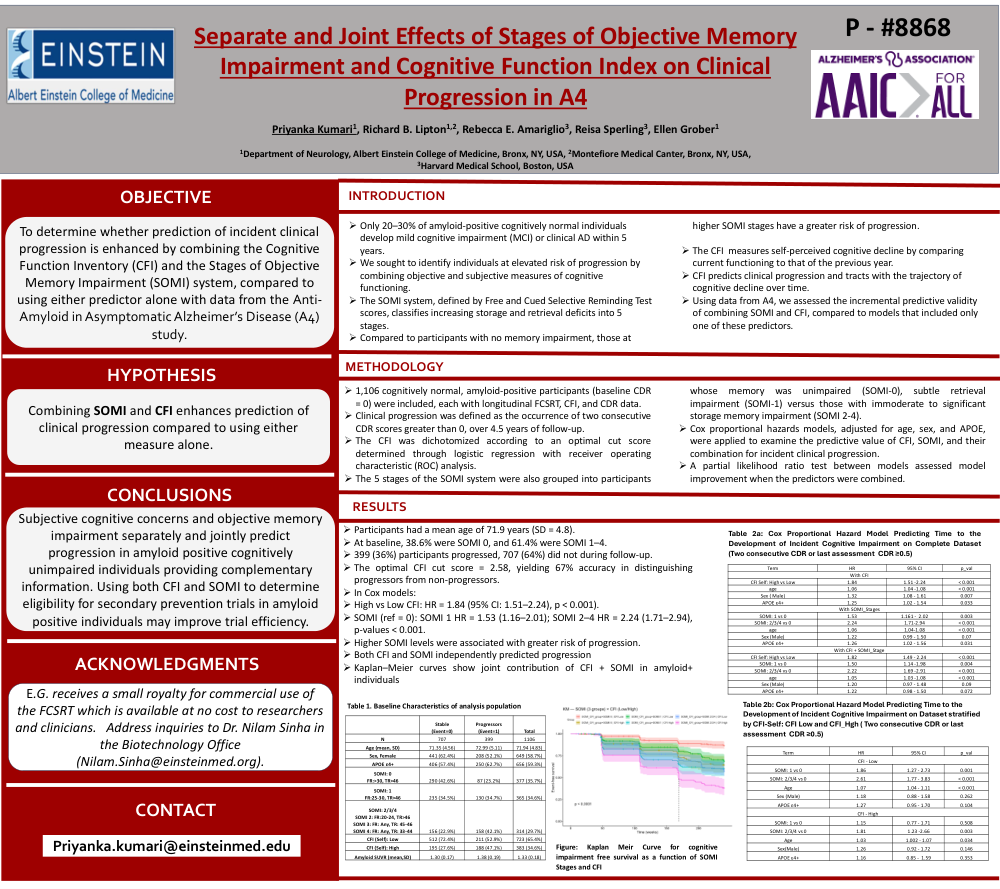
Results: Of 1106 enrolled individuals, 399 (36%) progressed and 707 (64%) did not. Baseline
characteristics are shown (Table 1). In the full cohort, the adjusted Cox model shows that that high CFI
(vs. low CFI) predicted progression (HR=1.82; 95% CI: 1.49-2.24). Using SOMI 0 as the reference, the HR
for progression for the SOMI 1 group is 1.50(95% CI:1.14-1.98) and for the SOMI 2-4 group the HR is
2.22 (95% CI: 1.69-2.91). In models including both CFI and SOMI as predictors of progression. each
made a significant independent contribution. (Table 2a). We examined the effect of SOMI in groups
with high vs low CFI. In the low CFI group, SOMI=1 (HR=1.86) and SOMI=2-4 (HR=2.61) significantly
predicted progression. In the high CFI group, SOMI (2-4) remained significant whereas SOMI-1 was not
(Table 2b). The Figure provides Kaplan-Meyer curves that show the contribution of CFI and SOMI to the
prediction of progression in amyloid positive individuals.
Conclusion: Subjective cognitive concerns and objective memory impairment separately and jointly
predict progression in amyloid positive cognitively unimpaired individuals providing complementary
information. Using both CFI and SOMI to determine eligibility for secondary prevention trials in amyloid
positive individuals may improve trial efficiency.
Comments
Email is required but is not shown publicly.
Loading comments...