4,068 posters, 219 videos, 101 topics, 69 sessions, 14,365 authors, 6,128 institutions
ePostersLive by SciGen Technologies S.A. All rights reserved.
Alzheimer's Association International Conference 2026
July 12-15, 2026 | London, United Kingdom, and Online

3511
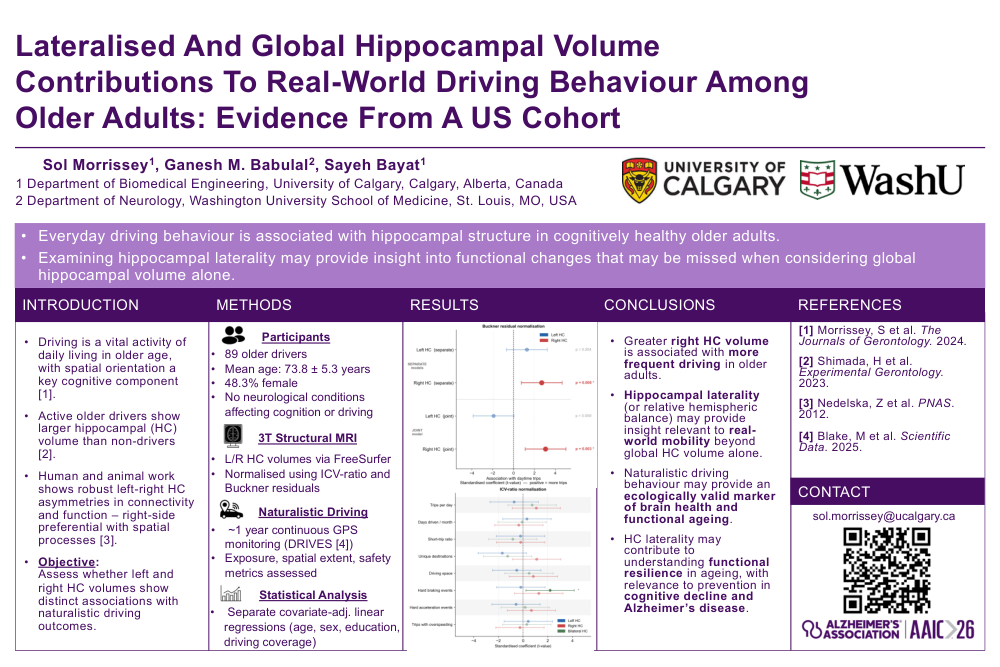
Lateralised And Global Hippocampal Volume Contributions To Real-World Driving Behaviour Among Older Adults: Evidence From A US Cohort
Poster Presenter
Authors
Affiliations
University of Calgary, Washington University School of Medicine
Part of Topic
Background:
Driving is a complex real-world behaviour essential for independence in older age, with spatial orientation as a key component. Although prior findings demonstrate the hippocampus impacts driving behaviour in older age, the relative contributions of left, right, and global hippocampal volumes to naturalistic driving behaviour in older adult populations remain poorly understood.
Method:
We analysed data from 89 community-dwelling older adults (mean age: 73.83 years, 48.31% female) without diagnosed neurological conditions known to affect cognition or driving behaviour, who underwent structural 3T MRI and continuous GPS-based driving monitoring as measured using the Driving Real World In-vehicle Evaluation System (DRIVES). Driving data comprised approximately 1 year of driving within 1 year of the most recent MRI scan per participant. Bilateral and global hippocampal volumes were normalised as proportions of intracranial volume. For each driving outcome (trip counts, trip duration, short-trip ratio, unique destinations, driving space, harsh braking/acceleration events, and trips with overspeeding), covariate-adjusted linear regression models including age, sex, education, and driving coverage were conducted. Left and right hippocampal volumes were entered jointly to assess lateralised effects, while bilateral hippocampal volume was examined in separate models. Buckner-normalised residuals were examined as sensitivity analyses.
Results:
Hippocampal associations with driving behaviour were lateralised. Greater right hippocampal volume was associated with higher trip frequency, whereas greater left hippocampal volume was associated with reduced trip frequency. Bilateral hippocampal volume effects were generally weaker; however, greater global hippocampal volume showed a positive association with hard-braking events. Patterns were similar across normalisation approaches.
Conclusions:
Left and right hippocampi exhibit divergent relationships with daily driving behaviour in community-dwelling older adults, consistent with previous functional lateralisation findings. Right-sided hippocampal volume appears to support greater real-world mobility, whereas left-sided volume may relate to more constrained driving patterns. Considering hippocampal laterality, rather than global volume alone, may inform clinical manifestation of early functional changes and resilience in ageing, with potential relevance for dementia prevention and characterising changes to driving behaviour in cognitive decline.
Comments
Email is required but is not shown publicly.
Loading comments...