4,068 posters, 219 videos, 101 topics, 69 sessions, 14,365 authors, 6,128 institutions
ePostersLive by SciGen Technologies S.A. All rights reserved.
Alzheimer's Association International Conference 2026
July 12-15, 2026 | London, United Kingdom, and Online

2319
Same Brain, Different Scanners - Bridging Clinical And Research MRI Through Harmonisation
Poster Presenter
Authors
Gaurav Bhalerao, Renato Besenczi, Alberto Lazari, John Broulidakis, Sofia Toniolo, Fidel Alfaro-Almagro, Mathhew Webster, Sanjay Manohar, Masud Husain, Stephen Smith, Ludovica Griffanti
Affiliations
University of Oxford, Oxford, Oxfordshire, United Kingdom, University of Oxford, Oxford, Oxfordshire, United Kingdom; Oxford University Hospital NHS foundation trust
Part of Topic
Video
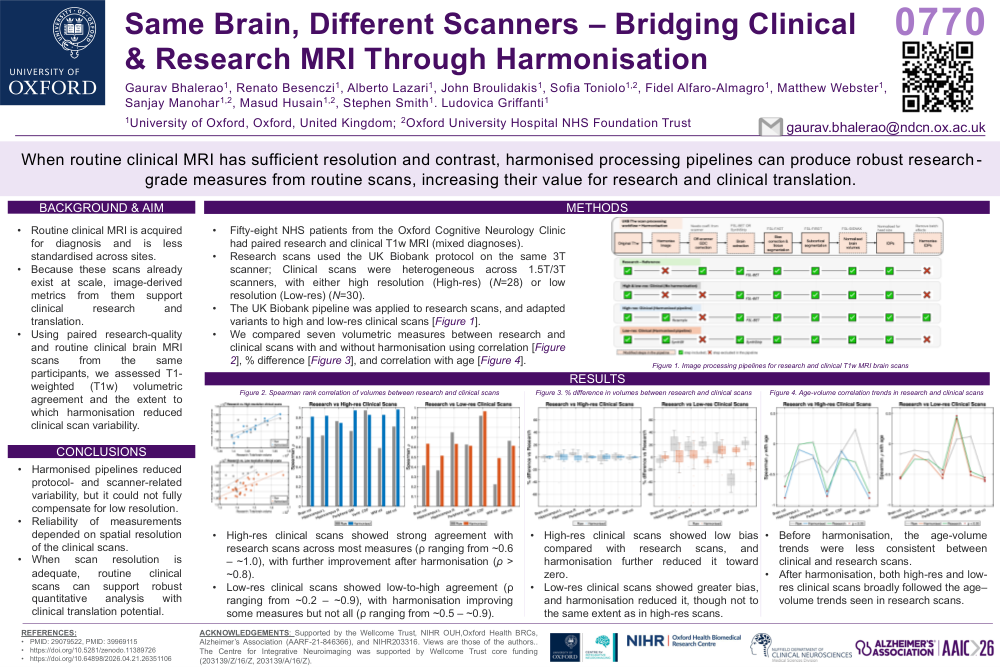
Hello, I am Gaurav Bhalerao, and this poster asks a simple question: can routine clinical MRI, which is already being collected at scale, be processed in a way that gives us reliable research-grade brain volume measures? The motivation is that clinical scans are less standardised than research scans, but they could be extremely valuable for both research and translation if we can account for scanner- and protocol-related variability. To test this, we analysed paired research and clinical T1-weighted MRI scans from 58 NHS patients from the Oxford Cognitive Neurology Clinic, with the clinical scans split into high-resolution and low-resolution groups. We then compared seven volumetric measures using agreement, percentage difference, and age-related associations, both before and after harmonisation.
The main result is that harmonisation helps, but spatial resolution still matters. In the high-resolution scans, agreement with research scans was already strong across most measures, and harmonisation pushed it even higher. In the low-resolution scans, agreement was more variable: some measures improved after harmonisation, but not all. The bias analysis shows the same pattern: high-resolution scans were already close to research scans, while low-resolution scans showed larger bias that was reduced, but not fully removed, by harmonisation.
We also looked at whether the scans captured the same age-related volume trends. Before harmonisation, the age–volume patterns were less consistent between clinical and research scans. After harmonisation, both high- and low-resolution clinical scans broadly followed the same age-related trends seen in the research data. That suggests the harmonised pipeline is doing more than just reducing numerical differences: it is also preserving biologically meaningful signal.
So the take-home message is that harmonised pipelines can substantially reduce protocol- and scanner-related variability, but they cannot fully compensate for low resolution. When the clinical scan resolution is adequate, routine clinical MRI can support robust quantitative analysis and has real potential for research and clinical translation.
Comments
Email is required but is not shown publicly.
Loading comments...