4,068 posters, 219 videos, 101 topics, 69 sessions, 14,365 authors, 6,128 institutions
ePostersLive by SciGen Technologies S.A. All rights reserved.
Alzheimer's Association International Conference 2026
July 12-15, 2026 | London, United Kingdom, and Online

1986
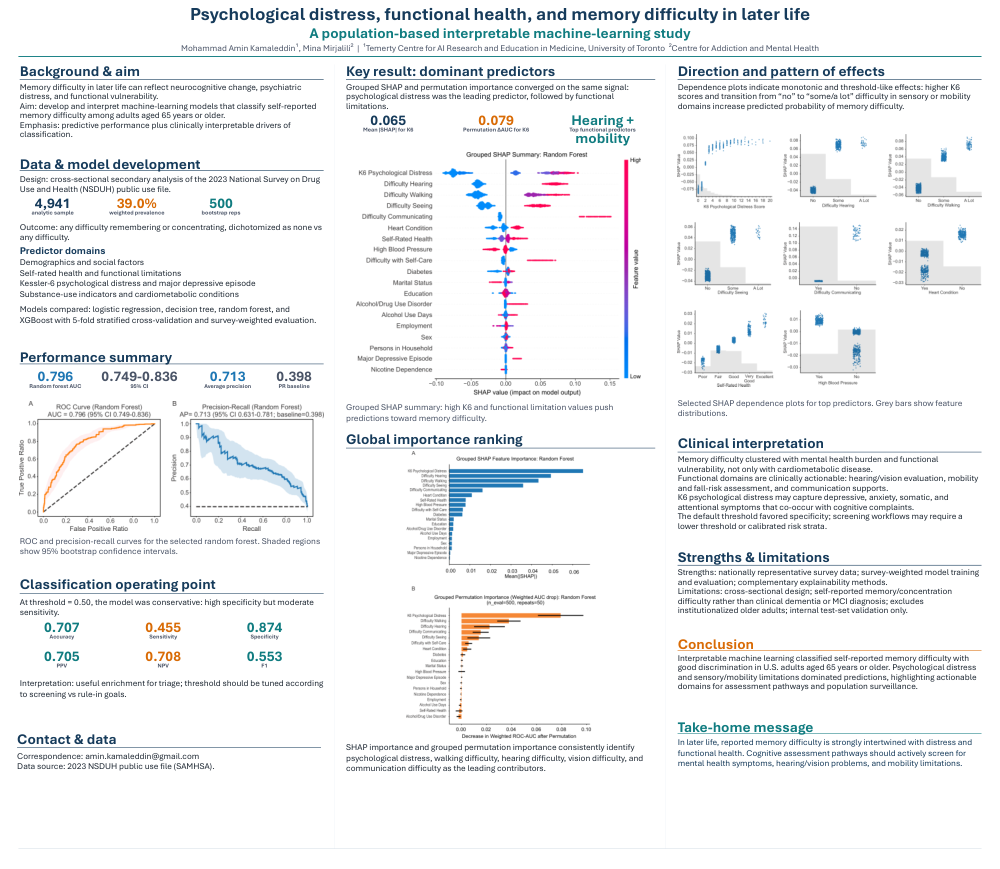
Psychological Distress And Functional Limitations Predict Memory Difficulty In Older Adults: Explainable ML Using A National Survey
Poster Presenter
Part of Topic
Background
Memory difficulty is common in later life and is clinically relevant because it may signal neurocognitive change, psychiatric distress, or functional vulnerability.
Aims
To develop and interpret machine-learning models that classify memory difficulty among adults aged ≥65 years using a nationally representative survey dataset, and to identify the dominant predictors of classification.
Method
We conducted a cross-sectional analysis of the 2023 National Survey on Drug Use and Health (NSDUH) public use file (U.S. civilian non-institutionalised population). The outcome was any memory difficulty derived from the NSDUH item assessing difficulty remembering or concentrating (dichotomised as none versus any). Candidate predictors included demographic characteristics, self-rated health, functional limitations (hearing, vision, mobility, communication, self-care), psychological distress (Kessler-6), major depressive episode with severe role impairment, substance-use indicators, and cardiometabolic conditions. We compared logistic regression, decision tree, random forest, and gradient-boosted trees with cross-validation and survey-weighted training/evaluation. Test-set performance was assessed using weighted area under the curve (AUC) and average precision with bootstrap 95% confidence intervals (CIs). Explainability used grouped SHAP values and permutation importance.
Results
The analytic sample included 4,941 respondents aged ≥65 years. The weighted prevalence of any memory difficulty was 39.0%. The best-performing model was a random forest, with test weighted AUC 0.796 (95% CI 0.749–0.836) and weighted average precision 0.713 (95% CI 0.631–0.781). Explainability analyses consistently identified psychological distress (Kessler-6) as the dominant predictor, followed by functional limitations, particularly hearing and mobility difficulty.
Conclusions
Interpretable machine learning classified memory difficulty with good discrimination in a nationally representative older adult sample. Psychological distress and functional limitations dominated predictions, underscoring clinically actionable domains relevant to assessment pathways for cognitive symptoms in later life.
Keywords
Memory difficulty; Older adults; Psychological distress; Functional limitations; Machine learning; Population-based study
Comments
Email is required but is not shown publicly.
Loading comments...