4,068 posters, 219 videos, 101 topics, 69 sessions, 14,365 authors, 6,128 institutions
ePostersLive by SciGen Technologies S.A. All rights reserved.
Alzheimer's Association International Conference 2026
July 12-15, 2026 | London, United Kingdom, and Online

7025
Mining Routine Health Records To Detect And Subtype Alzheimer's Disease And Related Dementias
Poster Presenter
Authors
Nicolás Aparicio, Carlos Ramírez, Paola Ruiz Puentes, Ram Mukunda
Affiliations
Part of Topic
Background.
Identifying Alzheimer’s disease and related dementias (AD/ADRD) in real-world settings is often limited by the lack of formal neurocognitive assessments. Inpatient electronic health records (EHRs) provide a scalable yet underutilized resource for detecting cognitive impairment through hospitalization patterns, medication use, and procedural history.
EHR Modalities Used.
Patient-level features were extracted from inpatient hospitalizations in the MIMIC-IV v3.1 database.
- Medications.
- Demographics.
- eMAR.
- HCPCS Procedures.
Methods.
- Feature extraction from four EHR modalities at the patient level using ICD hospitalization codes.
- Hierarchical classification framework (see Table 1): controls versus cognitively impaired patients, followed by MCI versus dementia, and finally classification of dementia subtypes.
- Random forest classifiers trained per modality and as an integrated multimodal model at each classification level.
- Feature importance analysis to identify clinically interpretable signatures across modalities.
Results.
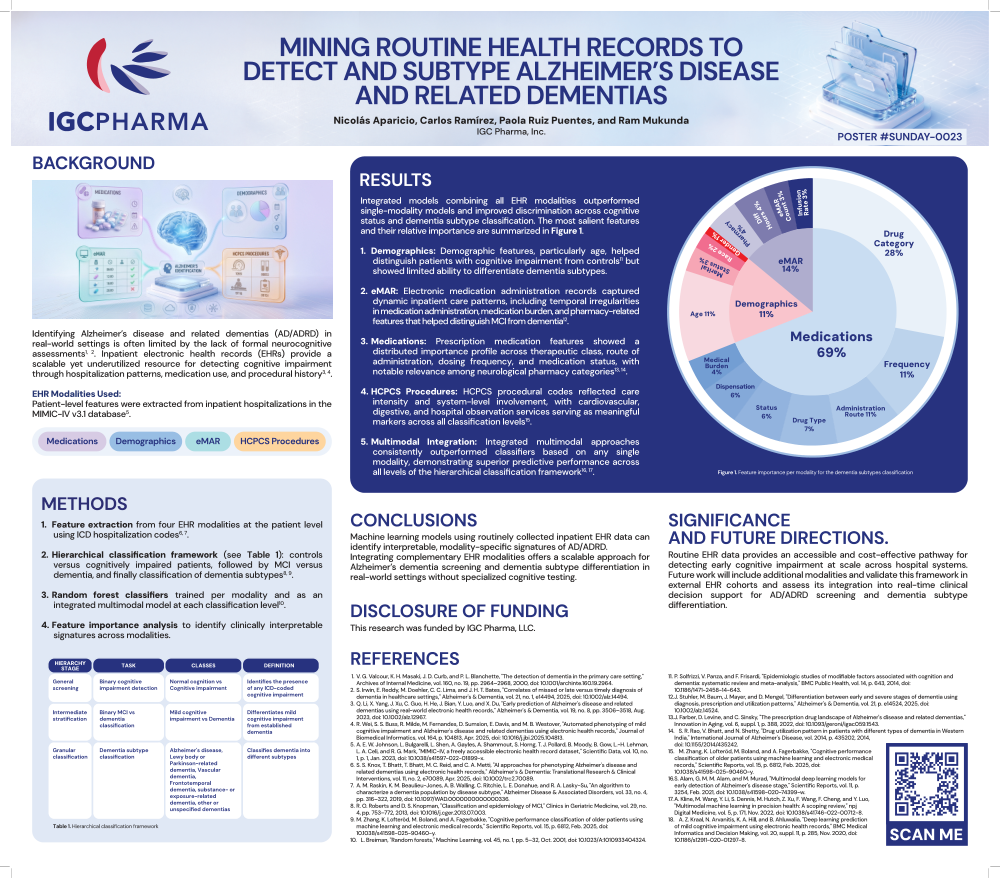
Integrated models combining all EHR modalities outperformed single-modality models and improved discrimination across cognitive status and dementia subtype classification. The most salient features and their relative importance are summarized in Figure 1.
- Demographics: Demographic features, particularly age, helped distinguish patients with cognitive impairment from controlsbut showed limited ability to differentiate dementia subtypes.
- eMAR: Electronic medication administration records captured dynamic inpatient care patterns, including temporal irregularities in medication administration, medication burden, and pharmacy-related features that helped distinguish MCI from dementia.
- Medications: Prescription medication features showed a distributed importance profile across therapeutic class, route of administration, dosing frequency, and medication status, with notable relevance among neurological pharmacy categories.
- HCPCS Procedures: HCPCS procedural codes reflected care intensity and system-level involvement, with cardiovascular, digestive, and hospital observation services serving as meaningful markers across all classification levels.
- Multimodal Integration: Integrated multimodal approaches consistently outperformed classifiers based on any single modality, demonstrating superior predictive performance across all levels of the hierarchical classification framework.
Conclusions.
Machine learning models using routinely collected inpatient EHR data can identify interpretable, modality-specific signatures of AD/ADRD.
Integrating complementary EHR modalities offers a scalable approach for Alzheimer’s dementia screening and dementia subtype differentiation in real-world settings without specialized cognitive testing.
Significance and Future Directions.
Routine EHR data provides an accessible and cost-effective pathway for detecting early cognitive impairment at scale across hospital systems. Future work will include additional modalities and validate this framework in external EHR cohorts and assess its integration into real-time clinical decision support for AD/ADRD screening and dementia subtype differentiation.
Comments
Email is required but is not shown publicly.
Loading comments...