4,068 posters, 219 videos, 101 topics, 69 sessions, 14,365 authors, 6,128 institutions
ePostersLive by SciGen Technologies S.A. All rights reserved.
Alzheimer's Association International Conference 2026
July 12-15, 2026 | London, United Kingdom, and Online

10589
Identification Of Persons Without Current Cognitive Decline Who Progress To Preclinical Or Clinical Alzheimer’s Disease
Poster Presenter
Authors
Affiliations
Part of Topic
Title: Identification of Persons Without Current Cognitive Decline Who Progress to Preclinical or Clinical Alzheimer’s Disease
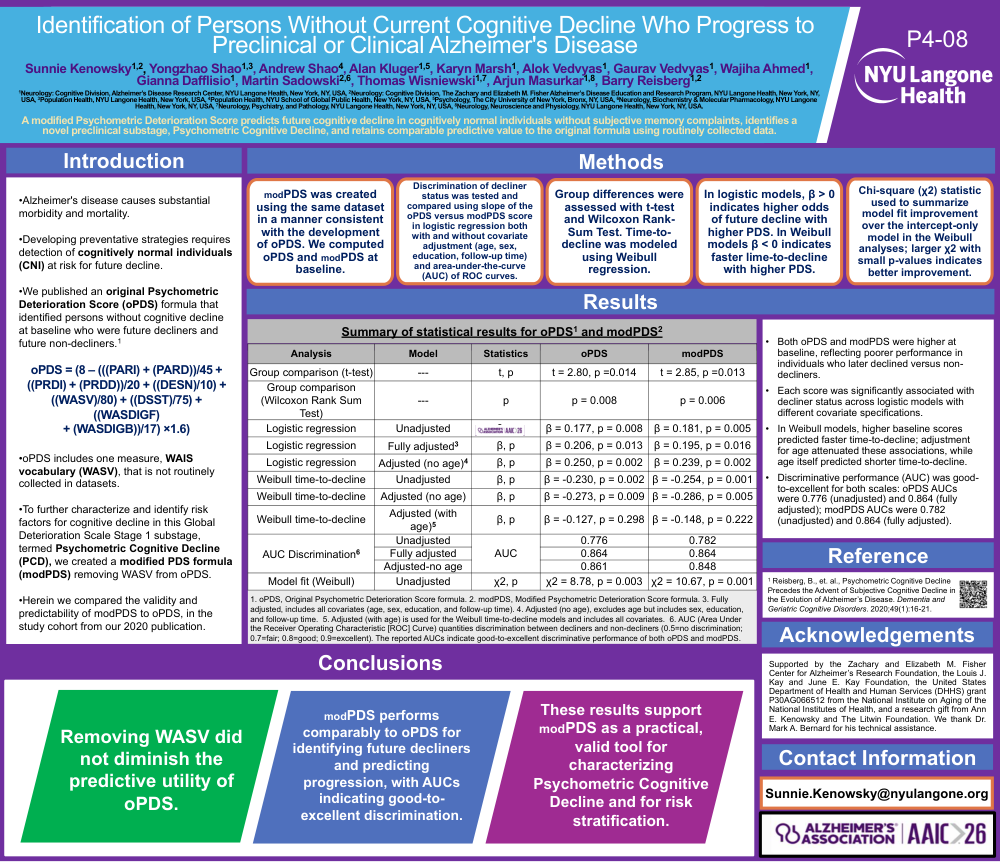
Background: Alzheimer’s disease (AD) causes substantial morbidity and mortality. The ability to detect cognitively normal individuals at risk for future decline is critical for developing preventative strategies. We published an original Psychometric Deterioration Score (oPDS, Reisberg et al., 2020, Dem Geriatr Cog Disord) that identified people without cognitive decline at baseline who were future decliners and future non-decliners. oPDS included one measure, WAIS vocabulary (WASV), that is not routinely collected in datasets. To further characterize and identify psychometric risk factors for cognitive decline in this Global Deterioration Scale Stage 1 substage, termed Psychometric Cognitive Decline, we created a modified PDS formula (modPDS) removing WASV from oPDS. We compared the validity and predictability of modPDS to oPDS, in the study cohort from our 2020 publication.
Methods: modPDS was created using the same dataset in a manner consistent with the development of oPDS. We computed oPDS and modPDS at baseline. Discrimination of decliner status was tested and compared using slope of the oPDS versus modPDS score in logistic regression with and without covariate adjustment (age, sex, education, follow-up time) and area-under-the-curve (AUC) of ROC curves. Group differences were assessed with t-test and Wilcoxon Rank-Sum Test. Time-to-decline was modeled using Weibull regression.
Results: Both oPDS and modPDS were higher at baseline reflecting poorer performance in individuals who later declined versus non-decliners, and each score was significantly associated with decliner status across logistic models with different covariate specifications. In Weibull models, higher baseline scores predicted faster time-to-decline; adjustment for age attenuated these associations, while age itself predicted shorter time-to-decline. Discriminative performance (AUC) was good-to-excellent for both scales: oPDS AUCs were 0.776 (unadjusted) and 0.864 (fully adjusted); modPDS AUCs were 0.782 (unadjusted) and 0.864 (fully adjusted). See Table 1 for statistical details.
Conclusions: Removing WASV did not degrade the predictive utility of oPDS. modPDS performs comparably to oPDS for identifying future decliners and predicting progression, with AUCs indicating good-to-excellent discrimination. These results support modPDS as a practical, valid tool for characterizing Psychometric Cognitive Decline and for risk stratification. Age independently contributes to shorter time-to-decline and modestly enhances classification performance when included in logistic models.
Comments
Email is required but is not shown publicly.
Loading comments...