4,068 posters, 219 videos, 101 topics, 69 sessions, 14,365 authors, 6,128 institutions
ePostersLive by SciGen Technologies S.A. All rights reserved.
Alzheimer's Association International Conference 2026
July 12-15, 2026 | London, United Kingdom, and Online

5951
Real-world Data On Use And Safety Of Anti-amyloid Monoclonal Antibodies In Alzheimer's Disease
Poster Presenter
Authors
Susie Sami, Kyle Duale, Brian Appleby, Rebecca Difranco, Mohamed Elkasaby, Alexsandra Kovacevich, Rajeet Shrestha
Affiliations
Neurological Institute, University Hospitals Cleveland Medical Center, Cleveland, OH, USA, Neurological Institute, University Hospitals Cleveland Medical Center, Cleveland, OH, USA; Case Western Reserve University, Department of Neurology, Cleveland, OH, USA, Case Western Reserve University, Department of Pathology, Cleveland, OH, USA, Case Western Reserve University, Department of Psychiatry, Cleveland, OH, USA, Neurological Institute, University Hospitals Cleveland Medical Center, Cleveland, OH, USA; Case Western Reserve University, Department of Neurology, Cleveland, OH, USA, Neurological Institute, University Hospitals Cleveland Medical Center, Cleveland, OH, USA; Case Western Reserve University, Department of Psychiatry, Cleveland, OH, USA, Neurological Institute, University Hospitals Cleveland Medical Center, Cleveland, OH, USA; Case Western Reserve University, Department of Neurology, Cleveland, OH, USA, Case Western Reserve University, Department of Psychiatry, Cleveland, OH, USA
Part of Topic
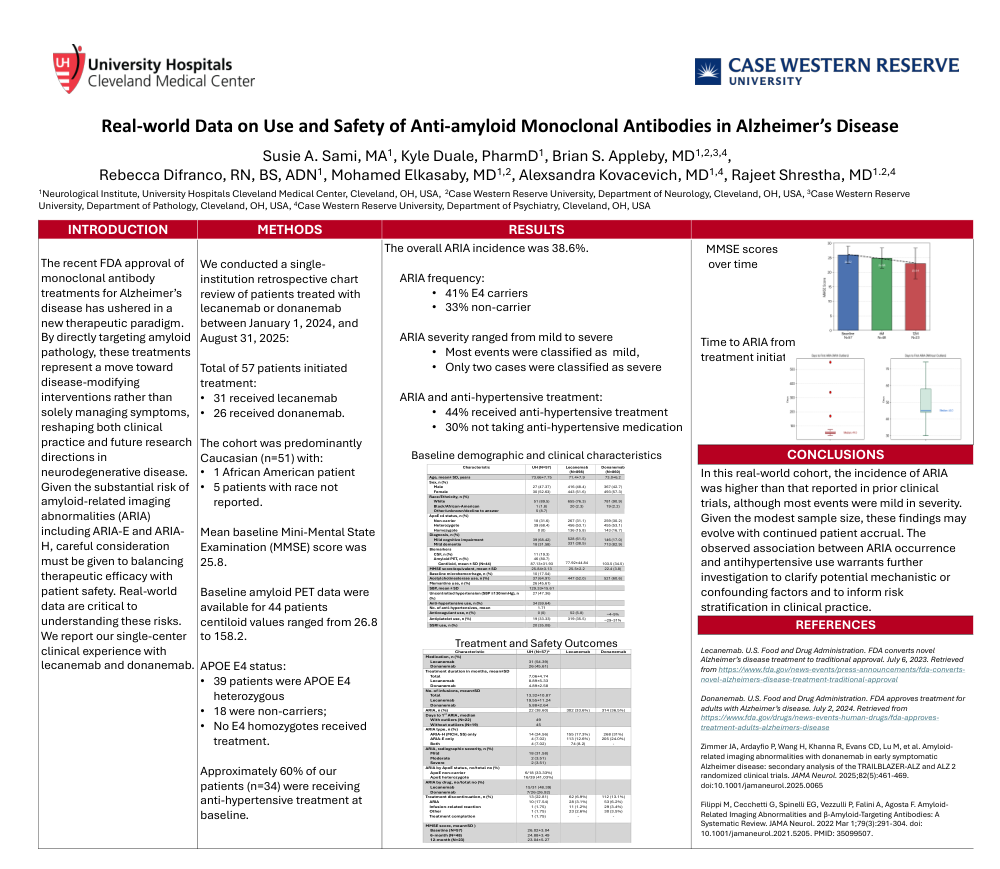
Background: The recent FDA approval of monoclonal antibody treatments for Alzheimer's disease has ushered in a new therapeutic paradigm. By directly targeting amyloid pathology, these treatments represent a move toward disease-modifying interventions rather than solely managing symptoms, reshaping both clinical practice and future research directions in neurodegenerative disease. Given the substantial risk of amyloid-related imaging abnormalities (ARIA) including ARIA-E and ARIA-H, careful consideration must be given to balancing therapeutic efficacy with patient safety. Real-world data are critical to understanding these risks. We report our single-center clinical experience with lecanemab and donanemab.
Methods: We conducted a single-institution retrospective chart review of patients treated with lecanemab or donanemab between January 1, 2024, and August 31, 2025. A total of 57 patients initiated treatment: 31 receiving lecanemab and 26 receiving donanemab. The cohort was pr dominantly Caucasian (n=51) with one African American patient and five patients with race not reported. Mean baseline Mini-Mental State Examination (MMSE) score was 25.8. Baseline amyloid PET data were available for 44 patients, with centiloid values ranging from 26.8 to 158.2. Thirty-nine patients were APOE E4 heterozygous while 18 were non-carriers; no E4 homozygotes received treatment. Approximately 60% of our patients (n=34) were receiving anti-hypertensive treatment at baseline.
Results: The overall ARIA incidence was 38.6%. ARIA occurred more frequently in E4 carriers (41%) as opposed to non-carriers (33%), consistent with prior reported associations. ARIA severity ranged from mild to severe; however, most events were mild with only two cases classified as severe. ARIA was more common among patients receiving antihypertensive therapy (44%) compared with those not receiving such treatment (30%).
Conclusion: In this real-world cohort, the incidence of ARIA was higher than that reported in prior clinical trials, although most events were mild in severity. Given the modest sample size, these findings may evolve with continued patient accrual. The observed association between ARIA occurrence and antihypertensive use warrants further investigation to clarify potential mechanistic or confounding factors and to inform risk stratification in clinical practice.
Comments
Email is required but is not shown publicly.
Loading comments...