4,068 posters, 219 videos, 101 topics, 69 sessions, 14,365 authors, 6,128 institutions
ePostersLive by SciGen Technologies S.A. All rights reserved.
Alzheimer's Association International Conference 2026
July 12-15, 2026 | London, United Kingdom, and Online

5147
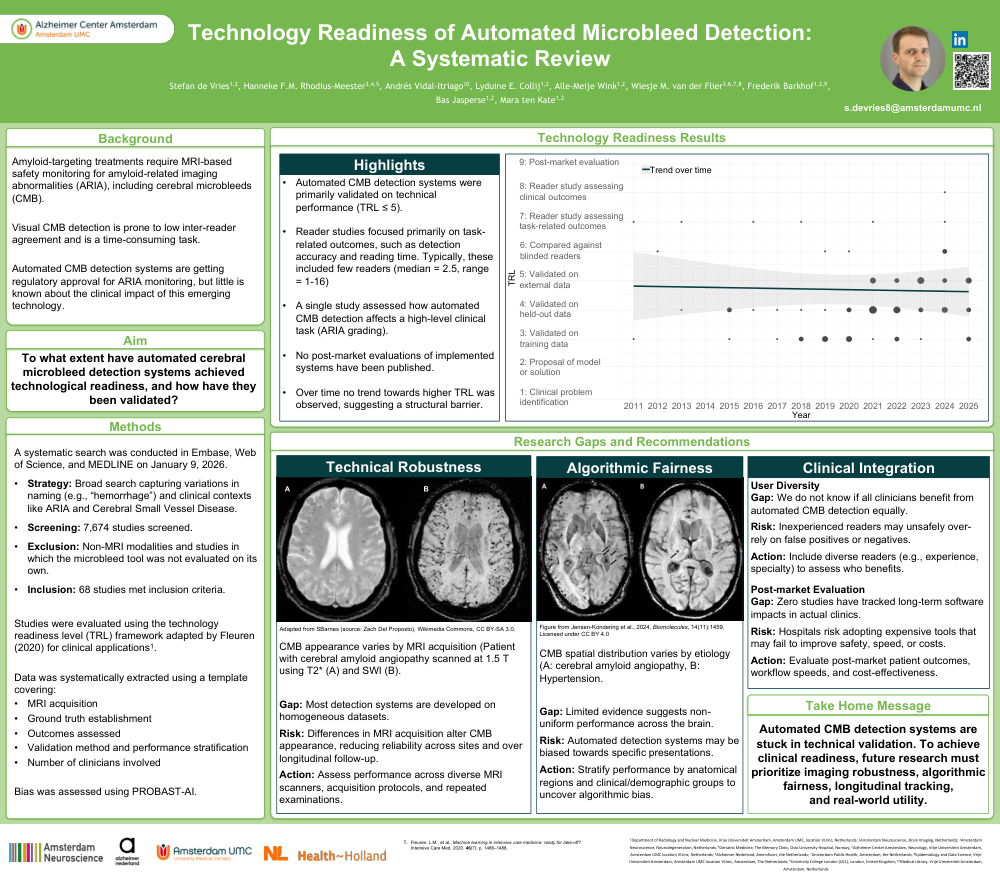
Clinical Readiness Of Automated Cerebral Microbleed Detection: A Technology Readiness Level Evaluation
Poster Presenter
Authors
Stefan de Vries, Hanneke Rhodius-Meester, Andrés Vidal-Itriago, Lyduine Collij, Alle-Meije Wink, Wiesje van der Flier, Frederik Barkhof, Bas Jasperse, Mara ten Kate
Affiliations
Department of Radiology and Nuclear Medicine, Vrije Universiteit Amsterdam, Amsterdam UMC, location VUmc, Netherlands; Amsterdam Neuroscience, Brain Imaging, Netherlands, Department of Radiology and Nuclear Medicine, Vrije Universiteit Amsterdam, Amsterdam UMC, location VUmc, Netherlands; Amsterdam Neuroscience, Brain Imaging, Netherlands; University College London (UCL), London, United Kingdom, Amsterdam Neuroscience, Neurodegeneration, Netherlands; Geriatric Medicine, The Memory Clinic, Oslo University Hospital, Norway; Alzheimer Center Amsterdam, Neurology, Vrije Universiteit Amsterdam, Amsterdam UMC location VUmc, Netherlands, Medical Library, Vrije Universiteit Amsterdam, Amsterdam, Netherlands, Amsterdam Neuroscience, Neurodegeneration, Netherlands; Alzheimer Nederland, Amersfoort, the Netherlands; Amsterdam Public Health, Amsterdam, the Netherlands; Epidemiology and Data Science, Vrije Universiteit Amsterdam, Amsterdam UMC location VUmc, Amsterdam, The Netherlands
Part of Topic
Background:
Amyloid-targeting treatments require MRI-based safety monitoring for amyloid-related imaging abnormalities (ARIA), including cerebral microbleeds (CMB).
Visual CMB detection is prone to low inter-reader agreement and is a time-consuming task.
Automated CMB detection systems are getting regulatory approval for ARIA monitoring, but little is known about the clinical impact of this emerging technology.
aim:
To what extent have automated cerebral microbleed detection systems achieved technological readiness, and how have they been validated?
Methods:
A systematic search was conducted in Embase, Web of Science, and MEDLINE on January 9, 2026.
Studies were evaluated using the technology readiness level (TRL) framework adapted by Fleuren (2020) for clinical applications1.
Data was systematically extracted using a template covering:
Bias was assessed using PROBAST-AI.
TRL results:
Gaps:
Technical robustness:
CMB appearance varies by MRI acquisition (Patient with cerebral amyloid angiopathy scanned at 1.5 T using T2* (A) and SWI (B).
Gap: Most detection systems are developed on homogeneous datasets.
Risk: Differences in MRI acquisition alter CMB appearance, reducing reliability across sites and over longitudinal follow-up.
Action: Assess performance across diverse MRI scanners, acquisition protocols, and repeated examinations.
Algorithmic Fairness:
CMB spatial distribution varies by etiology (A: cerebral amyloid angiopathy, B: Hypertension.
Gap: Limited evidence suggests non-uniform performance across the brain.
Risk: Automated detection systems may be biased towards specific presentations.
Action: Stratify performance by anatomical regions and clinical/demographic groups to uncover algorithmic bias.
Clinical intergation:
User Diversity
Gap: We do not know if all clinicians benefit from automated CMB detection equally.
Risk: Inexperienced readers may unsafely over-rely on false positives or negatives.
Action: Include diverse readers (e.g., experience, specialty) to assess who benefits.
Post-market Evaluation
Gap: Zero studies have tracked long-term software impacts in actual clinics.
Risk: Hospitals risk adopting expensive tools that may fail to improve safety, speed, or costs.
Action: Evaluate post-market patient outcomes, workflow speeds, and cost-effectiveness.
and real-world utility.
Comments
Email is required but is not shown publicly.
Loading comments...