4,068 posters, 219 videos, 101 topics, 69 sessions, 14,365 authors, 6,128 institutions
ePostersLive by SciGen Technologies S.A. All rights reserved.
Alzheimer's Association International Conference 2026
July 12-15, 2026 | London, United Kingdom, and Online

7138
Prediction Of The Conversion From SCD To MCI/AD By Integrating Imputation Techniques And Machine Learning Based On Multimodal Clinical Data
Poster Presenter
Authors
Part of Topic
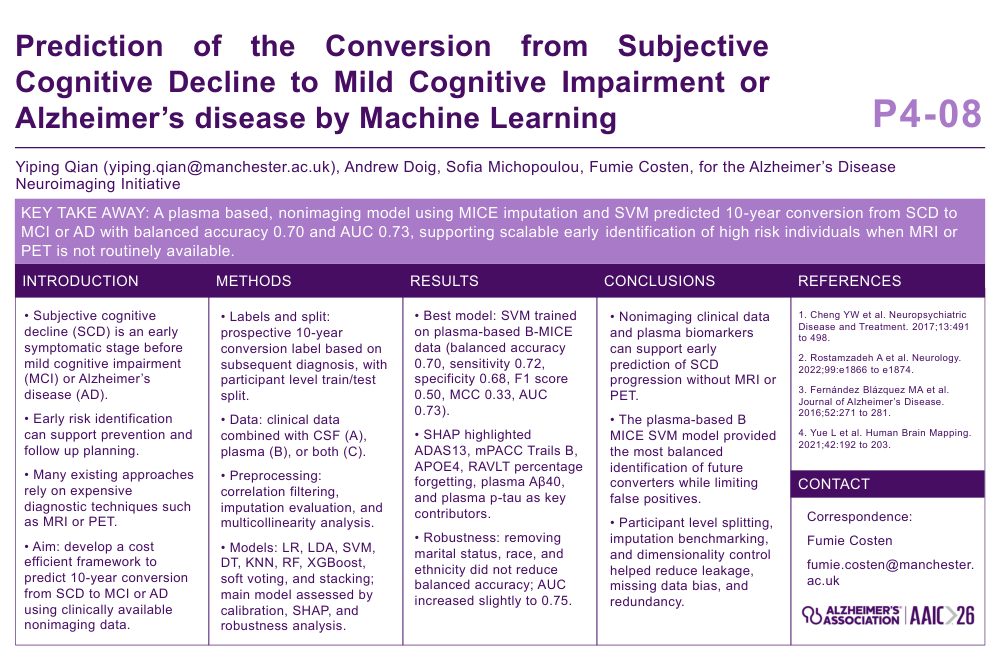
KEY TAKE AWAY: A plasma based, nonimaging model using MICE imputation and SVM predicted 10-year conversion from SCD to MCI or AD with balanced accuracy 0.70 and AUC 0.73, supporting scalable early identification of high risk individuals when MRI or PET is not routinely available.
Intruduction
• Subjective cognitive decline (SCD) is an early symptomatic stage before mild cognitive impairment (MCI) or Alzheimer’s disease (AD).
• Early risk identification can support prevention and follow up planning.
• Many existing approaches rely on expensive diagnostic techniques such as MRI or PET.
• Aim: develop a cost efficient framework to predict 10-year conversion from SCD to MCI or AD using clinically available nonimaging data.
Methods
• Labels and split: prospective 10-year conversion label based on subsequent diagnosis, with participant level train/test split.
• Data: clinical data combined with CSF (A), plasma (B), or both (C).
• Preprocessing: correlation filtering, imputation evaluation, and multicollinearity analysis.
• Models: LR, LDA, SVM, DT, KNN, RF, XGBoost, soft voting, and stacking; main model assessed by calibration, SHAP, and robustness analysis.
Results
• Best model: SVM trained on plasma-based B-MICE data (balanced accuracy 0.70, sensitivity 0.72, specificity 0.68, F1 score 0.50, MCC 0.33, AUC 0.73).
• SHAP highlighted ADAS13, mPACC Trails B, APOE4, RAVLT percentage forgetting, plasma Aβ40, and plasma p-tau as key contributors.
• Robustness: removing marital status, race, and ethnicity did not reduce balanced accuracy; AUC increased slightly to 0.75.
Conclusion
• Nonimaging clinical data and plasma biomarkers can support early prediction of SCD progression without MRI or PET.
• The plasma-based B MICE SVM model provided the most balanced identification of future converters while limiting false positives.
• Participant level splitting, imputation benchmarking, and dimensionality control helped reduce leakage, missing data bias, and redundancy.
Reference
1. Cheng YW et al. Neuropsychiatric Disease and Treatment. 2017;13:491 to 498.
2. Rostamzadeh A et al. Neurology. 2022;99:e1866 to e1874.
3. Fernández Blázquez MA et al. Journal of Alzheimer’s Disease. 2016;52:271 to 281.
4. Yue L et al. Human Brain Mapping. 2021;42:192 to 203.
Comments
Email is required but is not shown publicly.
Loading comments...