4,068 posters, 219 videos, 101 topics, 69 sessions, 14,365 authors, 6,128 institutions
ePostersLive by SciGen Technologies S.A. All rights reserved.
Alzheimer's Association International Conference 2026
July 12-15, 2026 | London, United Kingdom, and Online

7369
Latent Composites Of Multimodal MRI, Plasma Biomarkers & Cardiovascular Risk Are Sensitive To Cognition And Alzheimer's Disease Dementia
Poster Presenter
Authors
Ella Rowsthorn, Ying Xia, Michael Breakspear, Gail A Robinson, Michelle K Lupton, Meng Law, Matthew P Pase, Ian H Harding
Affiliations
Monash University, Australia, CSIRO Health and Biosecurity, Australia, QIMR Berghofer Medical Research Institute, Australia, The University of Queensland, Australia
Part of Topic
INTRODUCTION:
Many interdependent systems maintain brain homeostasis, including the neurovascular unit and the fluid transport (glymphatic) system1. These systems are dysfunctional long before overt cognitive impairment arises in many neurodegenerative diseases, including Alzheimer’s disease (AD)2. Despite their biological connection, markers of these systems are often considered in isolation, obscuring the broader system-level processes they reflect.
AIM: To identify latent constructs of brain health, validate these constructs in an independent cohort, and investigate their associations with cognition and AD dementia.
METHODS:
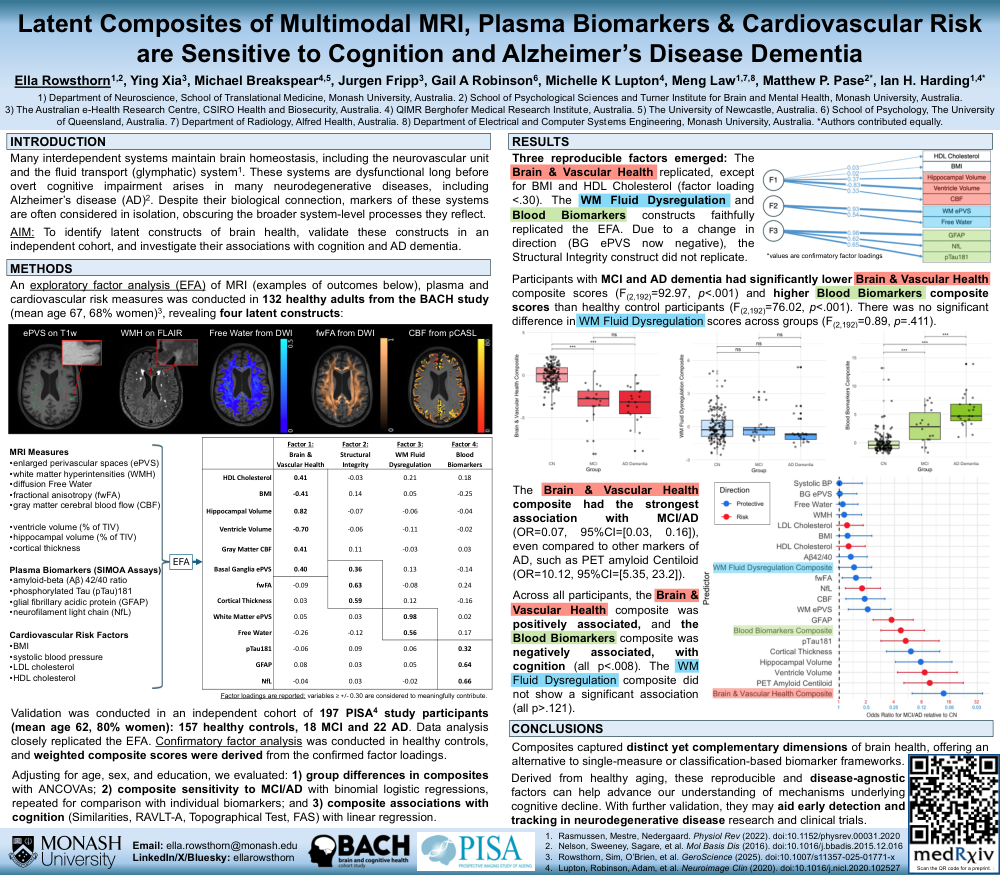
An exploratory factor analysis (EFA) of MRI (examples of outcomes below), plasma and cardiovascular risk measures was conducted in 132 healthy adults from the BACH study (mean age 67, 68% women)3, revealing four latent constructs: "Brain & Vascular Health", "Structural Integrity", "WM Fluid Dysregulation" and "Blood Biomarkers".
Validation was conducted in an independent cohort of 197 PISA4 study participants (mean age 62, 80% women): 157 healthy controls, 18 MCI and 22 AD. Data analysis closely replicated the EFA. Confirmatory factor analysis was conducted in healthy controls, and weighted composite scores were derived from the confirmed factor loadings.
Adjusting for age, sex, and education, we evaluated: 1) group differences in composites with ANCOVAs; 2) composite sensitivity to MCI/AD with binomial logistic regressions, repeated for comparison with individual biomarkers; and 3) composite associations with cognition (Similarities, RAVLT-A, Topographical Test, FAS) with linear regression.
RESULTS:
Three reproducible factors emerged: The Brain & Vascular Health replicated, except for BMI and HDL Cholesterol (factor loading <.30). The WM Fluid Dysregulation and Blood Biomarkers constructs faithfully replicated the EFA. Due to a change in direction (BG ePVS now negative), the Structural Integrity construct did not replicate.
Participants with MCI and AD dementia had significantly lower Brain & Vascular Health composite scores (F(2,192)=92.97, p<.001) and higher Blood Biomarkers composite scores than healthy control participants (F(2,192)=76.02, p<.001). There was no significant difference in WM Fluid Dysregulation scores across groups (F(2,192)=0.89, p=.411).
The Brain & Vascular Health composite had the strongest association with MCI/AD (OR=0.07, 95%CI=[0.03, 0.16]), even compared to other markers of AD, such as PET amyloid Centiloid (OR=10.12, 95%CI=[5.35, 23.2]).
Across all participants, the Brain & Vascular Health composite was positively associated, and the Blood Biomarkers composite was negatively associated, with cognition (all p<.008). The WM Fluid Dysregulation composite did not show a significant association (all p>.121).
CONCLUSIONS:
Composites captured distinct yet complementary dimensions of brain health, offering an alternative to single-measure or classification-based biomarker frameworks.
Derived from healthy aging, these reproducible and disease-agnostic factors can help advance our understanding of mechanisms underlying cognitive decline. With further validation, they may aid early detection and tracking in neurodegenerative disease research and clinical trials.
Comments
Email is required but is not shown publicly.
Loading comments...