4,068 posters, 219 videos, 101 topics, 69 sessions, 14,365 authors, 6,128 institutions
ePostersLive by SciGen Technologies S.A. All rights reserved.
Alzheimer's Association International Conference 2026
July 12-15, 2026 | London, United Kingdom, and Online

1974
A Reproducible Asl Analysis Pipeline For Cerebral Blood Flow Quantification On A Nigerian Cohort
Poster Presenter
Authors
Isaac Tigbee, Abraham Izuchukwu Awamba, Alaa Bessadok, Bilkisu Usman Farouk, Jeremiah Oluwatomi Itodo Daniel, Ernest Okyere Darko, Happiness Bankole, Said Ibrahim Said, Harrison O. Aduluwa, Oumayma Soula, Tolulope Olusuyi, Benjamin Anyanwu, Ethan C. Draper, Abdalla Z. Mohamed, Udunna Anazodo, Channelle O. Tham
Affiliations
Department of Medical Imaging, University for Development Studies, Tamale-Ghana, Institute of Radiography, Lagos, Nigeria, Université de Carthage, Institut Supérieur de Gestion de Bizerte, Campus Universitaire 7035 Menzel Abderrahmane, Bizerte, Tunisia, Department of Radiology, Barau Dikko Teaching Hospital/Kaduna State University, Kaduna, Nigeria, Obafemi Awolowo University Ile-Ife, Department of Radiology, Lagos University Teaching Hospital, Lagos, Nigeria, Department of Radiology, Federal Teaching Hospital Gombe, Gombe, Nigeria, Montreal Neurological Institute, McGill University, Montreal, QC, Canada, Faculty of Medicine of Sfax, Tunisia, Sfax, Tunisia, Medical Artificial Intelligence Laboratory (MAI Lab), Lagos, Nigeria, Regions Healthcare, Mgbirichi Ohaji, Imo State, Nigeria, Department of Bioengineering, Imperial College London, UK, Department of Cognitive Sciences, College of Humanities and Social Sciences, United Arab Emirates University, Al Ain, Abu Dhabi, United Arab Emirates, Medical Artificial Intelligence Laboratory (MAI Lab), Lagos, Nigeria; Montreal Neurological Institute, McGill University, Montreal, QC, Canada
Part of Topic
A Reproducible ASL Analysis Pipeline for Cerebral Blood Flow Quantification on a Nigerian Cohort.
Keywords: MRI, ASL, perfusion, reproducibility, resource-efficiency, analysis pipeline, open-science, Nigeria, Africa
Background
Cerebral hypoperfusion is recognized as an early pathophysiological event in the Alzheimer’s disease (AD) continuum, preceding measurable cognitive decline and contributing to neurodegeneration. Arterial Spin Labeling (ASL) MRI provides a non-invasive, contrast-free measure of cerebral blood flow (CBF), yet its application is limited in resource-constrained settings by protocol variability, technical gaps, and non-reproducible processing. To overcome these barriers, we developed a standardized ASL pipeline to improve reproducibility, facilitate knowledge transfer, and strengthen open-science.
Methods
A low-cost, scalable perfusion analysis pipeline was implemented using Quantiphyse (v0.9.10) to enhance reproducibility in population studies within resource-constrained settings. This was conducted as a training exercise within the 2025 CONNExIN (COmprehensive Neuroimaging aNalysis Experience In resource-constraiNed settings) program, a neuroimaging analysis training initiative for African researchers. Six-trainees applied the processing pipeline to a local dataset of fourteen healthy Nigerian adults collected as part of the Scan With Me (SWiM) program. MRI data were acquired on a 1.5T United uMR 588 scanner including pseudo-continuous ASL acquired using a multi-postlabelling delay with a 3D GRASE readout, along with T1-weighted MPRAGE processed using Synthstrip. Data preprocessing and CBF quantification were performed using Quantifphyse automated pipeline, with the whole processes including step-by-step pipeline, configuration files and visual guide outlined in protocol.io.
Results
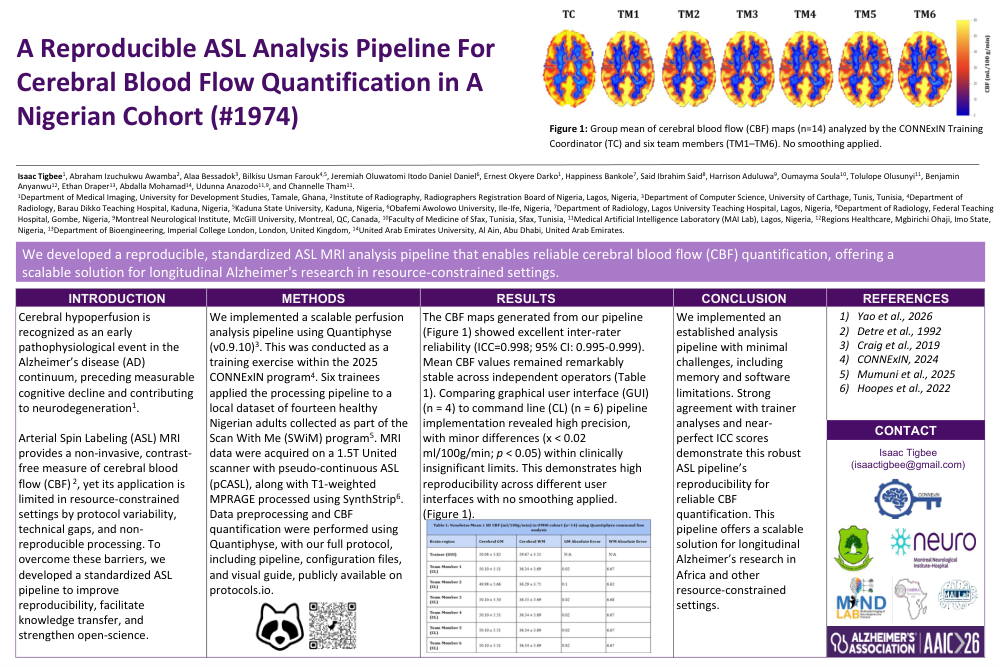
The CBF maps generated from our pipeline (Figure 1) showed excellent inter-rater reliability (ICC=0.998; 95% CI: 0.995–0.999). Mean CBF values remained remarkably stable across independent operators (Table 1). Comparing graphical user interface (GUI) (n = 4) to command line (CL) (n = 6) pipeline implementation revealed high precision, with minor differences (x < 0.02 ml/100g/min; p< 0.05) within clinically insignificant limits. This demonstrates high reproducibility across different user interfaces.
Conclusions
We implemented an established analysis pipeline with minimal challenges, including memory and software limitations. Strong agreement with trainer analyses and near-perfect ICC scores demonstrate this robust ASL pipeline’s reproducibility for reliable CBF quantification, offering a scalable pipeline for longitudinal Alzheimer’s research in Africa and other resource-constrained settings.
Figure 1: Group mean of cerebral blood flow (CBF) maps (n=14) analyzed by the CONNExIN Training Coordinator (TC) and six team members (TM1–TM6). No smoothing applied. CBF shown in mL/100 g/min.

Table 1: Table 1: Voxelwise Mean ± SD CBF (ml/100g/min) generated using our pipeline across the OMNI cohort (n=14) with a Graphical User Interface (GUI) and Command Line (CL) implementation

Comments
Email is required but is not shown publicly.
Loading comments...