4,068 posters, 219 videos, 101 topics, 69 sessions, 14,365 authors, 6,128 institutions
ePostersLive by SciGen Technologies S.A. All rights reserved.
Alzheimer's Association International Conference 2026
July 12-15, 2026 | London, United Kingdom, and Online

3191
A Rapid Aav-based Mouse Model Of Human Tdp-43 Overexpression Recapitulates Pathological, Multimodal Behavioral And Proteomic Deficits
Poster Presenter
Authors
Yi Chen, Tingqi Zhou, Hongzhe Wang, Yan Gu, Lang Wang, Benyan Luo, Guoping Peng
Affiliations
Department of Neurology, The First Affiliated Hospital of Zhejiang University School of Medicine, Hangzhou, China, School of Brain Science and Brain Medicine, Zhejiang University, Hangzhou, China, Center for Stem Cell and Regenerative Medicine, Zhejiang University School of Medicine, Hangzhou, China
Part of Topic
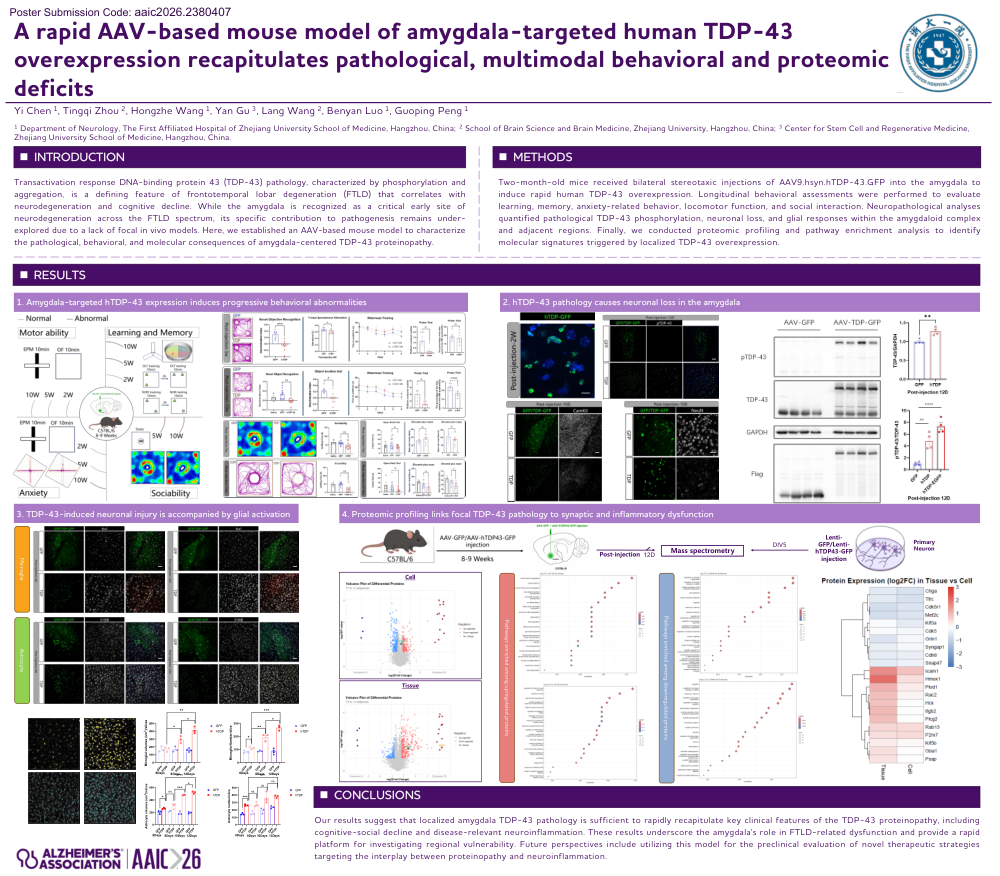
A rapid AAV-based mouse model of amygdala-targeted human TDP-43 overexpression recapitulates pathological, multimodal behavioral and proteomic deficits
Yi Chen 1, Tingqi Zhou 2, Hongzhe Wang 1, Yan Gu 3, Lang Wang 2, Benyan Luo 1, Guoping Peng 1
1 Department of Neurology, the First Affiliated Hospital, Zhejiang University School of Medicine, Hangzhou, China; 2 School of Brain Science and Brain Medicine, Zhejiang University, Hangzhou, China; 3 Center for Stem Cell and Regenerative Medicine, Zhejiang University School of Medicine, Hangzhou, China.
Background
Transactivation response DNA-binding protein 43 (TDP-43) pathology, characterized by phosphorylation and aggregation, is a defining feature of frontotemporal lobar degeneration (FTLD) that correlates with neurodegeneration and cognitive decline. While the amygdala is recognized as a critical early site of neurodegeneration across the FTLD spectrum, its specific contribution to pathogenesis remains under-explored due to a lack of focal in vivo models. Here, we established an AAV-based mouse model to characterize the pathological, behavioral, and molecular consequences of amygdala-centered TDP-43 proteinopathy.
Method
Two-month-old mice received bilateral stereotaxic injections of AAV9.hsyn.hTDP-43.GFP into the amygdala to induce rapid human TDP-43 overexpression. Longitudinal behavioral assessments were performed to evaluate learning, memory, anxiety-related behavior, locomotor function, and social interaction. Neuropathological analyses quantified pathological TDP-43 phosphorylation, neuronal loss, and glial responses within the amygdaloid complex and adjacent regions. Finally, we conducted proteomic profiling and pathway enrichment analysis to identify molecular signatures triggered by localized TDP-43 overexpression.
Result
Behavioral analyses revealed that amygdala-targeted expression of human TDP-43 led to progressive deficits in social preference and emotional reactivity, alongside impairments in learning and memory, while overall locomotor activity remained largely across different timepoints. Histological examination confirmed robust pathological TDP-43 forms and significant neuronal loss within the amygdala and surrounding areas, accompanied by extensive glial activation and proliferation. Proteomic characterization identified significant dysregulation of pathways involved in synaptic plasticity and neuroinflammation, providing a molecular link between focal pathology and the observed multimodal behavioral phenotypes.
Conclusion
Our results suggest that localized amygdala TDP-43 pathology is sufficient to rapidly recapitulate key clinical features of the TDP-43 proteinopathy, including cognitive-social decline and disease-relevant neuroinflammation. These results underscore the amygdala's role in FTLD-related dysfunction and provide a rapid platform for investigating regional vulnerability. Future perspectives include utilizing this model for the preclinical evaluation of novel therapeutic strategies targeting the interplay between proteinopathy and neuroinflammation.
Comments
Email is required but is not shown publicly.
Loading comments...